Anyway or Anyways: Choose the Right Word for Any Context
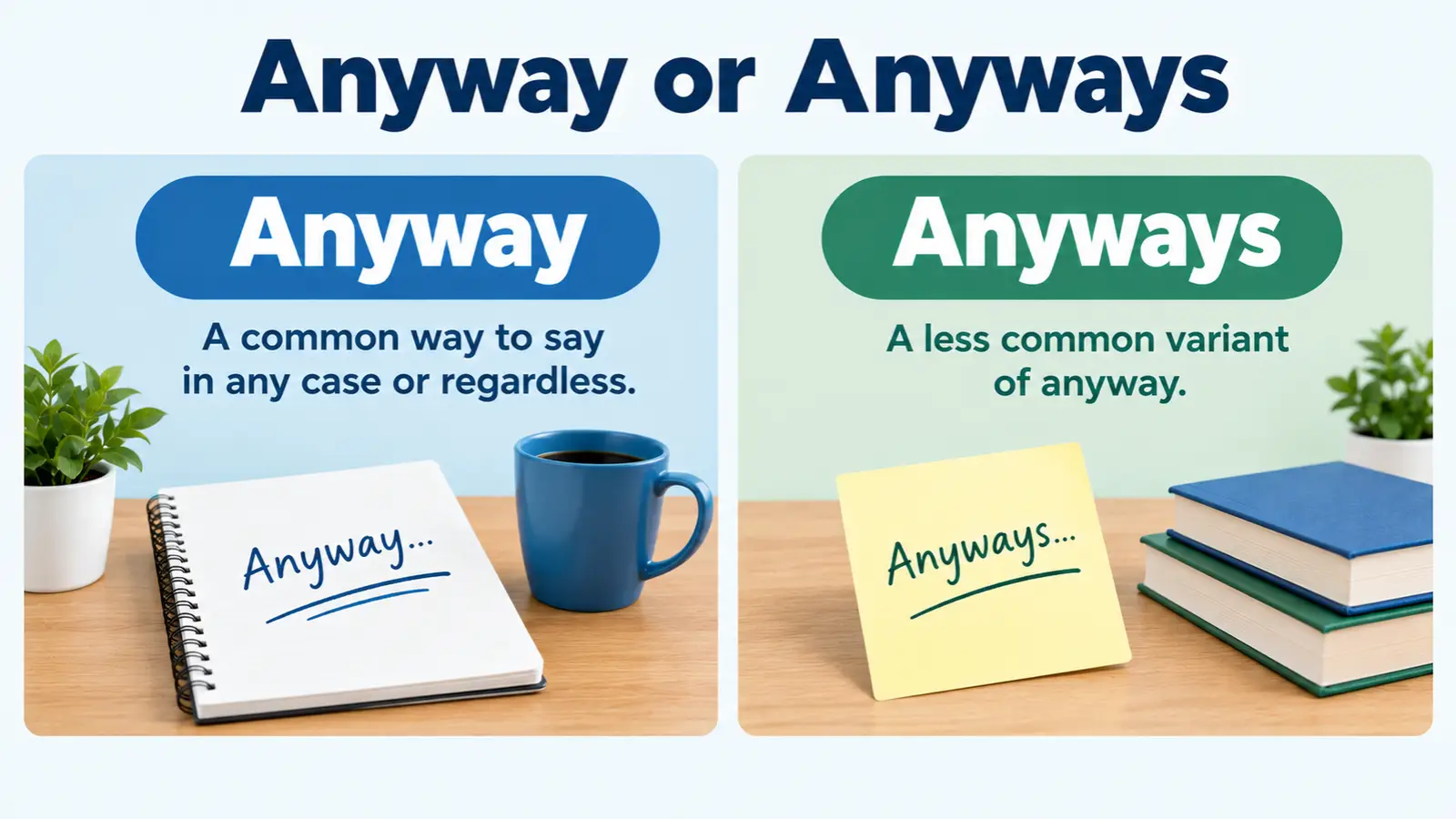
Anyway and anyways are both used to mean “in any case” or “despite that,” but they differ in tone and usage. Anyway is the standard choice for American English, including formal and professional writing. Anyways is an informal variant commonly used in casual conversation and dialogue.
The distinction matters when writing emails, school assignments, articles, or workplace documents. Choosing the form that suits your audience helps keep your tone consistent and your message clear.
Related Post: Prey vs. Pray
Anyway vs. Anyways: The Key Difference
| Term | Meaning or status | When to use it | Example |
|---|---|---|---|
| Anyway | Standard adverb meaning “in any case,” “nevertheless,” or “despite that” | Formal and informal writing, including professional communication | I was tired, but I went anyway. |
| Anyways | Informal variant of anyway | Casual conversation, dialogue, or writing that reflects informal speech | Anyways, what were we talking about? |
The words often express the same idea, so the difference is mainly a matter of formality and style rather than meaning. Anyway is the safer choice when you are unsure.
What Does Anyway Mean?
Anyway is an adverb used to show that something happens despite a difficulty, add a point to a discussion, or move a conversation forward. It can also help a speaker return to an earlier topic or wrap up a conversation.
When to Use Anyway
Use anyway when you want to:
- Show that something happened despite an obstacle.
- Introduce a related point or reinforce an argument.
- Return to the main subject after a digression.
- End a conversation or move to the next topic.
- Correct or qualify a previous statement.
Anyway in Example Sentences
1. It was raining, but we went hiking anyway.
Here, anyway means “despite the rain.”
2. Anyway, let’s return to the main question.
Here, it signals a return to the topic.
3. The restaurant is expensive, and anyway, we already have dinner plans.
In this sentence, anyway introduces an additional reason for not going.
What Does Anyways Mean?
Anyways is an informal variant of anyway. It is often used in casual speech to mean “in any case” or to signal a shift in conversation. Although many speakers use it naturally, it is generally less suitable than anyway for formal writing.
When to Use Anyways
Use anyways when the context is conversational and an informal tone feels natural, such as:
- Text messages between friends.
- Casual dialogue in fiction.
- Informal social media posts.
- Conversations where the speaker’s natural voice matters.
For school essays, business reports, and professional emails, anyway is usually the better option.
Anyways in Example Sentences
1. Anyways, are we still meeting at six?
The word shifts the conversation to a new question.
2. I didn’t really want to go, but I went anyways.
Here, anyways means “despite that.”
3. Anyways, I’ll let you get back to work.
The speaker uses it to move toward ending the conversation.
How to Choose the Right Word
For most American English writing, choose anyway. Reserve anyways for situations where an informal or conversational tone is appropriate.
A Quick Test You Can Apply
Ask yourself whether you would use the word in a formal email or academic assignment.
- “Thank you for considering my application. I will follow up anyway.”
Anyway is the standard choice. - “Anyways, what did you want to tell me?”
Anyways can fit casual conversation, but anyway would also work.
When the Quick Test Does Not Work
The choice is not always about correctness. Anyways is a recognized informal variant, not simply a typo. A character’s dialogue, a personal message, or a casual social post may call for it to preserve the intended voice.
Also, do not confuse anyways with any way, which has a different grammatical function and meaning.
Common Mistakes and How to Fix Them
| Original sentence | Corrected sentence | Why it changes |
|---|---|---|
| Anyways, I would like to discuss the proposal. | Anyway, I would like to discuss the proposal. | Anyway is more appropriate for professional writing. |
| It was late, but we continued anyways. | It was late, but we continued anyway. | Anyway is the standard choice in neutral writing. |
| Anyways, thank you for your time and consideration. | Anyway, thank you for your time and consideration. | Anyway is more suitable for a formal closing, though “Thank you for your time and consideration” may be more polished on its own. |
Why These Forms Get Confused
Both words are pronounced similarly and often convey the same meaning. The extra -s in anyways can sound natural in everyday speech, so writers may use it without noticing that it creates a more informal tone.
The key distinction is conventional usage: anyway is standard across writing styles, while anyways is generally conversational.
Does the Choice Change With Context?
Formal Writing vs. Casual Conversation
In formal writing, use anyway for a neutral, polished tone. In casual dialogue, anyways may sound natural and can reflect how a person actually speaks.
For example:
- Professional: “Anyway, I have attached the revised document.”
- Casual: “Anyways, I’ll see you later!”
The second example is conversational rather than formal. The first could also use anyway at the end of the sentence if the meaning called for it.
Can You Use Anyway and Anyways Interchangeably?
Usually, yes, when both words mean “in any case” or “despite that.” Replacing one with the other generally preserves the basic meaning, but it may change the tone.
When Both Forms Work
- “I was tired, but I went anyway.”
- “I was tired, but I went anyways.”
Both communicate that the person went despite being tired. The first is more neutral and appropriate for a wider range of writing; the second sounds informal.
When Switching Changes the Meaning
Compare anyways with any way, written as two words:
- “I’ll help you anyway.” This can mean “I’ll help you regardless.”
- “I’ll help you any way I can.” This means “I’ll help you by whatever method is possible.”
The two-word phrase refers to a manner or method. It should not be treated as a spelling variant of anyway.
Anyway vs. Any Way: Is There a Difference?
Yes. Anyway is one word and functions as an adverb. Any way is a two-word phrase that refers to a method, manner, or possible means of doing something.
| Phrase | When to use it | Original example |
|---|---|---|
| Anyway | To mean “regardless” or “in any case” | We were running late, but we stopped for coffee anyway. |
| Anyways | As an informal alternative to anyway | Anyways, let’s talk about something else. |
| Any way | To refer to a method or possible means | Is there any way to repair the damaged screen? |
A useful test for any way is to see whether you can replace it with “any method” or “any manner.” If that fits the sentence, the two-word phrase is likely correct.
Apply the Rule to a Real Situation
Original Version
“Anyways, I am writing to ask whether you have reviewed my job application.”
Improved Version and Explanation
“Anyway, I am writing to ask whether you have reviewed my job application.”
The revision replaces the informal anyways with the standard anyway, which is more appropriate for a professional email. For an even more direct opening, you could remove the transition word altogether: “I am writing to ask whether you have reviewed my job application.”
An Easy Way to Remember the Difference
Remember this simple rule:
- Anyway: the standard choice for nearly any writing situation.
- Anyways: the informal option for casual speech and dialogue.
- Any way: means a method or manner.
When in doubt, choose anyway. It works in both formal and informal contexts without sounding unnecessarily casual.
Practice: Can You Choose the Right Form?
Fill in each blank with anyway, anyways, or any way.
- The weather was poor, but the event continued _____.
- _____, let’s get back to the story.
- Is there _____ we can finish this project by Friday?
Answers and Explanations
- Anyway — It means the event continued despite the poor weather.
- Anyway or Anyways — Both can introduce a topic shift, but anyway is the standard choice.
- Any way — The sentence asks whether a method or means exists to finish the project.
Frequently Asked Questions
Is anyways a real word?
Yes. Anyways is used as an informal variant of anyway, particularly in conversational American English. However, anyway is the more widely appropriate choice for formal writing.
Is anyway or anyways correct in American English?
Both forms are used, but anyway is the standard choice. Use anyways when you deliberately want a casual or conversational tone.
Should I use anyways in an essay?
It is generally better to use anyway in an academic essay. Unless the assignment specifically calls for informal language or dialogue, anyway is the more conventional option.
Is any way the same as anyway?
No. Anyway means “in any case” or “despite that,” while any way means “by any method” or “in any manner.” For example, “I’ll help anyway” differs from “I’ll help any way I can.”
Which Form Should You Use?
For a US audience, anyway is the safest choice in almost every context. Use anyways when a casual tone suits the situation, and write any way as two words when referring to a method or manner. These distinctions help you maintain the right tone and communicate your meaning clearly.
Sources