
Hi or Hello: Meaning, Tone, and When to Use Each
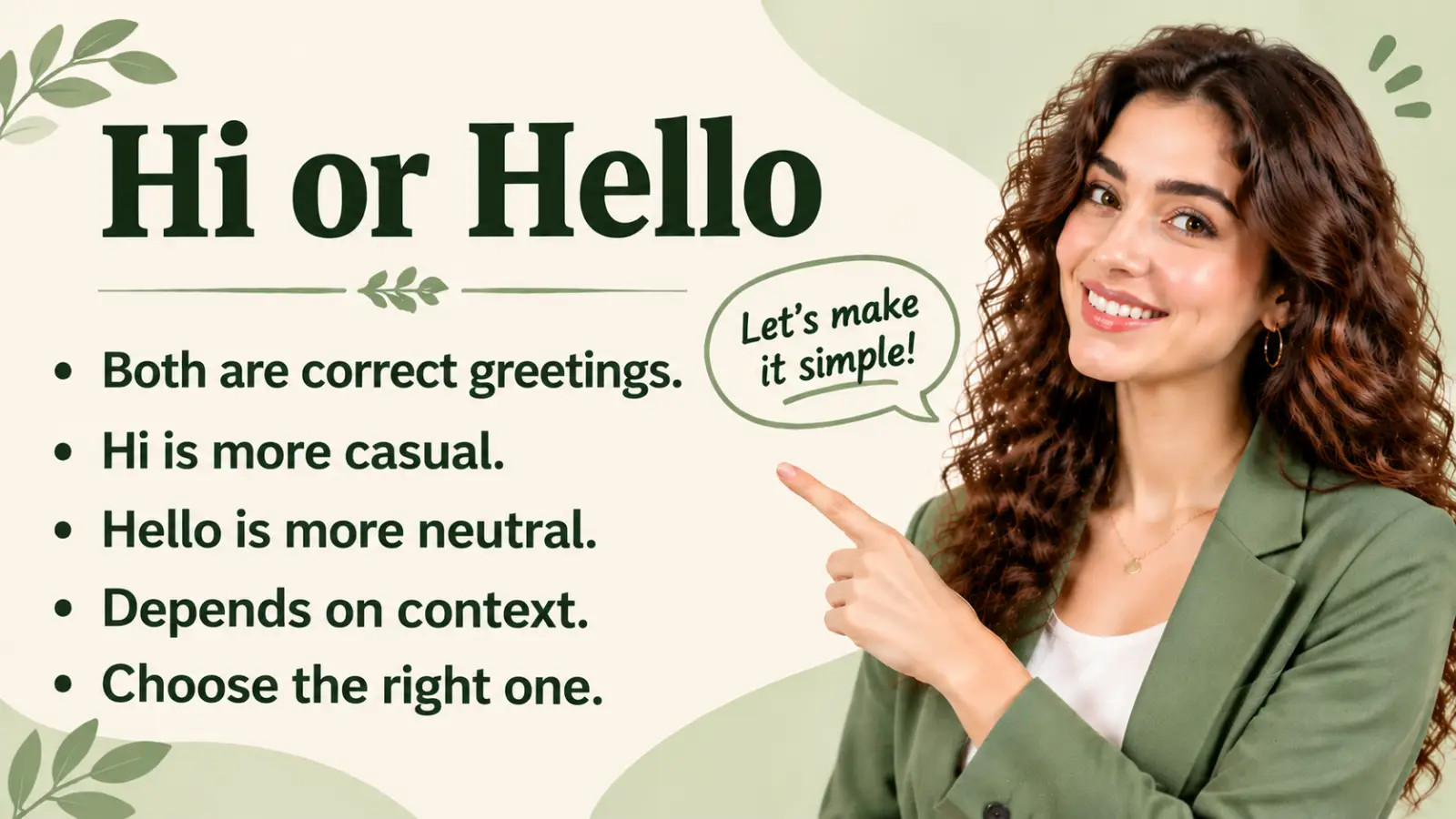
Both hi and hello are correct English greetings. Hi is generally more casual and conversational, while hello is a little more neutral and can suit both relaxed and professional situations. Neither word is incorrect; the best choice depends on the person you are addressing and the tone you want to create.
This distinction is useful when starting conversations, writing emails, answering phone calls, or greeting someone you have just met. Choosing the right greeting helps your message sound friendly without being too informal for the situation.
Related Post: A vs. An
Hi vs. Hello: The Key Difference
| Term | Meaning or status | When to use it | Example |
|---|---|---|---|
| Hi | Informal greeting | Casual conversations, friendly messages, and familiar colleagues | Hi, Jordan! How are you? |
| Hello | Neutral greeting that also works in more formal settings | First meetings, professional conversations, phone calls, and everyday interactions | Hello, Jordan. It’s nice to meet you. |
Both words introduce a conversation or acknowledge another person. The main difference is tone: hi tends to sound more relaxed, while hello offers a slightly more neutral or polished opening.
What Does Hi Mean?
Hi is an informal greeting used when meeting someone, beginning a conversation, or acknowledging a person. It is short, friendly, and common in everyday American English.
Although it is informal, hi is not automatically rude or disrespectful. It is widely used among friends, relatives, classmates, coworkers, and even people who are meeting for the first time in relaxed settings.
When to Use Hi
Use hi when you want a friendly, conversational opening.
Common situations include:
- Greeting friends and family.
- Starting a text message or casual email.
- Speaking with coworkers you know.
- Joining a relaxed group conversation.
- Introducing yourself in an informal setting.
For example, Hi, Alex! is a natural way to greet a friend or colleague. It sounds approachable without requiring a formal introduction.
Hi in Example Sentences
- Hi, Sarah! How was your weekend? This greeting works well when speaking to someone you know.
- Hi, everyone. Thanks for joining the meeting. It creates a friendly opening for a group.
- Hi, I’m Daniel. It’s nice to meet you. This is a relaxed way to introduce yourself to someone new.
What Does Hello Mean?
Hello is a greeting used when meeting someone, starting a conversation, answering a phone call, or attracting someone’s attention. It is more neutral than hi and works across a wider range of social and professional situations.
The word can also function as a noun, as in “We exchanged a quick hello before the meeting.”
When to Use Hello
Choose hello when you want a greeting that sounds friendly but not overly casual.
It is especially useful when:
- Meeting someone for the first time.
- Greeting a client, customer, or unfamiliar colleague.
- Opening a professional conversation.
- Answering or beginning a phone call.
- Calling out to someone to get their attention.
For instance, Hello, Ms. Carter. Thank you for meeting with me. is a polite opening for a professional conversation.
Hello in Example Sentences
- Hello, Mr. Davis. It’s a pleasure to meet you. The greeting suits a first meeting.
- Hello, this is Rachel speaking. This is a natural way to begin a phone conversation.
- She walked into the room and said hello to everyone. Here, hello describes the greeting she gave the group.
How to Choose Between Hi and Hello
The easiest way to choose is to consider your relationship with the person and the impression you want to create.
- Choose hi for a relaxed, friendly, or familiar tone.
- Choose hello for a neutral, polite, or slightly more formal tone.
Neither greeting is limited to one type of situation. You can say hi to a coworker, and you can say hello to a close friend. The difference is a matter of tone and context rather than a strict grammar rule.
A Quick Test You Can Apply
Ask yourself: Would a relaxed greeting feel natural here, or would a more neutral greeting be better?
| Situation | Natural choice | Reason |
|---|---|---|
| Texting a close friend | Hi | Friendly and casual |
| Meeting a new client | Hello | Neutral and professional |
| Greeting your coworkers | Hi or Hello | Both can sound appropriate |
| Answering a business phone call | Hello | A conventional phone greeting |
| Greeting a group at a casual event | Hi | Warm and conversational |
If both choices sound natural, either is acceptable. Select the one that matches the tone of the interaction.
Common Mistakes and How to Fix Them
Because both words are valid greetings, most errors involving hi and hello are related to tone or sentence construction rather than spelling.
| Original sentence | Corrected sentence | Why it changes |
|---|---|---|
| Hi, Mr. Thompson, I am pleased to make your acquaintance. | Hello, Mr. Thompson. I am pleased to make your acquaintance. | Hello creates a more neutral opening for this formal introduction. |
| Hello, dude! What’s up? | Hi, dude! What’s up? | Hi may sound more natural in this casual exchange, although hello is also correct. |
| I said hi to her and we exchanged a hello. | I said hello to her, and we exchanged greetings. | The revision avoids an awkward repetition of two greeting words. |
Why These Forms Get Confused
The two words have the same basic purpose: they greet someone or begin an interaction. Because their meanings overlap, people sometimes assume they are identical in tone.
Their usage is not completely interchangeable in every situation, however. Hi usually sounds more casual, while hello is more flexible when the relationship or setting calls for a neutral greeting. This difference is a matter of convention and tone, not a strict grammatical boundary.
Does the Choice Change With Context?
Yes. The basic meaning stays similar, but the setting and relationship can influence which greeting sounds more suitable.
Formal Writing vs. Casual Conversation
In casual conversation, hi is a natural choice for friends, relatives, classmates, and familiar coworkers.
Hello is useful when you want a more neutral tone, especially when meeting someone for the first time or addressing someone you do not know well.
Neither greeting is restricted to speech. Both are common in written communication, including emails, messages, and online conversations.
Workplace, Academic, or Everyday Usage
At work, hi is often suitable for a friendly message to a teammate:
“Hi, Morgan. Could you send me the updated report?”
For a first email to an unfamiliar client, hello can provide a neutral opening:
“Hello, Ms. Reed. I am contacting you about the upcoming project.”
In academic settings, either can work depending on the relationship. A student might write Hi, Professor Lee to an instructor they know well, while Hello, Professor Lee may feel more appropriate for a first message.
Can You Use Hi and Hello Interchangeably?
In many everyday greetings, yes. Both words can introduce a conversation or acknowledge another person without changing the basic message.
However, replacing one with the other can change the tone. Hi tends to sound more casual, while hello can sound more neutral or polished.
When Both Forms Work
Both greetings can be appropriate when speaking to a coworker:
- Hi, Taylor. Do you have a minute?
- Hello, Taylor. Do you have a minute?
Both sentences are correct. The first sounds a little more relaxed, while the second sounds slightly more neutral.
When Switching Changes the Tone
Consider these examples:
- Hi, everyone! Ready for the game? This sounds relaxed and friendly.
- Hello, everyone. Thank you for attending today’s presentation. This sounds more composed and professional.
The words do not change the central meaning, but they influence how the speaker comes across.
Common Phrases With Hi and Hello
These expressions show how each greeting appears in natural conversation.
| Phrase | When to use it | Original example |
|---|---|---|
| Hi there | A friendly greeting to one person | Hi there! Did you find the office? |
| Say hi | Asking someone to greet another person | Please say hi to your brother for me. |
| Hi, everyone | Greeting a group casually | Hi, everyone. Let’s get started. |
| Say hello | Greeting someone or asking another person to do so | I stopped by to say hello to my neighbors. |
| Hello there | A warm or welcoming greeting | Hello there! Welcome to our store. |
Apply the Difference to a Real Situation
Imagine sending an email to a hiring manager after receiving an invitation to discuss a job opportunity.
Original Version
“Hi, Ms. Bennett. Thank you for inviting me to discuss the position. I look forward to speaking with you.”
Improved Version and Explanation
“Hello, Ms. Bennett. Thank you for inviting me to discuss the position. I look forward to speaking with you.”
Both versions are grammatically correct. The revised version uses hello to create a slightly more neutral tone for a professional exchange. However, if you already have a friendly relationship with the hiring manager, hi may be perfectly appropriate.
The change is a style choice, not a necessary grammar correction.
Is Hello More Formal Than Hi?
Generally, yes. Hello is often perceived as slightly more formal or neutral than hi, but the difference is not absolute. Both greetings are acceptable in many everyday and workplace situations.
An Easy Way to Remember the Difference
Think of hi as the relaxed greeting and hello as the flexible greeting.
- Hi: A friendly choice for familiar people and casual interactions.
- Hello: A versatile choice for new acquaintances, professional exchanges, and phone conversations.
This is a practical guide rather than a strict rule. Your relationship with the person and the tone of the conversation matter more than the greeting alone.
Practice: Can You Choose the Right Greeting?
Choose the greeting that best matches the situation.
- You are texting a close friend. Which greeting sounds natural: Hi or Hello?
- You are answering a business phone call. Which greeting is the more conventional choice?
- You are greeting a coworker you know well. Can you use either word?
Answers and Explanations
- Hi is a natural choice because the conversation is casual. Hello would also be acceptable.
- Hello is the conventional choice for beginning a phone conversation.
- Yes. Both greetings are appropriate; hi sounds more relaxed, while hello is more neutral.
Frequently Asked Questions
Is Hi More Casual Than Hello?
Yes. Hi generally sounds more informal and conversational. Hello is more neutral and can fit both casual and professional situations.
Is It Rude to Say Hi Instead of Hello?
No. Hi is a normal, friendly greeting in American English. It may be too casual for certain formal occasions, but it is not inherently rude.
Should You Use Hi or Hello in a Professional Email?
Both can work. Use hello when writing to someone you do not know or when you want a neutral tone. Hi is suitable for many everyday workplace emails, especially when communicating with familiar colleagues.
Can You Start a Phone Call With Hi?
Yes, particularly when speaking with someone you know. Hello is a more conventional opening for business calls or calls with unfamiliar people.
Is Hi a Short Form of Hello?
Hi is a separate established greeting with a similar meaning to hello. It is not simply an abbreviation created by removing letters from hello.
Which Form Should You Use?
Choose hi when you want a relaxed, friendly greeting. Choose hello when you prefer a neutral opening or are addressing someone in a more formal situation.
Both are correct, widely understood greetings. Let your relationship with the person, the setting, and the tone of your message guide your choice.
Sources







One Comment