Their vs. There vs. They’re: How to Choose the Right Word
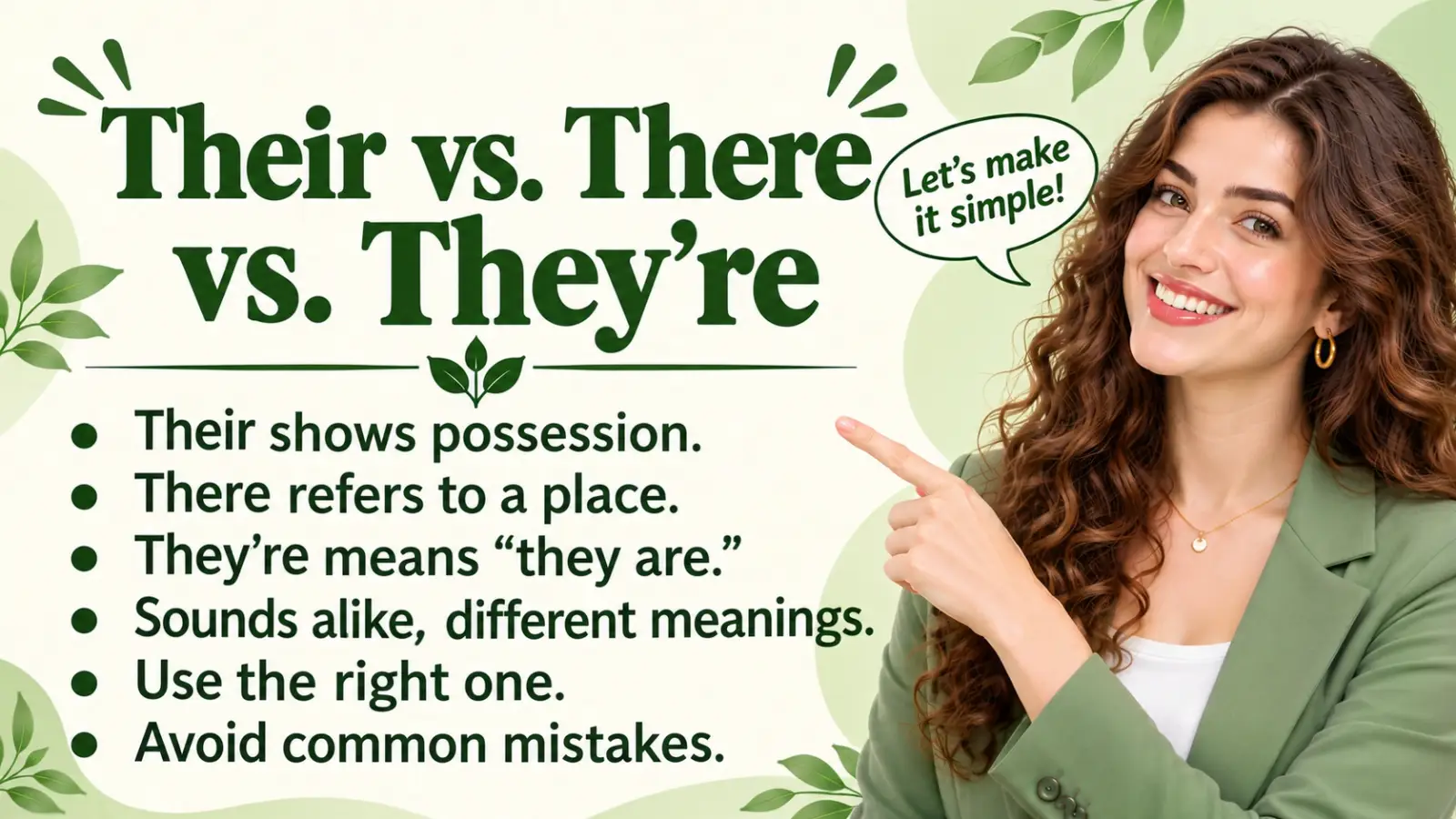
Their, there, and they’re sound alike in many varieties of English, but they have different meanings and grammatical functions. Their shows possession, there refers to a place or introduces the existence of something, and they’re is a contraction of “they are.”
The distinction matters in emails, school assignments, work documents, and everyday messages. Because the three words sound alike, pronunciation alone usually cannot tell you which spelling belongs in a sentence. You need to check what the word means and how it functions.
Related post: Genius vs. Genious
Their vs. There vs. They’re: The Key Difference
| Term | Meaning or status | When to use it | Example |
|---|---|---|---|
| Their | Possessive form associated with “they” | To show ownership or association | “They brought their laptops.” |
| There | Refers to a place or introduces existence | To indicate where something is or that something exists | “Put the bags over there.” |
| They’re | Contraction of “they are” | When “they are” fits the sentence | “They’re ready to leave.” |
All three are standard English words. None is inherently incorrect; the mistake happens when you use one in place of another.
What Does “Their” Mean?
Their is a possessive determiner that shows something belongs to, relates to, or is associated with someone or something referred to as “they.” It usually appears before a noun, much like my, your, his, or her.
For example, in “The players packed their equipment,” the word their connects the equipment to the players.
When to Use Their
Use their when you want to answer the question “Whose?”
It can identify ownership, relationships, responsibilities, characteristics, or things associated with a person or group.
- Ownership: “The neighbors painted their house.”
- Responsibility: “The employees submitted their reports.”
- Association: “The team celebrated their victory.”
Their can also refer to one person when the person’s gender is unknown or unspecified, or when that person uses they/them pronouns. For example, “Someone left their umbrella in the lobby” is standard English.
Their in Example Sentences
- “The students left their notebooks in the classroom.” Their shows that the notebooks belong to the students.
- “Maya and Jordan invited their friends to dinner.” The possessive word connects the friends with Maya and Jordan.
- “Every applicant should bring their identification.” Here, their refers to each applicant individually.
What Does “There” Mean?
There has several grammatical uses. Most commonly, it refers to a place or introduces a statement about the existence or presence of something.
It can identify a physical location, point to an abstract situation, or appear in constructions such as there is, there are, there was, and there were.
When to Use There
Use there when you mean a place or when you are saying that something exists.
- Location: “Your jacket is over there.”
- Existence: “There is a mistake in this paragraph.”
- Availability: “There are two seats left.”
- An abstract point or situation: “There is no reason to panic.”
In a sentence such as “There are three options,” the word there introduces the existence of the options. It does not show ownership.
There in Example Sentences
- “We stopped there for lunch.” There refers to a location.
- “There were several questions after the presentation.” The word introduces the existence of questions.
- “I know there is a better way to solve this problem.” Here, there introduces the idea that a better way exists.
What Does “They’re” Mean?
They’re is a contraction of they are. The apostrophe marks the omitted letter a.
Use it whenever replacing they’re with they are preserves the intended meaning and grammar.
When to Use They’re
They’re works wherever the full phrase they are would fit. It can describe a state, identity, location, action in progress, or characteristic.
- A state: “They’re excited about the trip.”
- A location: “They’re at the library.”
- An action in progress: “They’re preparing the presentation.”
- A characteristic: “They’re very helpful.”
The contraction is common in conversation and everyday writing. In formal writing, it is also grammatically acceptable, although some organizations or style guides prefer fewer contractions.
They’re in Example Sentences
- “They’re going to arrive before noon.” This means “They are going to arrive before noon.”
- “I think they’re the best people for the job.” The contraction means “they are.”
- “They’re working late because the deadline is tomorrow.” The sentence describes what they are doing.
How to Choose the Right Word
The easiest way to choose among their, there, and they’re is to identify the meaning you need before looking at the spelling.
- If something belongs to or is associated with someone, use their.
- If you mean a location or introduce the existence of something, use there.
- If you mean they are, use they’re.
A Quick Test You Can Apply
Try these checks in order:
1. Replace the word with “they are.”
If the sentence still makes sense, choose they’re.
- “They’re ready.” → “They are ready.” Correct.
- “Their ready.” → “They are ready.” The replacement reveals that their is the wrong choice.
2. Ask “Whose?”
If the word identifies who owns or is associated with a noun, choose their.
- “They forgot their tickets.” Whose tickets? Their tickets.
3. Ask “Where?” or check for existence.
If the word identifies a place or introduces something that exists, choose there.
- “Leave the tickets there.” Where should you leave them? There.
- “There is a ticket on the desk.” The sentence states that a ticket exists.
When the Quick Test Does Not Work
The substitution test is reliable for they’re, but not every use of there refers to a physical location. In “There is a problem,” for example, there introduces the existence of a problem rather than identifying a place.
Also, their does not always indicate literal ownership. In “their decision” or “their responsibility,” it shows association rather than possession of a physical object.
Common Mistakes and How to Fix Them
| Original sentence | Corrected sentence | Why it changes |
|---|---|---|
| “Their going to call us later.” | “They’re going to call us later.” | The intended meaning is “They are going to call us later.” |
| “The kids left there shoes outside.” | “The kids left their shoes outside.” | Their shows whose shoes they are. |
| “Please put the boxes over they’re.” | “Please put the boxes over there.” | There identifies the location for the boxes. |
| “Their is a problem with my account.” | “There is a problem with my account.” | There is introduces the existence of a problem. |
Why These Forms Get Confused
The three words are homophones in many varieties of English: they sound alike even though their spellings and meanings differ. When speaking, listeners often rely on context to understand which word someone means.
In writing, however, the spelling has to communicate the grammatical function. It is easy to type the wrong form when writing quickly because the sound does not provide a reliable clue. Checking meaning and sentence structure is more effective than relying on pronunciation.
Does the Choice Change With Context?
Workplace, Academic, or Everyday Usage
The grammatical rules stay the same across contexts, but the consequences of an error can vary. In an informal text, readers may understand what you intended. In a report, résumé, academic paper, or client email, a mix-up can distract from the message or make the writing appear less carefully edited.
For professional writing, check the word’s role before sending or submitting your work. You do not need to avoid they’re simply because a document is formal; follow the relevant style guide if your school or organization has a specific rule about contractions.
Can You Use Their, There, and They’re Interchangeably?
No. They serve different grammatical functions, so replacing one with another usually changes the meaning or creates an error.
When Switching Changes the Meaning
Compare these three sentences:
- “Their meeting starts at nine.” — The meeting is associated with them.
- “There is a meeting at nine.” — The sentence announces that a meeting exists.
- “They’re meeting at nine.” — The sentence means “They are meeting at nine.”
The sentences may describe related circumstances, but the words are not interchangeable. Each version communicates a different grammatical relationship.
Common Phrases With Their, There, and They’re
| Phrase | When to use it | Original example |
|---|---|---|
| Their own | To emphasize that something belongs to or is associated with them | “The designers created their own website.” |
| Their best | To refer to someone’s greatest effort or performance | “The athletes gave their best during the final round.” |
| Over there | To point out a location | “The customer service desk is over there.” |
| There is / There are | To introduce the existence or presence of something | “There are several ways to solve the issue.” |
| They’re going to | To describe a future plan or expected action | “They’re going to review the proposal tomorrow.” |
Apply the Rule to a Real Situation
Imagine you are sending a work email about a team presentation. You want to explain that the team has finished its slides and will present them in a meeting room.
Original Version
“Hey, their almost finished with there slides, and they’re going to present them over their.”
Improved Version and Explanation
“Hey, they’re almost finished with their slides, and they’re going to present them over there.”
Each correction serves a different purpose:
- They’re almost finished means “They are almost finished.”
- Their slides identifies the slides associated with the team.
- They’re going to present means “They are going to present.”
- Over there identifies the presentation location.
The correction changes only the word choices, preserving the intended message. In a more formal email, you might replace “Hey” with “Hello,” but that is a tone adjustment, not a correction required by the grammar rule.
Can “Their” Refer to One Person?
Yes. Their can refer to a single person when the person’s gender is unknown or unspecified, or when the person uses they/them pronouns.
For example, “The new employee said their computer was not working” is grammatically acceptable. The word their remains possessive even though it refers to one person rather than a group.
Do not confuse this use with they’re: “their computer” means the computer associated with that person, while “they’re working” means “they are working.”
What Is the Difference Between “There’s” and “They’re”?
There’s usually means “there is” and can also mean “there has” in contexts where the following verb supports that expansion. They’re means only “they are.”
Compare:
- “There’s a message for you.” → “There is a message for you.”
- “They’re waiting for you.” → “They are waiting for you.”
A useful check is to expand the contraction. If the sentence needs “there is,” write there’s. If it needs “they are,” write they’re.
An Easy Way to Remember the Difference
Use this three-part memory aid:
- Their = ownership or association. Think of the word heir, someone who inherits something.
- There = place or existence. The word contains here, which also refers to a place.
- They’re = they are. The apostrophe marks the missing a in “are.”
Try the rule in one sentence: “They’re bringing their bags over there.”
- They’re = they are bringing.
- Their = the bags belong to or are associated with them.
- There = the place where the bags are going.
This mnemonic is a reminder, not a substitute for understanding the sentence. In particular, there can introduce existence rather than a literal location.
Frequently Asked Questions
Is “their,” “there,” or “they’re” correct?
All three are correct words, but they have different uses. Their is possessive, there refers to a place or introduces existence, and they’re means “they are.”
Is “their” ever used for a singular person?
Yes. Singular their is accepted in standard English for a person whose gender is unknown or unspecified and for a person who uses they/them pronouns. For example, “Someone forgot their phone” is correct.
Does “they’re” always mean “they are”?
Yes. They’re is the contraction of “they are.” If expanding the word to “they are” does not fit your sentence, you probably need their or there instead.
Is “there” always about a place?
No. There can refer to a location, as in “Wait over there,” but it can also introduce existence, as in “There are three messages.” Check how the word functions in the sentence before choosing it.
How do you spell “their’s”?
The standard possessive form is theirs, without an apostrophe. For example, write “The blue folder is theirs,” not “The blue folder is their’s.” The form their usually comes before a noun, as in “their folder.”
Which Form Should You Use?
Choose their for possession or association, there for a place or to introduce existence, and they’re when you mean “they are.” If you are unsure, expand they’re first, ask “Whose?” to check their, and use there when the sentence refers to a location or announces that something exists.
One final example brings all three together: “They’re taking their coats over there.”
Sources
- Merriam-Webster — How to Use They’re, There, and Their
- Cambridge Dictionary — There, their or they’re?