Yea or Nay: Learn the Meaning and Use It Correctly
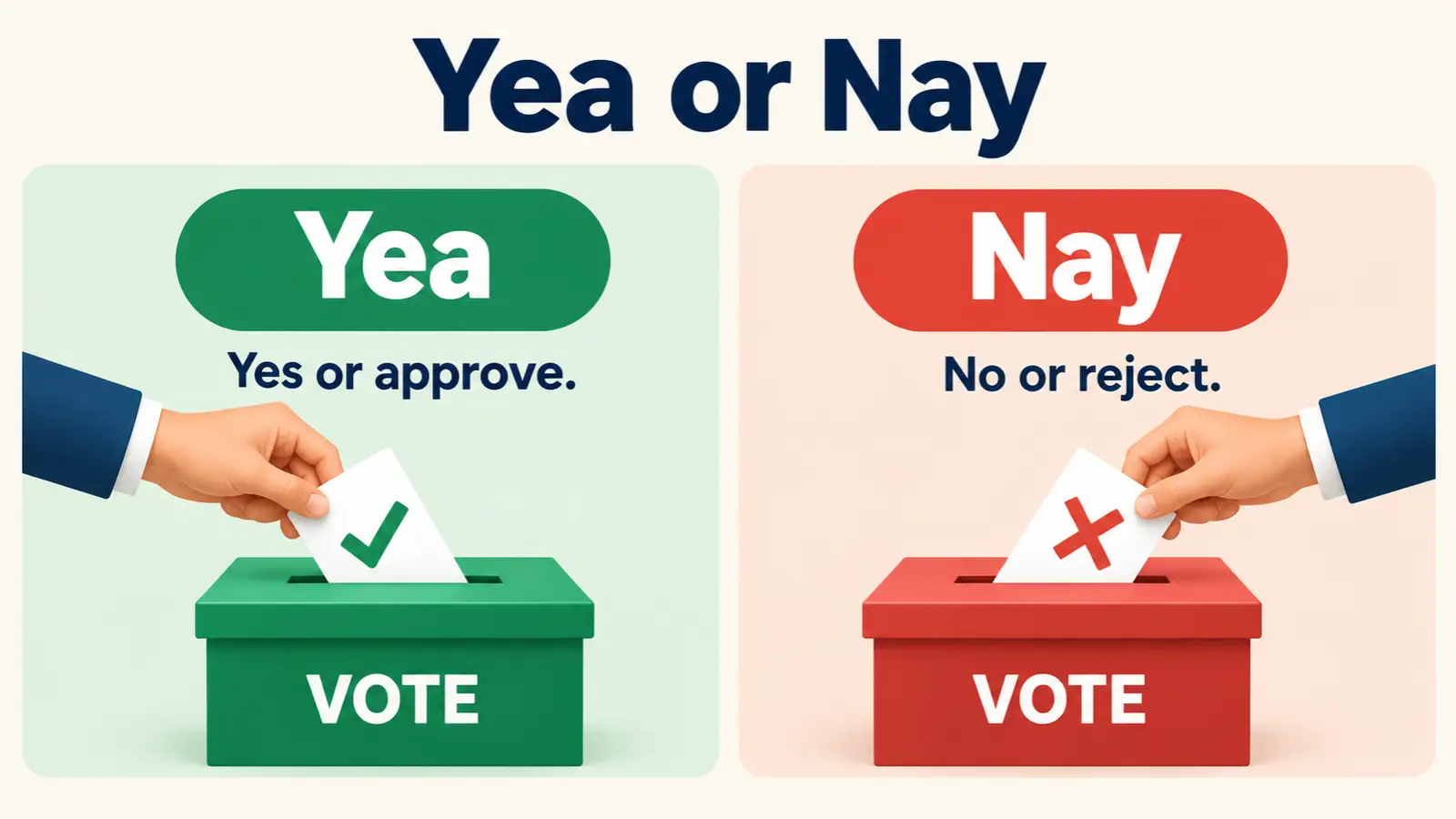
“Yea or nay” means “yes or no.” The expression asks someone to approve or reject a proposal, make a decision, or state a clear preference. Both yea and nay are legitimate English words, not spelling mistakes.
The phrase is especially familiar from voting, formal decisions, and parliamentary discussions. It also works in everyday conversation when someone wants a quick, decisive answer, although “yes or no” is usually more natural for ordinary communication.
Related Post: Happy New Year or Happy New Years
Yea vs. Nay: The Key Difference
| Term | Meaning or status | When to use it | Example |
|---|---|---|---|
| Yea | Yes; an affirmative answer or vote | To express approval or support | “My vote is yea.” |
| Nay | No; a negative answer or vote | To express opposition or rejection | “Three members voted nay.” |
| Yea or nay | Yes or no | To ask for a definite decision | “Is your answer yea or nay?” |
Both words are established English terms. In American English, yea is particularly associated with voting and formal approval, while nay commonly appears as its opposite in the same context.
What Does Yea Mean?
Yea means “yes” or expresses agreement, approval, or support. It is pronounced like “yay,” which is why the two words are sometimes confused. In voting, a yea is an affirmative vote in favor of a proposal.
When to Use Yea
Use yea when you want to express an affirmative vote or answer, particularly during a formal decision. It can also appear in older, literary, or religious writing with the sense of “indeed.”
Examples include:
- The committee voted yea on the proposed changes. The members supported the proposal.
- Please record my vote as yea. The speaker wants their approval officially recorded.
- The final count showed 18 yeas and 7 nays. The sentence reports the number of affirmative and negative votes.
In everyday conversation, “yes” is generally the more familiar choice. “Yea” can sound formal, traditional, or deliberately playful outside a voting context.
What Does Nay Mean?
Nay means “no” or expresses disagreement or opposition. In voting, a nay is a vote against a proposal. It is commonly paired with yea when a group records support and opposition.
When to Use Nay
Use nay when expressing a negative vote or reporting that someone rejected a proposal. The word can also appear in older or literary expressions.
Examples include:
- Four members voted nay on the motion. Four members opposed the proposal.
- Her answer was a firm nay. She clearly rejected the suggestion.
- The proposal received 12 yeas and 9 nays. The sentence gives the vote totals.
For most everyday conversations, “no” sounds more natural than “nay.” Reserve “nay” for voting contexts, a deliberately formal tone, or an established expression.
How to Choose the Right Expression
Choose yea or nay when you want a clear decision about approval or rejection. Use yes or no when you want a neutral, familiar question or answer.
A Quick Test You Can Apply
Ask yourself whether the sentence concerns a decision or vote:
- A formal vote: “Will you vote yea or nay?”
- An everyday question: “Are you coming, yes or no?”
- A vote result: “The yeas have it.” This means the affirmative votes have won.
If replacing “yea” with “yes” or “nay” with “no” preserves the intended meaning, you are probably using the terms correctly. The main difference is tone and context rather than spelling.
When the Quick Test Does Not Work
The words yea and yay sound alike but have different meanings. Yea means “yes,” especially in voting; yay is an exclamation expressing excitement or approval, as in “Yay! We won!”
Also, nay can have a literary meaning beyond simply answering “no.” For example, in “It was a privilege, nay, an honor,” the word introduces a stronger description. That use is different from the voting expression “yea or nay.”
Common Mistakes and How to Fix Them
| Original sentence | Corrected sentence | Why it changes |
|---|---|---|
| “The senator voted yay on the bill.” | “The senator voted yea on the bill.” | Yea is the appropriate term for an affirmative vote. |
| “The committee voted nay, meaning they approved it.” | “The committee voted yea, meaning they approved it.” | Nay indicates a negative vote, not approval. |
| “Give me a yay or nay on the proposal.” | “Give me a yea or nay on the proposal.” | Yea or nay is the traditional expression for a yes-or-no decision. |
| “The board needs a yea or nay, but nobody has made a decision.” | “The board needs a yea or nay, so members must decide whether to approve or reject the plan.” | The revision makes the requested decision explicit. |
The first three examples correct word choice. The last improves clarity rather than fixing a strict grammatical error.
Why These Forms Get Confused
Yea, yay, and yeah sound similar, but their meanings differ. Yea is associated with affirmative votes, yay expresses excitement, and yeah is an informal way to say yes. Nay adds to the confusion because it is less common in everyday conversation but pairs naturally with yea.
Does the Choice Change With Context?
Formal Writing vs. Casual Conversation
In formal voting, government proceedings, and committee decisions, yea or nay is a suitable expression. It clearly frames the choice as approval or rejection.
In casual conversation, the phrase can sound playful or old-fashioned:
- Formal: “Please submit your yea or nay on the proposed budget.”
- Casual: “New pizza place tonight—yea or nay?”
For an everyday question that does not involve a decision-making process, “yes or no” is usually simpler and more natural.
Workplace, Academic, or Everyday Usage
At work, “yea or nay” can be useful when asking for a decision about a proposal, budget, or project. In academic writing, use it when discussing votes or when the traditional wording is relevant. For routine emails and assignments, yes or no is generally the clearest choice.
Can You Use Yea and Nay Interchangeably?
No. Yea expresses agreement or approval, while nay expresses disagreement or rejection. They are opposites, so substituting one for the other reverses the meaning.
When Switching Changes the Meaning
- “The council voted yea on the proposal.” The council supported it.
- “The council voted nay on the proposal.” The council opposed it.
The complete expression “yea or nay” asks a person to choose between those two positions. It does not mean that the words themselves are interchangeable.
Common Phrases With Yea or Nay
| Phrase | When to use it | Original example |
|---|---|---|
| Yea or nay | Asking for a yes-or-no decision | “Do you support the revised plan, yea or nay?” |
| Yeas and nays | Reporting affirmative and negative votes | “The clerk recorded the yeas and nays.” |
| The yeas have it | Announcing that the affirmative side has won a vote | “The yeas have it, so the motion passes.” |
| Vote yea | Instructing someone to vote in favor | “Members who support the amendment should vote yea.” |
| Vote nay | Instructing someone to vote against a proposal | “Those who oppose the motion may vote nay.” |
These expressions are especially associated with formal voting and group decisions.
LII / Legal Information Institute
+1
Apply the Rule to a Real Situation
Imagine a project manager asking a team to approve a proposed software purchase.
Original Version
“Please reply with a yay or nay on the software proposal by Friday.”
Improved Version and Explanation
“Please reply with a yea or nay on the software proposal by Friday.”
Why it works: The revised sentence uses the traditional voting expression. “Yay” generally expresses excitement or approval, whereas “yea” is the more precise choice for an affirmative vote or formal decision.
If the manager is simply asking for an informal opinion rather than a vote, “Please let me know whether you support the software proposal by Friday” may be even clearer.
Is It “Yea or Nay” or “Yay or Nay”?
Yea or nay is the established expression when the intended meaning is “yes or no,” particularly for voting or deciding whether to approve something. Yay or nay sometimes appears in casual online language, where “yay” suggests enthusiasm or approval, but it is not the traditional wording for an affirmative vote.
How Do You Pronounce “Yea or Nay”?
Yea rhymes with “day,” “say,” and “yay.” Nay rhymes with “day” and “say” as well. The expression is pronounced approximately “yay or nay.”
Although yea and yay sound alike, their meanings differ: yea means yes, while yay usually expresses excitement or celebration.
An Easy Way to Remember the Difference
Remember this simple rule:
- Yea = Yes
- Nay = No
- Yay = Hooray
For example, if a committee approves a proposal, its members vote yea. If they reject it, they vote nay. If someone announces, “Yay, our proposal passed!” they are expressing happiness rather than recording a vote.
Frequently Asked Questions
Is “yea or nay” grammatically correct?
Yes. “Yea or nay” is a recognized English idiom meaning “yes or no.” It is especially appropriate when someone must approve or reject a proposal.
Is “yea” a real word?
Yes. Yea is a legitimate English word meaning “yes” or an affirmative vote. It can also mean “indeed” in older or literary writing.
Is “nay” the opposite of “yea”?
Yes. In voting, yea means a vote in favor, while nay means a vote against. The pair is commonly used to report or request a decision.
Should I use “yea or nay” in a professional email?
Use it when asking for a clear decision on a proposal or approval, especially if the tone is formal. For routine communication, “yes or no” or “please approve or reject the proposal” may sound more natural.
What is the difference between “yea” and “yeah”?
Yea is traditionally associated with voting, formal agreement, and older or literary usage. Yeah is an informal form of “yes” used widely in everyday conversation.
Which Form Should You Use?
Use yea or nay when you need a clear yes-or-no decision, especially in voting, formal approvals, or deliberately playful conversation. Choose yes or no for most everyday communication, and remember that yay expresses excitement rather than serving as the traditional spelling for an affirmative vote.
Sources