Any Time or Anytime: Learn the Difference With Examples
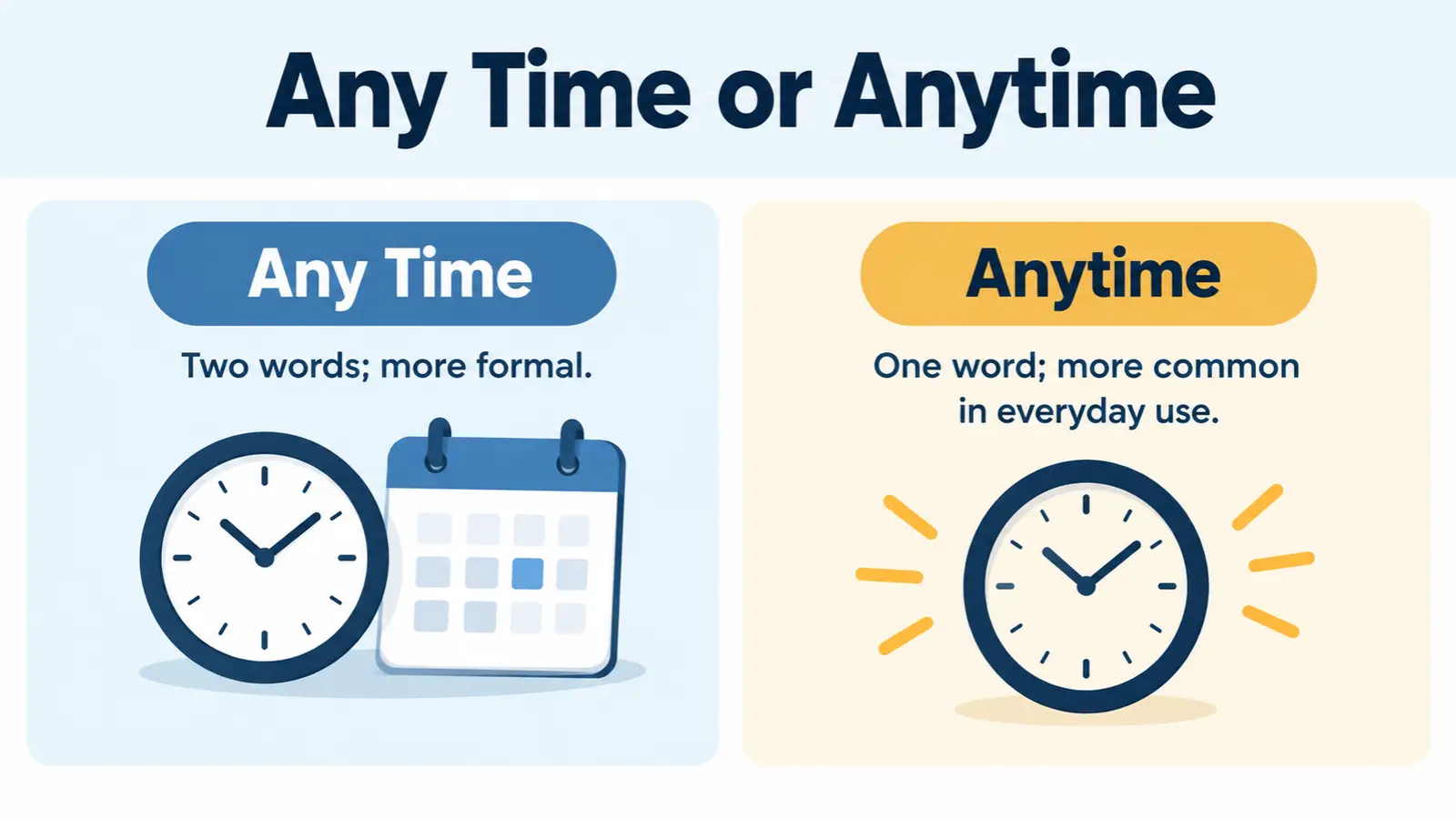
Both any time and anytime are correct, but their grammatical uses can differ. Any time is usually a two-word noun phrase, while anytime is commonly an adverb meaning “whenever” or “at any time.” In some sentences, both forms are acceptable.
Knowing when to use each form helps you write clearly in emails, school assignments, workplace messages, and everyday conversations. One especially useful rule is to write at any time, not at anytime, in standard usage.
Related Post: Setup or Set Up
Any Time vs. Anytime: The Key Difference
| Term | Meaning or status | When to use it | Example |
|---|---|---|---|
| Any time | A noun phrase referring to an unspecified amount or period of time; also used in the phrase “at any time” | When referring to time as a noun or following a preposition such as at | Do you have any time to talk? |
| Anytime | An adverb meaning “whenever” or “at any time” | When describing when an action can happen | You can call me anytime. |
| Any time as a response | An informal expression meaning “you’re welcome” or “glad to help” | When responding to someone’s thanks | “Thanks for your help.” “Any time!” |
The key difference is grammatical, not simply a matter of spelling. Both forms can refer to an unspecified time, but the sentence structure helps determine which one fits best.
What Does Any Time Mean?
Any time, written as two words, commonly functions as a noun phrase. It can refer to an amount of available time or an unspecified occasion.
For example, “I don’t have any time to spare” means there is no available time. In “You may cancel at any time,” the phrase follows the preposition at and means that cancellation is permitted whenever the person chooses.
When to Use Any Time
Use any time when the word time functions as a noun, particularly when discussing availability, duration, or a particular opportunity.
Examples include:
- Do you have any time this afternoon? This asks whether someone has time available.
- We need any time we can get to finish the project. This emphasizes the importance of whatever time is available.
- You may contact customer support at any time. The phrase follows the preposition at.
A useful rule for standard writing is to keep the words separate after prepositions such as at: at any time, by any time when grammatically appropriate, and similar constructions where any time functions as a noun phrase.
Any Time in Example Sentences
- I don’t have any time to review the report today. Here, any time refers to available time.
- Any time you choose will work for me. The phrase acts as a noun phrase referring to whichever time you select.
- Please submit your questions at any time during the session. The two-word form follows at.
What Does Anytime Mean?
Anytime is an adverb that means “whenever” or “at any time.” It describes when an action can occur without requiring a specific date or hour.
For example, “You can visit anytime” means you can visit whenever it suits you. The one-word form is also common in expressions such as anytime soon and anytime now.
When to Use Anytime
Use anytime when it can naturally be replaced by whenever or at any time without changing the main meaning.
Examples include:
- Call me anytime you need advice.
- We can schedule the meeting anytime next week.
- The delivery should arrive anytime now.
The word is suitable for everyday communication and much professional writing. However, if you are writing a sentence that specifically uses the preposition at, choose the two-word phrase at any time.
Anytime in Example Sentences
- You can borrow my notes anytime. You may borrow them whenever you need them.
- I don’t expect the weather to improve anytime soon. The improvement is not expected in the near future.
- Anytime you visit, we’ll make you feel welcome. The word introduces a situation that may happen whenever you visit.
How to Choose Between Any Time and Anytime
Choose the form based on its grammatical role and the meaning of the sentence. Use any time when referring to time as a noun or when writing the phrase at any time. Use anytime when the word functions as an adverb meaning “whenever.”
A Quick Test You Can Apply
Try replacing the word with whenever.
- Correct: You can call me anytime.
- Substitution: You can call me whenever you want.
The sentence still makes sense, so anytime works.
Now try the same test with this sentence:
- I don’t have any time to spare.
- I don’t have whenever to spare.
The replacement fails because any time refers to an amount of time, not when an action happens. Keep the two-word form.
Also check for the preposition at:
- Correct: Please contact us at any time.
- Incorrect in standard usage: Please contact us at anytime.
When the Quick Test Does Not Work
The substitution test is helpful, but it does not settle every case. Both forms can work when the intended meaning is “whenever.”
For example:
- You may visit any time.
- You may visit anytime.
Both are used to mean that a visit is welcome whenever the person chooses. The one-word form functions as an adverb, while the two-word version retains the open phrase.
When you are unsure, consider the sentence’s grammar. If time refers to an amount or follows at, use any time. If the word means whenever, anytime is often appropriate.
Common Mistakes and How to Fix Them
| Original sentence | Corrected sentence | Why it changes |
|---|---|---|
| You can reach me at anytime. | You can reach me at any time. | Standard usage keeps the phrase separate after at. |
| I don’t have anytime to finish the task. | I don’t have any time to finish the task. | The sentence refers to an amount of available time. |
| Call me any time you need help. | Call me anytime you need help. | The one-word adverb is a natural choice when the meaning is “whenever.” The original is also acceptable. |
| Thank you for helping me. “Anytime.” | Thank you for helping me. “Any time!” | The two-word expression is a conventional response meaning “you’re welcome.” |
Not every difference is a strict error. In the third example, both spellings can be acceptable. The correction shows an alternative rather than fixing a definite mistake.
Why These Forms Get Confused
The two forms sound alike and often express nearly the same idea. That overlap can make the difference seem arbitrary.
The distinction becomes clearer when you look at grammar. Any time can function as a noun phrase, while anytime commonly functions as an adverb. Since both forms can mean “at any time” in some contexts, writers may choose one without considering how it fits into the sentence.
Does the Choice Change With Context?
The main distinction applies to American English and is also useful in British English. Both any time and anytime are established forms, though dictionary entries and usage preferences may vary by region.
Formal Writing vs. Casual Conversation
Both forms can appear in professional writing, but the sentence structure matters more than formality alone.
- Formal: You may contact the office at any time during business hours.
- Casual: Text me anytime.
Do not assume that anytime is always informal or that any time is always more formal. Choose the form that fits the grammar and intended meaning.
Workplace, Academic, or Everyday Usage
For workplace emails and academic assignments, use at any time when the phrase follows at. For example, “Students may submit questions at any time during office hours.”
In a casual message, “Call me anytime” is natural and concise. When discussing available time, use the two-word form: “I don’t have any time this morning.”
Can You Use Any Time and Anytime Interchangeably?
Sometimes. When both forms mean “whenever,” they can be interchangeable in sentences such as “You can stop by any time” and “You can stop by anytime.”
However, they are not interchangeable in every context. When time refers to an amount or functions as a noun, the two-word phrase is needed. The standard phrase after at is also at any time.
When Both Forms Work
Both forms can be correct when you mean that an action may happen whenever the opportunity arises.
- You can email me any time.
- You can email me anytime.
Both sentences invite the person to email whenever they choose. The one-word version is a straightforward adverb; the two-word version is also common in this use.
When Switching Changes the Meaning
Compare these sentences:
- I have any time to spare. This is not a natural sentence for the intended meaning.
- I have some time to spare. This means that some time is available.
For a clearer comparison:
- Do you have any time to talk? This asks whether the person has time available.
- You can talk to me anytime. This means the person may talk whenever they want.
The first asks about availability; the second gives permission to talk at a flexible time.
Common Phrases With Any Time and Anytime
| Phrase | When to use it | Original example |
|---|---|---|
| At any time | To say something is possible whenever needed | You may request assistance at any time. |
| Anytime soon | To refer to the near future, often in a negative sentence or question | The road repairs won’t finish anytime soon. |
| Anytime now | To suggest that something is expected very soon | The bus should arrive anytime now. |
| Any time you want | To offer flexibility about when something happens | You can use the meeting room any time you want. |
| Any time! | As an informal response to thanks | “Thanks for covering my shift.” “Any time!” |
These expressions are useful in everyday and professional communication. Pay special attention to at any time, which keeps the two words separate.
Apply the Rule to a Real Situation
Imagine you’re writing an email to a colleague to explain when they can contact you.
Original Version
Feel free to contact me at anytime if you have questions. I don’t have anytime to discuss the details today, but we can talk tomorrow.
Improved Version and Explanation
Feel free to contact me at any time if you have questions. I don’t have any time to discuss the details today, but we can talk tomorrow.
Both corrections use any time because the first follows the preposition at and the second refers to available time. The revised email preserves the intended meaning while correcting the word spacing.
Is Any Time One Word or Two?
Both spellings are correct, but they serve different grammatical roles.
- Any time: Usually a noun phrase, as in “I don’t have any time left.”
- Anytime: Usually an adverb, as in “You can visit anytime.”
- At any time: The standard phrase when at introduces the time expression.
If you’re uncertain, the two-word phrase is appropriate in many contexts, but it is important to check the sentence rather than apply a blanket rule.
An Easy Way to Remember the Difference
Remember this simple guide:
Any time = time as a noun.
Anytime = whenever.
For example, “I don’t have any time” refers to the amount of time available. “You can call anytime” means you can call whenever you choose.
One additional reminder makes the distinction easier: write at any time, with a space after any.
Practice: Can You Choose the Right Form?
Choose the form that best fits each sentence.
- You can visit us ______ you are in town. (any time / anytime)
- I don’t have ______ to finish the assignment tonight. (any time / anytime)
- Please contact the help desk ______. (at any time / at anytime)
Answers and Explanations
- Anytime is a natural choice because it means “whenever.” The two-word form is also possible.
- Any time is correct because it refers to an amount of available time.
- At any time is the standard form after the preposition at.
Frequently Asked Questions
Is anytime one word or two?
Anytime is one word when used as an adverb meaning “whenever” or “at any time.” The two-word phrase any time is used when time functions as a noun and in standard constructions such as at any time.
Is “at anytime” grammatically correct?
In standard usage, write at any time, with two words. The phrase follows the preposition at, so the open form is the appropriate choice.
Is any time more formal than anytime?
Not necessarily. Both appear in different kinds of writing. The key consideration is grammar: use at any time after at, and use anytime when it naturally functions as an adverb.
Can I say “thank you” and respond with “anytime”?
Yes, but “Any time!” is a conventional two-word response meaning “you’re welcome” or “I’m happy to help.” The one-word form may also appear informally, but the two-word expression is a safe choice for this reply.
Which form should I use in American English?
Both are accepted in American English. Use anytime to mean “whenever,” and use any time when referring to an amount of time or writing at any time.
Which Form Should You Use?
Use anytime when it means “whenever,” as in “You can call me anytime.” Use any time when discussing available time, as in “I don’t have any time,” and after the preposition at, as in “You may contact us at any time.”
The forms sometimes overlap, so check how the phrase functions in your sentence. When you remember the difference between a noun phrase and an adverb, choosing the right form becomes much easier.
Sources