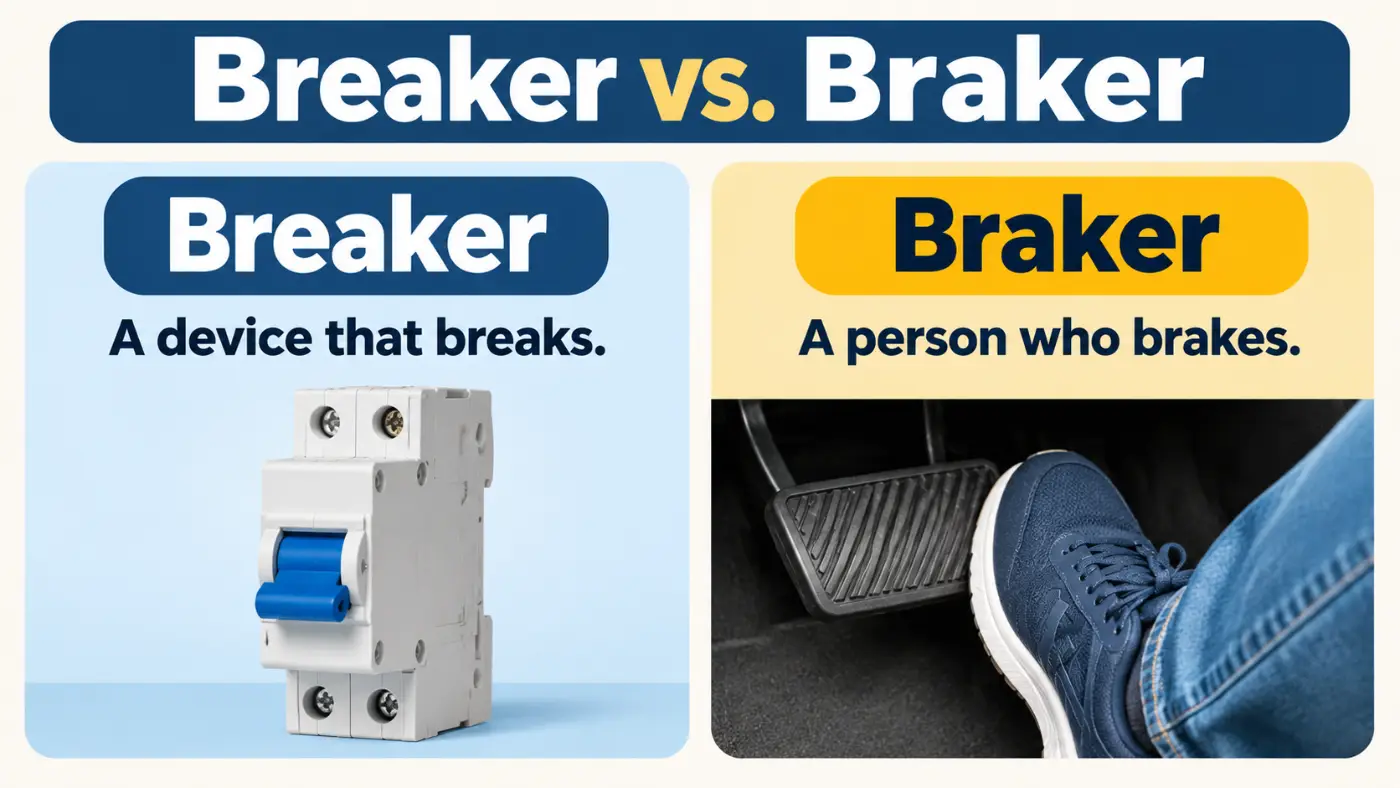
Breaker vs. Braker: Which Spelling Is Correct?
Breaker is the correct spelling in most everyday situations, including circuit breaker, record breaker, and deal-breaker. Braker is a real but rare word in specialized occupational usage, so it is not always meaningless—but it should not replace breaker in common expressions.
The distinction is especially useful when writing about electrical equipment, sports, business decisions, or anything involving the words break and brake. Although breaker and braker sound alike in American English, their spellings and uses are different
Related Post: Smoky or Smokey
Breaker vs. Braker: The Key Difference
| Term | Meaning or status | When to use it | Example |
|---|---|---|---|
| Breaker | Common, standard noun for someone or something that breaks, interrupts, or breaks a wave | Everyday, technical, and figurative contexts | The circuit breaker tripped. |
| Braker | Rare, specialized noun associated with certain machine-operating jobs | Only when the specific occupational meaning is intended | The historical record referred to a braker in a food-production facility. |
The practical rule is simple: use breaker unless you have a specific reason to use the rare word braker.
What Does Breaker Mean?
Breaker is a noun formed from the verb break. It can refer to a person, object, or device that breaks, interrupts, or brings something to an end. It also describes a wave that breaks into foam near the shore.
When to Use Breaker
Use breaker in common expressions such as:
- Circuit breaker: A safety device that interrupts electrical current when a fault occurs.
- Deal-breaker: A condition that makes an agreement or arrangement unacceptable.
- Record breaker: A person or achievement that surpasses a previous record.
- Rule-breaker: Someone who violates a rule.
- Wave breaker: A wave that crests and collapses toward the shore.
Breaker in Example Sentences
1. The electrician checked the circuit breaker after the power went out. Here, breaker refers to the electrical safety device.
2. The unexpected fee was a deal-breaker for the customer. The fee made the proposed agreement unacceptable.
3. She became a record breaker after running the fastest time in the competition. The expression describes someone who surpasses a previous record.
Is Braker a Word?
Yes. Braker is a rare word recorded in specialized occupational usage. One dictionary meaning refers to a worker who operates a machine called a brake to roll or process dough for baked goods or macaroni products.
However, braker is not the standard spelling of breaker. In ordinary writing, phrases such as circuit braker, deal braker, and record braker should be corrected to circuit breaker, deal-breaker, and record breaker.
Braker in Example Sentences
- The historical document identified a worker as a braker in a food-processing operation.
- The technician replaced the faulty circuit breaker in the electrical panel.
The first example illustrates a rare occupational use; the second uses the common word breaker. Do not use braker simply because the subject involves stopping or slowing something.
How to Choose the Right Spelling
Start with the meaning of the word you intend to use:
- If you mean something that breaks or interrupts, write breaker.
- If you mean a device used to slow or stop a vehicle, write brake.
- If you mean the rare occupational term, use braker only when that specific meaning fits.
A Quick Test You Can Apply
Try connecting the word to its base word:
- Break → breaker: The circuit breaker breaks or interrupts the electrical circuit.
- Brake → brake: The driver presses the brake to slow the car.
For everyday expressions, the first pattern is the one to remember. A circuit breaker is not a circuit braker.
When the Quick Test Does Not Work
The test helps with common usage, but it does not cover every specialized occupational term or proper name. If you encounter braker in a historical document or technical source, check the context rather than automatically treating it as a typo.
Common Mistakes and How to Fix Them
| Original sentence | Corrected sentence | Why it changes |
|---|---|---|
| The circuit braker needs replacing. | The circuit breaker needs replacing. | Breaker is the established electrical term. |
| The extra charge was a deal braker. | The extra charge was a deal-breaker. | Deal-breaker is the standard expression. |
| He is a record braker. | He is a record breaker. | The noun comes from break, not brake. |
| She pressed the break to stop the car. | She pressed the brake to stop the car. | Brake refers to the device used to slow or stop a vehicle. |
Why These Forms Get Confused
Break and brake are pronounced alike in standard American English, even though they have different meanings. Adding the ending -er makes breaker and the rare braker sound alike, too. The spelling therefore depends on the intended meaning, not pronunciation alone.
Does the Choice Change With Context?
Workplace, Academic, or Everyday Usage
In emails, reports, school assignments, and technical writing, use breaker for electrical equipment and familiar expressions. Use braker only when you genuinely mean the rare occupational term and the context makes that meaning clear.
There is no standard American-versus-British spelling change that makes braker a normal alternative to breaker in phrases such as circuit breaker.
Can You Use Breaker and Braker Interchangeably?
No, not in ordinary usage. The words are not interchangeable just because they sound alike.
When Switching Changes the Meaning
Compare these sentences:
- The breaker tripped during the storm.
- The driver pressed the brake during the storm.
The first sentence refers to an electrical safety device. The second refers to a vehicle’s stopping mechanism. Writing braker in the first sentence would be a spelling error, while breaker would not be the correct word for the vehicle’s brake pedal.
Common Phrases With Breaker
| Phrase | When to use it | Original example |
|---|---|---|
| Circuit breaker | An electrical safety device | The circuit breaker shut off power after the fault. |
| Deal-breaker | A condition that makes an agreement unacceptable | A lack of flexible hours was a deal-breaker for her. |
| Record breaker | Someone or something that surpasses a record | The athlete became a record breaker at the national meet. |
| Rule-breaker | Someone who violates a rule | The teacher spoke privately with the rule-breaker. |
| Icebreaker | An activity or remark that helps people feel comfortable | The host used a quick question as an icebreaker. |
Apply the Rule to a Real Situation
Original Version
“Please check the circuit braker because the lights went out, and make sure the driver knows where the break pedal is.”
Improved Version and Explanation
“Please check the circuit breaker because the lights went out, and make sure the driver knows where the brake pedal is.”
The revision corrects two different word-choice errors:
- Circuit breaker uses the standard spelling for the electrical device.
- Brake pedal refers to the pedal used to slow or stop a vehicle. Break pedal is incorrect in this context.
An Easy Way to Remember the Difference
Remember this short rule:
Break makes a breaker; brake stops a vehicle.
- The breaker interrupts an electrical circuit.
- The brake slows a car.
- Braker belongs only in rare, specialized contexts where that word is specifically intended.
This distinction will help you choose the correct spelling in nearly all everyday writing.
Frequently Asked Questions
Is breaker or braker correct?
Breaker is correct for most everyday meanings, including electrical devices, breaking waves, and expressions such as deal-breaker. Braker is a rare word with specialized occupational usage.
Is “circuit braker” correct?
No. The standard term is circuit breaker, which refers to a safety device that interrupts electrical current when a fault occurs.
Is braker ever correct in English?
Yes. It appears in specialized occupational usage, including a dictionary sense for a worker who operates a particular dough-processing machine. It is not a general alternative to breaker.
What is the difference between break and brake?
Break can mean to damage, separate, or interrupt something. Brake refers to a device or action used to slow or stop movement. Their derived forms and related phrases must be spelled according to meaning.
Is it “deal breaker” or “deal braker”?
The correct spelling is deal-breaker or deal breaker. The hyphen is a style choice in this expression; deal braker is not the standard spelling.
Which Form Should You Use?
Use breaker for common expressions and electrical equipment, and brake when referring to slowing or stopping a vehicle. Reserve braker for the rare specialized meaning. When in doubt, identify the intended meaning first rather than relying on how the word sounds
Sources