
Laid Out vs. Layed Out: Which Spelling Is Correct?
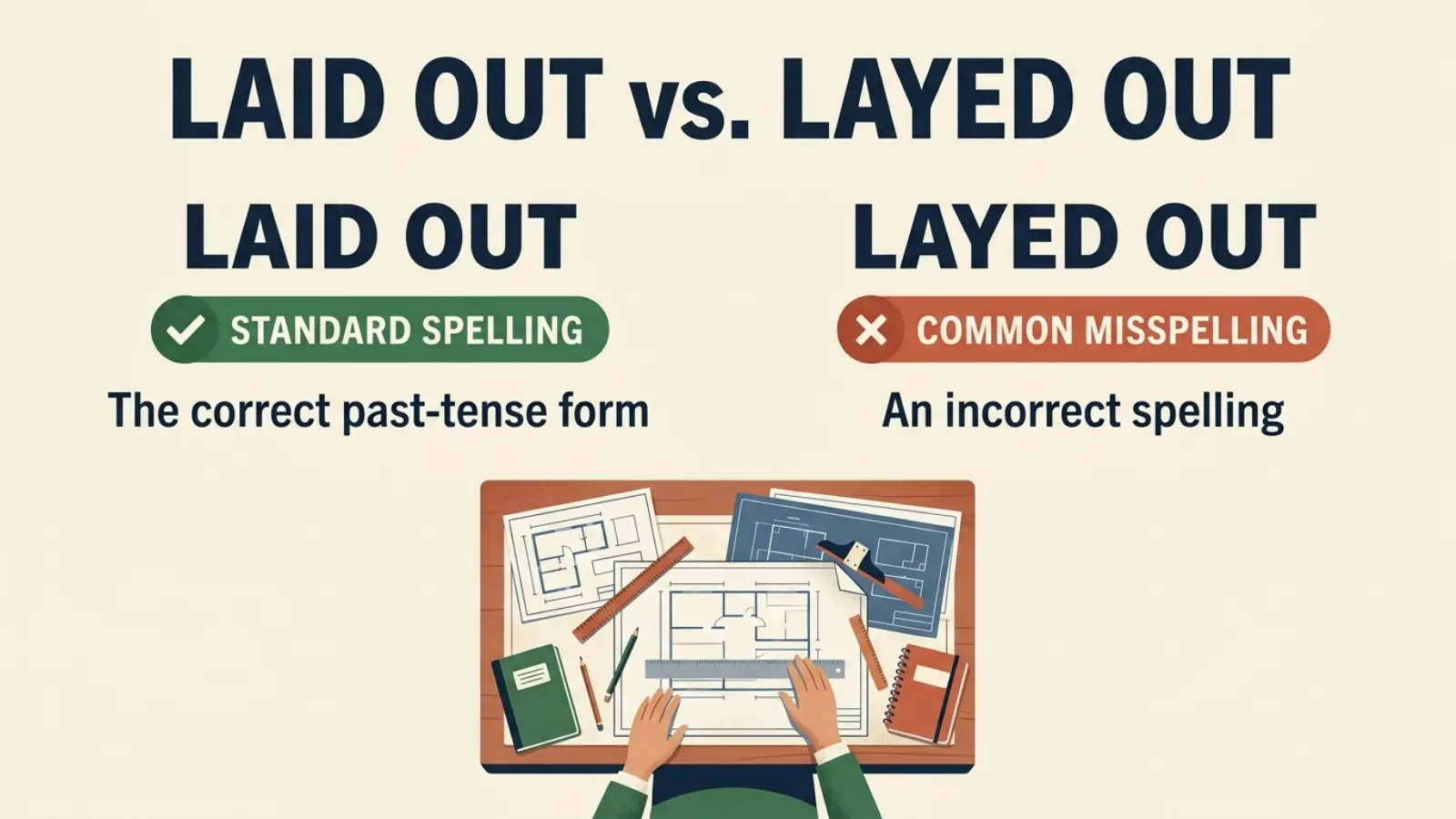
Laid out is the correct spelling in standard English. Layed out is a misspelling when used as the past tense or past participle of lay out. Use laid out when describing something that was arranged, displayed, planned, designed, or explained.
This distinction matters in emails, school assignments, reports, and everyday messages. It also helps to understand the related forms lay out, laying out, and layout, which serve different grammatical purposes.
Related Post:Awhile or a While
Laid Out vs. Layed Out: The Key Difference
| Term | Meaning or status | When to use it | Example |
|---|---|---|---|
| Laid out | Correct past tense and past participle of lay out | Describing something arranged or explained in the past | She laid out the documents. |
| Layed out | Nonstandard misspelling in this context | Avoid it in standard English writing | Incorrect: She layed out the documents. |
| Lay out | Base form of the verb phrase | Giving instructions or describing a present or future action | Please lay out the materials. |
| Laying out | Present participle or gerund form | Describing an ongoing action or activity | He is laying out the design. |
| Layout | Usually a noun meaning the arrangement of elements | Describing the structure of a page, room, or website | The layout looks clean. |
The rule is straightforward: the verb lay changes to laid in the past tense and past participle. Adding out does not change that spelling.
What Does “Laid Out” Mean?
Laid out is the past tense or past participle of the phrasal verb lay out. Its meaning depends on the context, but it commonly describes placing things in an organized way or presenting information clearly.
When to Use “Laid Out”
Use laid out when someone:
- Arranged objects so they could be seen or used.
- Presented a plan, argument, or set of instructions.
- Designed the arrangement of a room, garden, or page.
- Explained the details of a proposal or situation.
- Spread something out for viewing or use.
The phrase can also describe someone being incapacitated by illness or injury, as in “The flu laid him out for a week.” The spelling remains laid out.
“Laid Out” in Example Sentences
- She laid out her clothes before going to bed.
The clothes were placed in advance so they would be ready to use. - The manager laid out the project requirements during the meeting.
Here, the phrase means the manager explained the requirements clearly. - The architect laid out the garden with paths and flower beds.
The sentence describes how the garden was planned and arranged.
Is “Layed Out” a Word?
Layed out is not the standard spelling when you mean that someone arranged, placed, or explained something. The correct form is laid out.
The mistake often happens because many English verbs form their past tense by adding -ed. For example, play becomes played, and stay becomes stayed. However, lay is an irregular verb in this respect: its past tense is laid, not layed.
Compare these examples:
- Incorrect: They layed out the proposal.
- Correct: They laid out the proposal.
- Incorrect: The designer has layed out the page.
- Correct: The designer has laid out the page.
In standard writing, layed out does not provide a separate meaning or an accepted alternative spelling for this verb phrase.
How to Choose the Right Form
Choose the form according to the time and grammatical role of the verb.
| Situation | Correct form | Example |
|---|---|---|
| Base verb or instruction | Lay out | Lay out the papers on the desk. |
| Present-tense action with he, she, or it | Lays out | She lays out the schedule each morning. |
| Completed past action | Laid out | She laid out the schedule yesterday. |
| Action completed before now | Has/have laid out | They have laid out the options. |
| Ongoing action | Laying out | He is laying out the presentation. |
| Noun describing arrangement | Layout | The presentation layout needs revision. |
A Quick Test You Can Apply
Try replacing lay out with put out or arrange to check whether the sentence describes a past action. Then use the correct form of lay.
Worked example
Original: The teacher layed out the instructions before the test.
Corrected: The teacher laid out the instructions before the test.
Why it works: The teacher already explained the instructions, so the sentence needs the past tense of lay out. That form is laid out.
You can also use a simple verb pattern:
- Present: lay
- Past: laid
- Past participle: laid
- -ing form: laying
Therefore, the correct sequence is lay out → laid out → have laid out → laying out.
When the Quick Test Does Not Work
The verb lay is easy to confuse with lie, but the two verbs have different grammatical patterns.
- Lay means to put or place something and normally takes an object: “I laid the book on the desk.”
- Lie means to recline or rest in a horizontal position: “I lay on the sofa yesterday.”
In the second sentence, lay is the past tense of lie. It is not a misspelling of laid. This distinction matters because a sentence about reclining may need lay, while a sentence about placing something needs laid in the past tense.
Common Mistakes and How to Fix Them
| Original sentence | Corrected sentence | Why it changes |
|---|---|---|
| She layed out the papers for the meeting. | She laid out the papers for the meeting. | Laid is the correct past tense of lay. |
| He has layed out his argument clearly. | He has laid out his argument clearly. | The past participle after has is laid. |
| Please laid out the supplies before lunch. | Please lay out the supplies before lunch. | A direct instruction uses the base form lay. |
| The website’s laid out is confusing. | The website’s layout is confusing. | The sentence needs the noun layout, not the verb phrase laid out. |
Why These Forms Get Confused
The main reason is that English uses both regular and irregular past-tense forms. Many verbs take -ed, so layed may look reasonable at first glance. However, lay follows an irregular pattern: lay, laid, laid.
Another source of confusion is the similar-looking noun layout. Although layout and laid out are related in meaning, they have different grammatical functions. One names an arrangement; the other describes an action or its result.
Does the Choice Change With Context?
American vs. British English
There is no meaningful American-versus-British spelling difference here. Laid out is the standard form in both varieties of English. Writers should not use layed out simply because they are writing for a particular English-speaking region.
Formal Writing vs. Casual Conversation
Use laid out in professional emails, academic work, reports, social media posts, and casual messages. Although layed out may appear in informal writing, it remains nonstandard for the intended verb form.
The phrase laid out itself is neutral. It can describe physical arrangements, plans, explanations, or designs in both casual and formal contexts.
Can You Use “Laid Out” and “Layed Out” Interchangeably?
No. In standard English, laid out is the correct choice when you mean the past tense or past participle of lay out. Layed out is not an accepted alternative spelling for that meaning.
When Switching Changes the Meaning
Compare these sentences:
- I laid out the blanket. I spread or arranged the blanket.
- I lay on the blanket. I reclined on top of the blanket.
The first sentence uses the past tense of lay, meaning to place something. The second uses the past tense of lie, meaning to recline. The distinction is grammatical, not merely a spelling preference.
Common Phrases With “Laid Out”
| Phrase | When to use it | Original example |
|---|---|---|
| Laid out a plan | When someone presented or organized a plan | The director laid out a plan for the next quarter. |
| Laid out the facts | When information was presented clearly | The report laid out the facts in chronological order. |
| Laid out the options | When available choices were explained | The adviser laid out the options before the decision. |
| Laid out the design | When the arrangement of a space or visual project was planned | The designer laid out the new office floor plan. |
| Laid out the rules | When expectations or requirements were explained | The coach laid out the rules before practice. |
What Is the Difference Between “Laid Out” and “Layout”?
Laid out is a verb phrase, while layout is usually a noun.
- Verb phrase: The designer laid out the page.
- Noun: The page layout looks balanced.
Use laid out to describe what someone did or how something was arranged. Use layout to name the arrangement itself.
A useful check is to ask whether the sentence describes an action or names a thing. If it describes the action of arranging, laid out may fit. If it names the design or arrangement, layout is usually the right choice.
An Easy Way to Remember the Difference
Remember this pair:
Pay becomes paid; lay becomes laid.
You would normally write “I paid the bill,” not “I payed the bill.” Apply the same pattern to lay: “I laid out the documents,” not “I layed out the documents.”
This memory aid works for the standard past tense and past participle of lay. It does not mean that every verb ending in -ay changes to -aid; for example, play becomes played.
Frequently Asked Questions
Is “layed out” ever correct?
Not as the standard past tense or past participle of lay out. Use laid out in ordinary English writing. A deliberate spelling in a name, title, or creative work is a separate case, not a standard verb form.
What is the past tense of “lay out”?
The past tense is laid out. For example, “They laid out the materials before the workshop began.”
Is it “has laid out” or “has layed out”?
Use has laid out. After has or have, the past participle of lay is laid.
Is “laid out” the same as “layout”?
No. Laid out is a verb phrase, while layout is usually a noun. For example, “She laid out the page” describes an action, while “She revised the page layout” names the arrangement.
Does “laid out” always mean arranged?
No. Depending on context, it can mean arranged, explained, designed, or spread out. Informally, it can also mean that someone was left unable to function normally because of illness or injury.
Which Form Should You Use?
Choose laid out, not layed out, when writing about something that was arranged, presented, planned, or explained. Use lay out for the base verb, laying out for an ongoing action, and layout when you need a noun.
The key rule is simple: lay → laid → laid. Following this pattern will help you use the phrase correctly in both everyday and professional writing.
Sources
- Cambridge Dictionary — “Lay or lie?”
https://dictionary.cambridge.org/us/grammar/british-grammar/lay-or-lie - Merriam-Webster Dictionary — “Lay”
https://www.merriam-webster.com/dictionary/lay







One Comment