Smoky or Smokey: Which Spelling Should You Use?
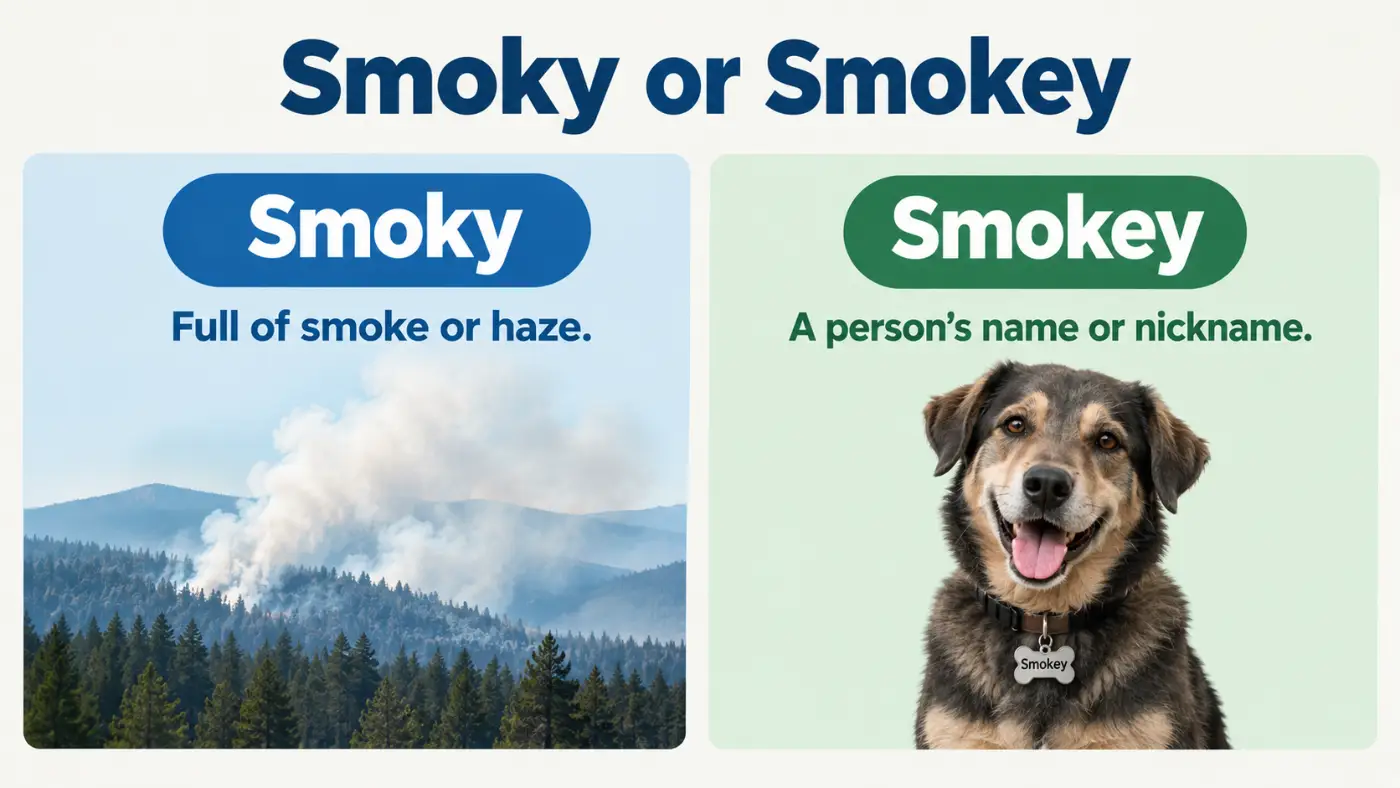
Smoky is the preferred spelling in standard American English when describing something filled with smoke, resembling smoke, or having a smoky taste or smell. Smokey is also an accepted spelling variant, so it is not always incorrect. It also appears in proper names, such as Smokey Bear.
The difference matters most in polished writing, food descriptions, and references to smoke or color. For everyday American English, choose smoky unless you are using an established name, brand, or a specific spelling that needs to be preserved.
Related Post: Laid Out vs. Layed Out
Smoky vs. Smokey: The Key Difference
| Term | Meaning or status | When to use it | Example |
|---|---|---|---|
| Smoky | Standard, preferred adjective spelling | General writing about smoke, flavor, smell, or appearance | The ribs have a smoky flavor. |
| Smokey | Accepted variant spelling; also used in proper names | When a name or chosen spelling specifically uses it | We visited Smokey Bear’s exhibit. |
Both spellings are recognized as adjective forms by major dictionaries. However, smoky is the safer default for general American English
What Does Smoky Mean?
Smoky is an adjective describing something that contains smoke, produces smoke, resembles smoke, or has a taste or smell associated with smoke. It can also describe a grayish, hazy, or muted appearance.
When to Use Smoky
Use smoky when describing:
- Air or places: a smoky room, a smoky kitchen.
- Food and drinks: smoky barbecue, smoky cheese, a smoky flavor.
- Colors and appearance: smoky gray, smoky glass, a smoky blue shade.
- Smells: a smoky odor after a fire.
Smoky in Example Sentences
1. The restaurant became smoky when the grill started producing too much smoke. Here, smoky describes the air inside the restaurant.
2. The chef added paprika to give the sauce a smoky flavor. The adjective describes a taste reminiscent of smoke or smoked food.
3. She chose smoky gray curtains for the living room. Smoky describes a soft, muted gray color.
What Does Smokey Mean?
Smokey is a recognized variant spelling of the adjective smoky. It can carry the same meaning, but it is less conventional as the default spelling in general American writing.
It is also used in proper names. For example, Smokey Bear is the familiar name of the fire-prevention mascot. When writing a name, follow its established spelling rather than changing it to the more common adjective form.
When to Use Smokey
Use smokey when:
- It is part of a person’s nickname, a character’s name, or another proper name.
- A business, product, or brand deliberately uses that spelling.
- You are following a source that uses smokey as an accepted adjective variant.
Smokey in Example Sentences
1. Smokey Bear appears in public-service messages about preventing wildfires. Smokey is part of the mascot’s name.
2. The menu described the sauce as smokey, using the restaurant’s chosen spelling. The spelling is a stylistic choice; smoky would be the more conventional option in standard prose.
3. The brand’s Smokey seasoning blend has a bold barbecue taste. The capitalized spelling is appropriate if that is the product’s official name.
How to Choose the Right Spelling
The simplest rule is to use smoky in ordinary writing and Smokey when that spelling belongs to a name or is intentionally used by a brand.
A Quick Test You Can Apply
Ask yourself: Am I describing smoke, flavor, smell, or color, or am I writing a specific name?
- If you are describing something, use smoky by default.
- If you are writing an official name such as Smokey Bear, preserve the spelling.
- If a brand uses smokey, follow its official spelling when referring to that brand or product.
When the Quick Test Does Not Work
Because smokey is also recognized as an adjective variant, it is not always a spelling error. You may encounter it in published writing, menus, product names, and informal descriptions. For formal or edited American English, consistency and the standard spelling smoky are usually the clearest choices.
Common Mistakes and How to Fix Them
| Original sentence | Preferred version | Why it changes |
|---|---|---|
| The chicken has a smokey flavor. | The chicken has a smoky flavor. | Smoky is the conventional spelling for a food description. |
| Smoke filled the smokey room. | Smoke filled the smoky room. | Smoky is preferred in standard descriptive writing. |
| We saw Smoky Bear at the event. | We saw Smokey Bear at the event. | The mascot’s name is spelled Smokey Bear. |
| She bought a smokey-gray scarf. | She bought a smoky-gray scarf. | Smoky is the preferred spelling in this color description. |
The first, second, and fourth examples show a preference for standard spelling, not an absolute rule that smokey can never be used as an adjective.
Why These Forms Get Confused
The two spellings are pronounced the same way in ordinary English. They also share the same basic meaning when used as adjectives, and dictionaries recognize smokey as a variant of smoky. Because the difference is mainly visual rather than grammatical, writers may not notice when they switch between the forms.
Does the Choice Change With Context?
American English and Formal Writing
For US readers, smoky is the best general-purpose choice in articles, school assignments, professional documents, recipes, and edited copy. Although smokey is an accepted variant, using smoky consistently helps keep your writing conventional.
Names, Brands, and Informal Usage
Proper names and brand names can preserve Smokey even when ordinary descriptions use smoky. Do not automatically change a name’s spelling to match the adjective preferred in standard prose.
Can You Use Smoky and Smokey Interchangeably?
Sometimes. When both words are used as adjectives, they can convey the same meaning. The main difference is spelling preference rather than meaning.
When Both Forms Work
Both forms can describe food, a smell, a room, or a color:
- The kitchen has a smoky smell.
- The kitchen has a smokey smell.
Both are understandable, but the first is the recommended choice for standard American writing.
When Switching Changes the Meaning or Accuracy
Compare these examples:
- The barbecue has a smoky flavor.
- The Smokey Bear poster explains wildfire prevention.
In the first sentence, smoky describes flavor. In the second, Smokey is part of a proper name. Changing the poster’s name to Smoky Bear would make the name incorrect.
Common Phrases With Smoky or Smokey
| Phrase | When to use it | Original example |
|---|---|---|
| Smoky flavor | Describing food or drinks | The grilled mushrooms developed a rich smoky flavor. |
| Smoky smell | Describing an odor associated with smoke | A smoky smell lingered after the fireplace cooled. |
| Smoky room | Describing a room filled with smoke | We opened the windows to clear the smoky room. |
| Smoky gray | Describing a muted gray color | The designer paired smoky gray walls with white trim. |
| Smokey Bear | Referring to the wildfire-prevention mascot | The children recognized Smokey Bear from the poster. |
Apply the Rule to a Real Situation
Imagine you are writing a restaurant review and want to describe a dish.
Original Version
“The brisket had a deep smokey flavor, and the dining room smelled smokey after dinner.”
Improved Version and Explanation
“The brisket had a deep smoky flavor, and the dining room smelled smoky after dinner.”
Both changes use the conventional spelling for general descriptions. The meaning stays the same, but the revised version is more suitable for edited American English.
Is Smokey Bear Spelled With an “E”?
Yes. The official name is Smokey Bear, with an e at the end of Smokey. This is a proper name, so its spelling should be preserved even though smoky is the preferred spelling for the ordinary adjective.
How Do You Spell the Comparative and Superlative Forms?
The standard forms are smokier and smokiest.
- Smoky: The kitchen is smoky.
- Smokier: This room is smokier than the living room.
- Smokiest: That was the smokiest barbecue restaurant we visited.
These are the usual comparative and superlative forms in standard writing. You generally do not need to write smokeyer or smokeyest.
An Easy Way to Remember the Difference
Remember this simple rule:
Smoke is the noun; smoky is the usual descriptive form. Smokey with an “e” often signals a name or an accepted spelling variant.
For example:
- A smoky barbecue describes the food or atmosphere.
- Smokey Bear identifies a specific mascot.
This memory aid is a practical writing preference, not a claim that the adjective smokey is always wrong.
Frequently Asked Questions
Is smoky or smokey correct in American English?
Both are recognized as adjective spellings, but smoky is the preferred default for standard American English. Use smokey when it is part of a proper name or when a specific brand or style uses it.
Is smokey a misspelling?
Not necessarily. Dictionaries recognize smokey as a variant of smoky. However, smoky is the more conventional spelling for general descriptive writing.
Is it smoky flavor or smokey flavor?
Smoky flavor is the preferred form in standard American English. Smokey flavor is understandable and appears in some usage, but smoky is the safer editorial choice.
Is Smokey Bear or Smoky Bear correct?
Smokey Bear is the correct name of the wildfire-prevention mascot. Keep the official spelling when referring to the mascot.
What are the correct forms: smokier or smokiest?
Use smokier for comparisons and smokiest for the highest degree. For example, “This cheese is smokier than the other one” and “That was the smokiest dish on the menu.”
Which Form Should You Use?
For most American English writing, choose smoky when describing smoke, food, smells, or colors. Use smokey when it is the established spelling of a name, brand, or other specific label. Both adjective spellings are recognized, but smoky is the clearest default for everyday and professional writing.
Sources