Per Se vs Per Say: Learn the Correct Spelling and Meaning
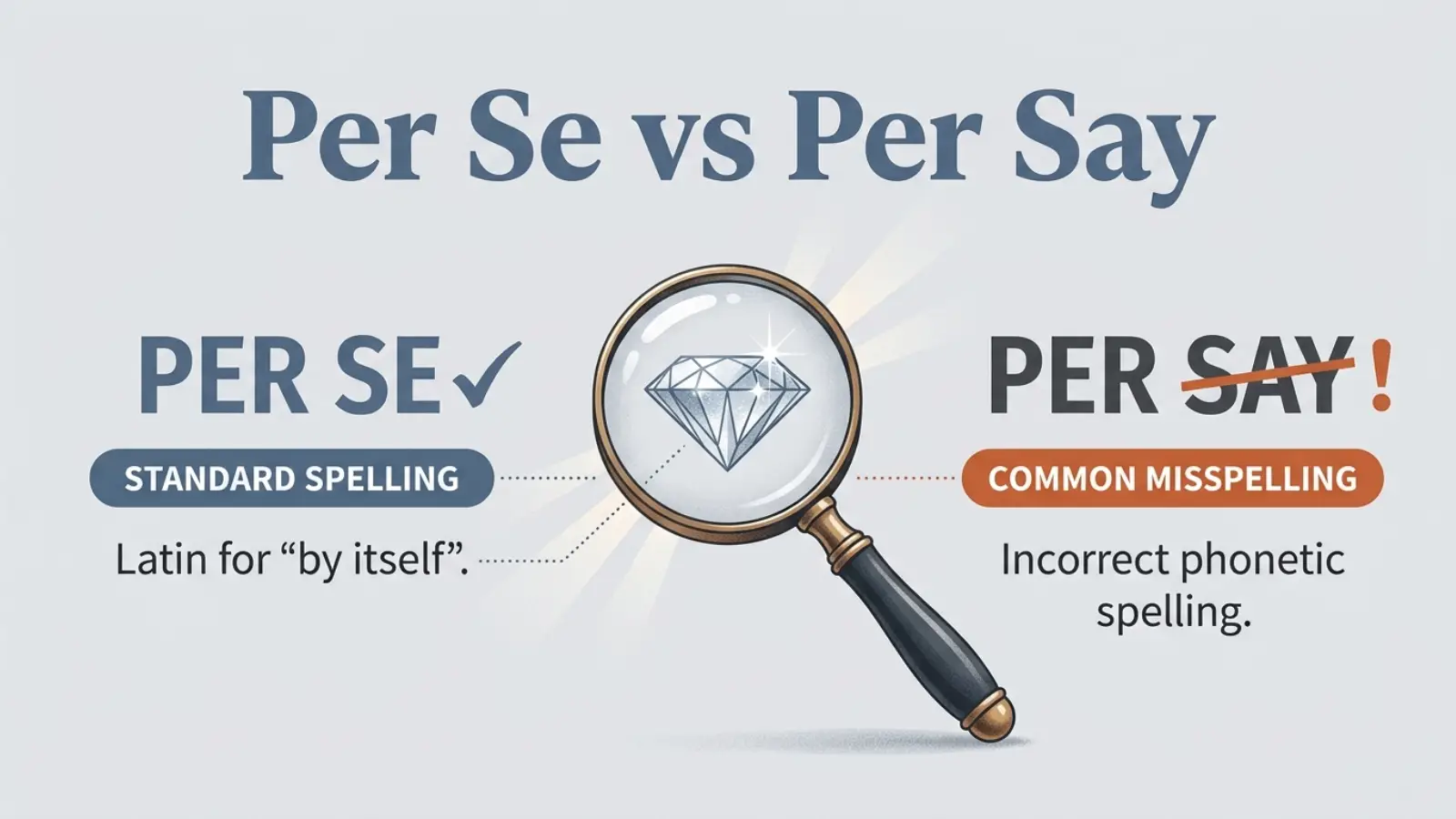
Per se is the correct expression when you mean “in itself,” “by itself,” or “considered on its own.” Per say is a common misspelling of this phrase, usually caused by its pronunciation.
Knowing the difference helps you write more accurately in emails, essays, workplace documents, and formal writing. Although the two forms sound alike, only per se is the standard spelling for this meaning.
Related Post: Roll Call vs Role Call
Per Se vs Per Say: The Key Difference
| Term | Meaning or status | When to use it | Example |
|---|---|---|---|
| Per se | A Latin expression meaning “in itself” or “by itself” | When considering something on its own, apart from other factors | The plan isn’t unreasonable per se. |
| Per say | A common misspelling of per se | Do not use it when you mean “in itself” | Incorrect: The plan isn’t unreasonable per say. |
The rule is simple: Write per se, not per say, when you mean “in itself” or “as such.”
What Does Per Se Mean?
Per se is a Latin expression used in English to mean “by or of itself.” It helps clarify that a statement applies to something considered on its own, rather than to its surrounding circumstances or related effects.
For example, if someone says, “The job isn’t difficult per se, but the schedule is demanding,” they mean that the work itself is not necessarily difficult. The demanding schedule is a separate issue.
The expression is often used in formal or academic writing, but it also appears in everyday conversation.
When to Use Per Se
Use per se when you want to distinguish something itself from other aspects of a situation.
Common patterns include:
- Not [something] per se: The issue is not the thing itself.
- [Something] per se is not the problem: The thing itself is not the problem.
- Not necessarily [something] per se: The description may not apply to the thing in its own right.
The phrase is most useful when you need to make a distinction or qualify a statement. If a simpler phrase such as in itself or by itself communicates your meaning just as well, you can use that instead.
Per Se in Example Sentences
1. The software isn’t complicated per se, but the instructions are confusing. The software itself is not necessarily complicated; the instructions create the difficulty.
2. I’m not against the proposal per se; I just want to review the details. The speaker is not opposed to the proposal in principle, although they have concerns about its specifics.
3. The price per se wasn’t the problem. The price itself was not the main issue; another factor caused the concern.
Is Per Say a Word?
Per say is listed by some dictionaries as a frequent misspelling of per se, but it is not the standard spelling of the expression meaning “in itself.” It should not be treated as an accepted alternative in edited American English.
The confusion comes from pronunciation: per se is commonly pronounced approximately “per SAY.” Someone who has heard the phrase but has not seen it written may spell it as two familiar English words.
Here are the corrections:
- Incorrect: The decision wasn’t unfair per say.
- Correct: The decision wasn’t unfair per se.
- Incorrect: I’m not opposed to the idea per say.
- Correct: I’m not opposed to the idea per se.
The correction is a spelling change, not a change in the sentence’s intended meaning.
How to Choose the Right Spelling
Use per se when you mean “in itself,” “by itself,” or “considered on its own.” Do not spell the expression per say just because it sounds that way.
A Quick Test You Can Apply
Try replacing per se with in itself. If the sentence keeps its intended meaning, per se is likely the right expression.
- “The policy isn’t unfair per se.”
- “The policy isn’t unfair in itself.”
Both sentences suggest that the policy itself is not inherently unfair, even if there may be concerns about how it is applied.
When the Quick Test Does Not Work
The substitution is a helpful guide, not a rule for every sentence. Per se can sometimes mean “as such” or “in that particular respect,” so a replacement such as in itself may sound less natural. Focus on the intended meaning rather than forcing an exact word-for-word substitution.
Common Mistakes and How to Fix Them
| Original sentence | Corrected sentence | Why it changes |
|---|---|---|
| The movie wasn’t bad per say. | The movie wasn’t bad per se. | Per se is the standard spelling. |
| I’m not against exercise per say, but I dislike gyms. | I’m not against exercise per se, but I dislike gyms. | The speaker distinguishes exercise itself from the setting. |
| The rule is not a problem per say. | The rule is not a problem per se. | The phrase means the rule itself is not necessarily the problem. |
| The app is easy per se, but the setup is confusing. | The app isn’t difficult per se, but the setup is confusing. | The correction fixes the spelling and makes the intended contrast clearer. |
In the final example, changing is easy to isn’t difficult is an optional clarity edit, not a spelling requirement. The essential spelling correction is per say to per se.
Why These Forms Get Confused
The main reason is pronunciation. In American English, per se is commonly pronounced “per SAY,” making the final word sound like the ordinary English word say.
Writers may therefore spell the phrase phonetically, especially if they have heard it in conversation more often than they have read it. However, its established spelling comes from Latin, so the final word remains se.
Does the Choice Change With Context?
The spelling does not change between casual and formal American English: per se remains the standard form. What changes is whether the expression is useful for the audience and purpose.
Formal Writing vs. Casual Conversation
In academic, legal, and professional writing, per se can express a precise distinction. In casual messages, it may sound unnecessarily formal if a simpler phrase works.
For example:
- More formal: “The proposal is not unreasonable per se.”
- More conversational: “The proposal isn’t unreasonable in itself.”
Both are understandable. Choose the wording that fits your audience, and avoid using per se merely to make a sentence sound sophisticated.
Can You Use Per Se and Per Say Interchangeably?
No. When the intended meaning is “in itself” or “as such,” per se is the standard expression and per say is a misspelling.
For example:
- Correct: “The fee isn’t excessive per se; the problem is the additional charges.”
- Incorrect: “The fee isn’t excessive per say; the problem is the additional charges.”
The intended meaning remains understandable in the second sentence, but the spelling is not standard.
Common Phrases With Per Se
| Phrase | When to use it | Original example |
|---|---|---|
| Not bad per se | Something is not inherently bad, though it may have drawbacks | The suggestion isn’t bad per se, but it needs more detail. |
| Not a problem per se | The thing itself is not the main issue | The deadline isn’t a problem per se; the lack of resources is. |
| Not opposed per se | Someone does not reject something in principle | I’m not opposed per se, but I’d like to discuss the timing. |
| Per se is not the issue | To emphasize that another factor matters more | The expense per se is not the issue; transparency is. |
These are useful sentence patterns rather than fixed idioms. Adapt them to the point you want to make, and use the expression only when the distinction matters.
Apply the Rule to a Real Situation
Original Version
Hi Jordan, The new schedule isn’t a problem per say, but the short notice makes it difficult to arrange childcare. Could we discuss the timing? Thanks!
Improved Version and Explanation
Hi Jordan, The new schedule isn’t a problem per se, but the short notice makes it difficult to arrange childcare. Could we discuss the timing? Thanks!
The necessary correction is per say to per se. The rest of the message already communicates the distinction clearly: the schedule itself is acceptable, but the short notice creates a separate problem.
Is Per Se Written as One Word or Two?
Write per se as two separate words. Do not combine it into perse or replace the second word with say when using the Latin expression.
- Correct: The change isn’t harmful per se.
- Incorrect: The change isn’t harmful perse.
- Incorrect: The change isn’t harmful per say.
Perse does appear in English in other contexts, such as the name of a color in some dictionaries, but it is not the standard spelling of this expression.
An Easy Way to Remember the Difference
Remember: Per se means “in itself”; per say is spelled the way it sounds.
When writing the expression, think of the meaning first:
- If you mean “in itself,” write per se.
- If you mean the ordinary verb say, use say in a sentence where it actually means to speak or state something.
For example, “The idea isn’t wrong per se” means the idea is not wrong in itself. The word say has no role in that meaning.
Practice: Can You Choose the Right Form?
Complete each sentence with per se or per say.
- The restaurant isn’t expensive ______, but the drinks cost a lot.
- I’m not against the change ______; I just need more information.
- The decision wasn’t unfair per ______.
Answers and Explanations
- Per se — The sentence distinguishes the restaurant’s general price level from the cost of drinks.
- Per se — The speaker is not opposed to the change in itself.
- Se — The complete expression is per se, not per say.
Frequently Asked Questions
Is per say ever correct?
Not as the standard spelling of the expression meaning “in itself.” Dictionaries may list per say to identify it as a common misspelling, but that does not make it an accepted spelling variant.
What does per se mean in simple words?
It means “in itself” or “by itself.” It helps you discuss something on its own rather than focusing on related circumstances.
How do you pronounce per se?
In American English, it is commonly pronounced approximately “per SAY.” That pronunciation explains why people sometimes write the incorrect form per say.
Is per se too formal for everyday conversation?
Not necessarily. People use it in everyday speech, but it can sound formal or slightly technical. In casual writing, in itself or by itself may be more natural.
Should per se be italicized?
For ordinary American English writing, italicization is not usually necessary for a familiar expression such as per se. Follow the relevant style guide if you are writing for an academic publication, legal document, or organization with specific formatting rules.
Which Form Should You Use?
Use per se when you mean “in itself,” “by itself,” or “as such.” Avoid per say when writing this expression, even in casual messages.
If you’re unsure, substitute in itself and check whether the sentence still makes sense. The spelling stays per se, regardless of whether the writing is formal or conversational.
Sources