Loose vs. Lose: How to Choose the Right Word
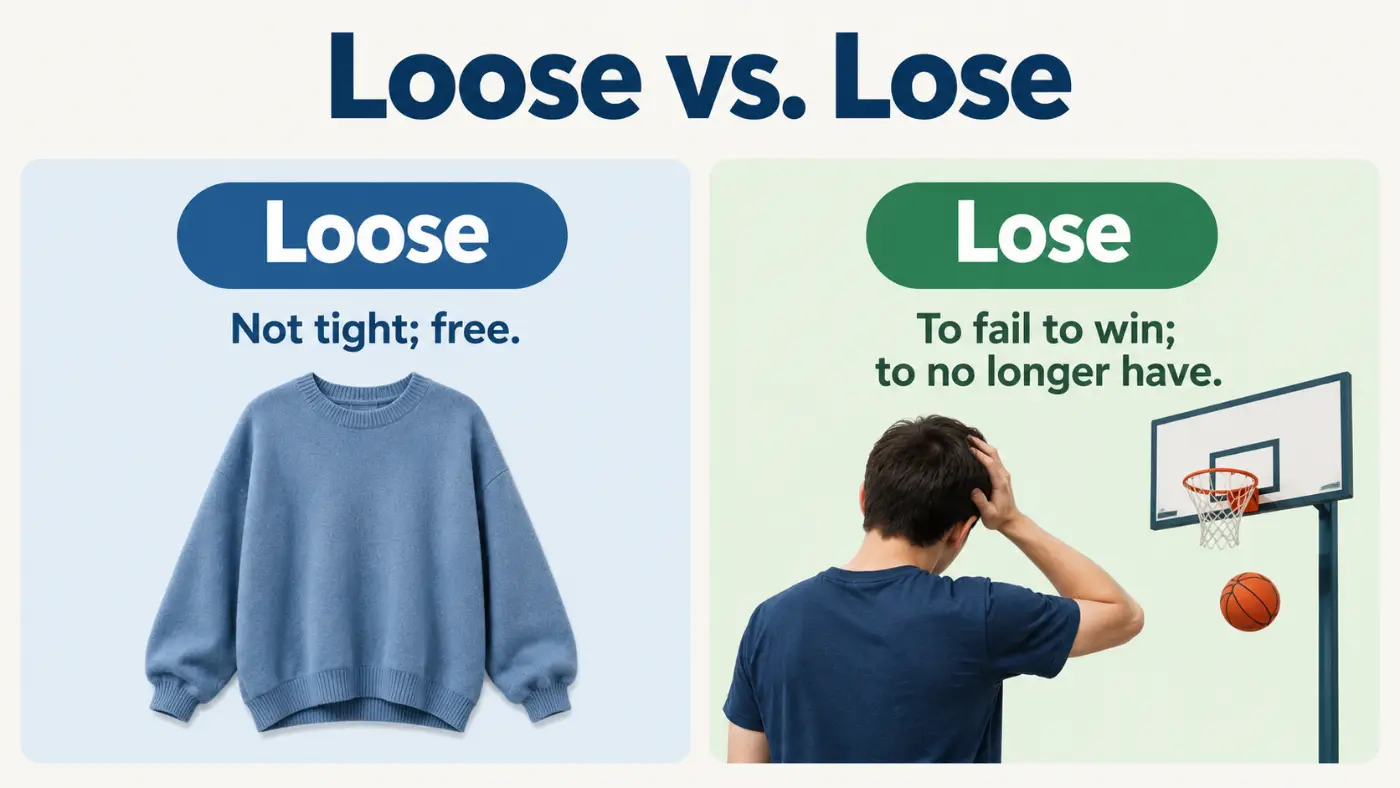
Loose and lose are both correct English words, but they have different meanings and grammatical uses. Loose usually describes something that is not tight, firmly attached, or restrained. Lose is a verb meaning to misplace something, fail to win, or no longer have something.
The distinction matters in emails, school assignments, work documents, and everyday messages. Writing “I don’t want to loose my keys,” for example, is a spelling mistake because the sentence needs the verb lose.
Related Post: Breaker vs. Braker
Loose vs. Lose: The Key Difference
| Term | Meaning or status | When to use it | Example |
|---|---|---|---|
| Loose | Usually an adjective meaning not tight, attached, or restrained | Describing clothing, objects, hair, or something not firmly secured | My jacket is too loose. |
| Lose | A verb meaning to misplace, no longer have, or fail to win | Describing losing an object, competition, opportunity, or possession | I don’t want to lose my jacket. |
The easiest distinction is that loose describes a condition, while lose describes an action or change. This is a useful guideline, although loose can also function as a verb meaning to release or make less tight.
What Does Loose Mean?
Loose is usually an adjective describing something that is not tight, firmly attached, or held in place. It can also describe something relaxed, approximate, or not strictly controlled.
When to Use Loose
Use loose when describing:
- Clothing that does not fit tightly: loose jeans, a loose shirt.
- Objects that are not securely attached: a loose screw, a loose button.
- Something free from restraint: a dog running loose.
- An approximate connection or interpretation: a loose translation or a loose interpretation of a rule.
Although it is most often an adjective in everyday use, loose can also be a verb meaning to release something or make it less tight.
Loose in Example Sentences
1. The tailor adjusted my loose trousers so they would fit better.
Here, loose describes how the trousers fit.
2. A loose wire was hanging behind the desk.
The wire was not securely attached.
3. The movie is a loose adaptation of the original novel.
In this sentence, loose means the movie does not follow the source material exactly.
What Does Lose Mean?
Lose is a verb with several common meanings. It can mean to misplace something, stop having something, fail to win, or have less of something than before.
Its past tense and past participle are both lost, not loosed when the intended meaning is losing something.
When to Use Lose
Use lose when talking about:
- Misplacing something: lose your phone, lose your keys.
- Failing to win: lose a game, lose a competition.
- No longer having something: lose a job, lose an opportunity.
- Having less of something: lose weight, lose money.
- No longer experiencing a feeling or ability: lose confidence, lose patience.
Lose in Example Sentences
1. I always worry that I will lose my keys when I travel.
Lose describes the possibility of misplacing the keys.
2. Our team might lose the final if we do not improve our defense.
Here, lose means fail to win.
3. She began to lose confidence after several unsuccessful interviews.
In this example, she gradually had less confidence.
How to Choose the Right Word
The most reliable way to choose between loose and lose is to identify what the sentence means.
- If you are describing something that is not tight or secure, use loose.
- If you are describing the act of misplacing, losing possession of, or failing to win something, use lose.
A Quick Test You Can Apply
Try replacing the word with a simpler expression.
Test 1: Does “not tight” fit?
Example: These shoes are too loose.
Correct: The shoes are not tight enough.
Test 2: Does “misplace” or “fail to win” fit?
Example: I don’t want to lose my wallet.
Correct: I don’t want to misplace my wallet.
Test 3: Check the verb tense
Example: I lost my wallet yesterday.
Correct: Lost is the past tense of lose.
When the Quick Test Does Not Work
The substitution test is a memory aid, not a rule that covers every meaning. Loose can also be a verb, as in “The guard loosed the dogs,” meaning the guard released them. In that less common usage, the past tense is loosed.
For ordinary writing, however, the distinction between loose and lose is usually straightforward.
Common Mistakes and How to Fix Them
| Original sentence | Corrected sentence | Why it changes |
|---|---|---|
| I don’t want to loose my phone. | I don’t want to lose my phone. | The sentence needs the verb meaning to misplace. |
| This shirt is too lose. | This shirt is too loose. | The sentence describes how the shirt fits. |
| We might loose the game. | We might lose the game. | The intended meaning is to fail to win. |
| I loosed my keys yesterday. | I lost my keys yesterday. | Lost is the past tense of lose when referring to misplacing keys. |
These are spelling or word-choice errors, not differences in writing style. The correction depends on the intended meaning.
Why These Forms Get Confused
Loose and lose look almost identical, and both contain the letters l, o, and s. Their pronunciation is also similar, but the final sound differs:
- Loose rhymes with goose and ends with an /s/ sound.
- Lose rhymes with choose and ends with a /z/ sound.
The shared spelling pattern and similar pronunciation likely contribute to the confusion. Paying attention to the final sound can help, especially when proofreading.
Does the Choice Change With Context?
The meanings of loose and lose remain distinct in American English. The main difference is grammatical: loose commonly describes something, while lose expresses an action or change.
In formal writing, casual messages, academic work, and workplace communication, the same basic distinction applies. Neither spelling is a regional alternative to the other.
Can You Use Loose and Lose Interchangeably?
No. Loose and lose are not interchangeable when you want to preserve the intended meaning.
Compare these sentences:
- The lid is loose. The lid is not secured tightly.
- I might lose the lid. I might misplace it or no longer have it.
Changing one word to the other changes the meaning or creates a spelling error.
There is a legitimate verb use of loose, but it means to release or make less tight, not to misplace something or fail to win.
Common Phrases With Loose and Lose
| Phrase | When to use it | Original example |
|---|---|---|
| Loose change | Small coins carried or kept together | I found some loose change in my coat pocket. |
| Loose ends | Unfinished details that need attention | We need to tie up a few loose ends before the project closes. |
| On the loose | Free and not under control or confinement | The escaped dog was still on the loose. |
| Lose track of | Stop knowing where something is or how something is progressing | I lost track of time while reading. |
| Lose your temper | Become angry and stop controlling your emotions | Try not to lose your temper during the discussion. |
These expressions illustrate the different roles of the two words: loose describes a state or condition, while lose appears in expressions about losing awareness, control, or possession.
Apply the Rule to a Real Situation
Imagine you are writing a message to a coworker about a set of office keys.
Original Version
Hi, I think I might loose the office keys because the key ring is lose. I’ll check my desk again.
Improved Version and Explanation
Hi, I think I might lose the office keys because the key ring is loose. I’ll check my desk again.
Two words need correcting:
- Loose → lose: You might misplace the keys, so you need the verb lose.
- Lose → loose: The key ring is not securely fastened, so you need the adjective loose.
The rest of the message is grammatically acceptable. No additional changes are necessary.
What Is the Past Tense of Lose?
The past tense of lose is lost. The past participle is also lost, and the present participle is losing.
| Form | Example |
|---|---|
| Base form | I might lose my wallet. |
| Third-person singular | She sometimes loses her keys. |
| Past tense | He lost his phone yesterday. |
| Past participle | I have lost my receipt. |
| Present participle | They are losing valuable time. |
Do not confuse lost with loosed. Lost is the form of lose used when something is misplaced or no longer possessed. Loosed is a form of the less common verb loose, meaning released or made less tight.
An Easy Way to Remember the Difference
Remember this sentence:
“You could lose your loose shoes.”
- Lose means you might misplace the shoes.
- Loose describes shoes that do not fit tightly.
You can also remember the final sounds: loose ends like goose, while lose ends like choose.
This mnemonic helps with the common spelling distinction, but always consider the meaning of the whole sentence.
Practice: Can You Choose the Right Form?
Fill in each blank with loose or lose.
- I don’t want to ______ my place in line.
- These pants are too ______ around the waist.
- If we don’t hurry, we’ll ______ our chance to see the show.
Answers and Explanations
- Lose — You might no longer have your place in line.
- Loose — The pants do not fit tightly around the waist.
- Lose — You might miss or no longer have the opportunity to see the show.
Frequently Asked Questions
Is loose or lose correct?
Both words are correct, but they have different meanings. Use loose to describe something that is not tight or secure, and lose for misplacing something, failing to win, or no longer having something.
Is it lose weight or loose weight?
The correct expression is lose weight. Lose is the verb describing a reduction in weight. Loose weight is incorrect for this meaning.
Is it loose or lose your mind?
The correct expression is lose your mind. It is an idiom that can mean becoming extremely upset, acting irrationally, or becoming unable to think clearly, depending on the context.
Is it loose or lose a game?
The correct expression is lose a game. The verb lose means to fail to win. Loose a game is incorrect when that is the intended meaning.
How do you pronounce loose and lose?
Loose ends with an unvoiced /s/ sound, like goose. Lose ends with a voiced /z/ sound, like choose. Listening for that final sound can help you remember which word to use.
Which Form Should You Use?
Use loose when describing something that is not tight, securely attached, or restrained. Use lose when talking about misplacing something, failing to win, or no longer having something.
When in doubt, ask yourself: Am I describing something, or am I talking about losing something? That quick check will help you choose the right word in most everyday situations.
Sources