
Worse Case or Worst Case: Which Is Correct?
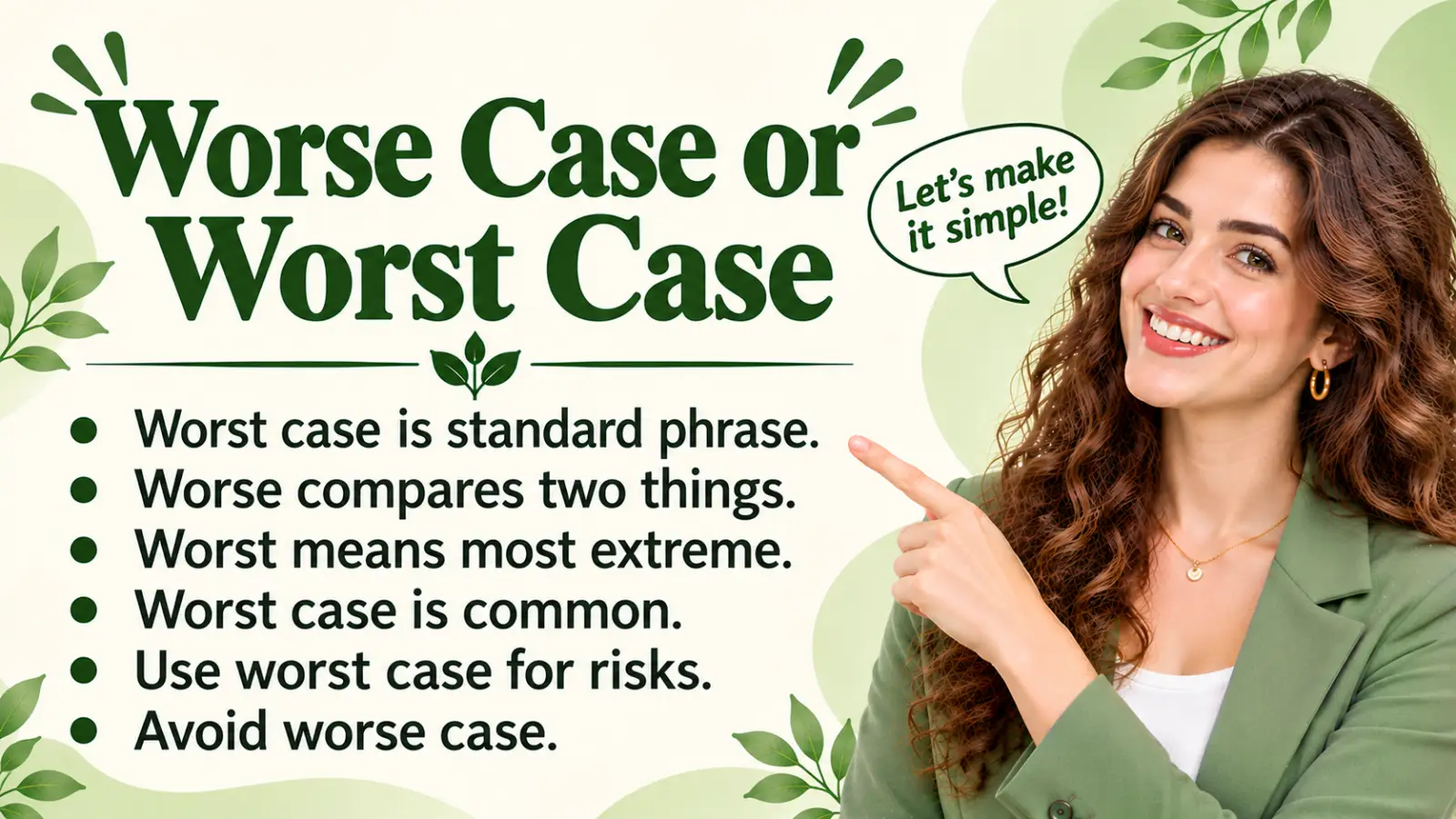
Worst case is the standard phrase when you mean the most unfavorable possible outcome. Worse is used to compare two things, while worst identifies the most unfavorable option or extreme. That is why “worst case” is the usual choice when discussing risks, problems, or what might go wrong.
The distinction matters in everyday conversation, workplace emails, reports, and academic writing. There is also a related punctuation question: use worst-case with a hyphen when it comes before a noun, as in “worst-case scenario.”
Related Post: Disc vs. Disk
Worse Case vs. Worst Case: The Key Difference
| Term | Meaning or status | When to use it | Example |
|---|---|---|---|
| Worse case | A possible comparative construction, but usually not the intended phrase | Only when explicitly comparing one case with another; often clearer to rephrase | This case is worse than the one we reviewed yesterday. |
| Worst case | Standard phrase for the most unfavorable possible situation | When discussing the most serious or negative outcome | In the worst case, we will need to postpone the launch. |
| Worst-case | Hyphenated compound modifier | Before a noun that it describes | We prepared a worst-case scenario. |
For most situations, choose worst case or worst-case scenario. The phrase worse case is usually a mistake when the intended meaning is “the most unfavorable outcome.”
What Does “Worse” Mean?
Worse is the comparative form of bad. It compares one person, thing, condition, or situation with another, or describes a change to a less favorable state.
When to Use “Worse”
Use worse when making a comparison or describing deterioration. The comparison may be explicit, using than, or clear from the surrounding context.
“Worse” in Example Sentences
- “Traffic is worse today than it was yesterday.” The sentence compares traffic on two different days.
- “The headache became worse after lunch.” The condition deteriorated over time.
- “Of the two proposals, the second is worse.” The second proposal is less favorable than the first.
Notice that worse does not automatically mean “the worst possible.” It means more unfavorable in comparison with something else.
What Does “Worst” Mean?
Worst is the superlative form of bad. It refers to the most unfavorable option in a group or to the most extreme negative outcome being considered.
When to Use “Worst”
Use worst when you mean the most serious, unpleasant, or unfavorable possibility. In the expression worst case, it describes the most negative outcome under consideration.
“Worst” in Example Sentences
- “That was the worst storm of the season.” The storm is being identified as the most severe in the period being discussed.
- “The worst case is that we have to start over.” This describes the most unfavorable outcome being considered.
- “She expected the worst but received good news.” Here, the worst refers to the most negative result she feared.
How to Choose Between “Worse Case” and “Worst Case”
The rule is simple: worse compares; worst identifies the extreme.
If you mean the most unfavorable possible result, write worst case. If you are comparing two cases, worse may be grammatically possible, although rewriting the sentence can make the comparison clearer.
A Quick Test You Can Apply
Try completing the thought with one of these questions:
- Do I mean “the most unfavorable possibility”? Use worst case.
- Do I mean “more unfavorable than another case”? Use worse, preferably in a clear comparison.
For example:
- “In the worst case, we lose the deposit.” This describes the most unfavorable outcome under consideration.
- “This case is worse than the one we handled last month.” This compares two cases.
When the Quick Test Does Not Work
Not every sentence explicitly names all the options being compared. For example, “This is the worst result I expected” may compare the result with several possibilities understood from context. You do not need to list every alternative for worst to be correct.
When the intended meaning is the most serious possible outcome, worst case remains the natural choice even if only one potential outcome is discussed.
Common Mistakes and How to Fix Them
| Original sentence | Corrected sentence | Why it changes |
|---|---|---|
| In the worse case, we miss the deadline. | In the worst case, we miss the deadline. | The sentence refers to the most unfavorable outcome, not a comparison. |
| We prepared a worse-case scenario. | We prepared a worst-case scenario. | The compound modifier needs worst, not worse. |
| The delay could get worst tomorrow. | The delay could get worse tomorrow. | The sentence describes a worsening condition, so the comparative form is needed. |
| This is the worse result of all three options. | This is the worst result of all three options. | The sentence identifies the most unfavorable result in a group. |
Why These Forms Get Confused
Worse and worst are closely related in meaning and spelling. Both express something negative, and their pronunciation is similar. That makes it easy to choose the wrong form when writing quickly.
The confusion also comes from the irregular comparison pattern of bad. Instead of adding -er and -est, English uses bad → worse → worst. Remembering this sequence helps distinguish a comparison from an extreme.
Does the Choice Change With Context?
The underlying grammar rule does not change between American and British English. The distinction is mainly about meaning and sentence structure.
Formal Writing vs. Casual Conversation
Worst case works in formal and informal English. You can use it in a risk assessment, a project update, a school assignment, or a casual text.
In casual conversation, people sometimes shorten the expression to “Worst case, we’ll try again tomorrow.” In formal writing, “In the worst case, we will try again tomorrow” may be more suitable. Both use the correct word.
Can You Use “Worse Case” and “Worst Case” Interchangeably?
No. They do not serve the same purpose. Worst case describes the most unfavorable outcome under consideration; worse makes a comparison.
When Switching Changes the Meaning
Compare these sentences:
- “This is the worst case we planned for.” This identifies the most unfavorable case in the plan.
- “This case is worse than the one we planned for.” This compares the current case with another and says the current one is more unfavorable.
The phrases communicate different ideas. If you are discussing a contingency plan or a possible negative outcome, use worst case.
Common Phrases With “Worst”
These expressions help show how worst is used naturally in everyday English.
| Phrase | When to use it | Original example |
|---|---|---|
| Worst-case scenario | The most unfavorable possible situation being considered | The worst-case scenario involves replacing the entire system. |
| In the worst case | When explaining the most negative outcome | In the worst case, the shipment arrives a week late. |
| At worst | To state the most negative reasonable estimate or possibility | The repair will take two hours at worst. |
| Prepare for the worst | To get ready for a possible bad outcome | We saved a backup copy to prepare for the worst. |
| If the worst comes to the worst | An established expression meaning if the situation becomes as bad as possible; less common in US usage than some alternatives | If the worst comes to the worst, we can reschedule the event. |
The first three expressions are useful in planning and everyday communication. Choose the one that fits your sentence rather than adding worst simply for emphasis.
Apply the Rule to a Real Situation
Imagine you are writing a project update to your manager and want to explain a possible delay.
Original Version
“If the supplier misses Friday’s delivery, the worse case scenario is that we delay the launch.”
Improved Version and Explanation
“If the supplier misses Friday’s delivery, the worst-case scenario is that we delay the launch.”
Two corrections make the sentence standard:
- Worse becomes worst because the sentence describes the most unfavorable outcome, not a comparison.
- Worst-case takes a hyphen because the compound modifier appears directly before the noun scenario.
The meaning of the original message remains the same.
Should You Write “Worst Case” or “Worst-Case”?
Both forms are correct, but they have different grammatical roles.
- Worst case is normally written without a hyphen when it functions as a noun phrase: “We planned for the worst case.”
- Worst-case is hyphenated when it acts as a compound modifier before a noun: “We prepared a worst-case estimate.”
More examples:
- “The worst case is a complete restart.” — No hyphen.
- “The worst-case estimate is two weeks.” — Hyphen before the noun estimate.
- “We discussed the worst-case outcome.” — Hyphen before the noun outcome.
The hyphen helps readers recognize that the two words work together to describe the noun that follows.
An Easy Way to Remember the Difference
Remember the three-step pattern:
Bad → Worse → Worst
- Bad: The first outcome is bad.
- Worse: The second outcome is worse than the first.
- Worst: This is the worst outcome of all the possibilities being considered.
A short memory cue is: Worse compares; worst goes to the extreme.
Use that distinction whenever you are deciding how to write the phrase.
Practice: Can You Choose the Right Form?
Choose worse, worst, or worst-case to complete each sentence.
- If the backup fails, the ______ outcome is losing the latest changes.
- The weather is getting ______ as the storm approaches.
- We created a ______ plan in case the main system goes offline.
Answers and Explanations
- Worst — The sentence identifies the most unfavorable outcome.
- Worse — The sentence describes a condition that is deteriorating.
- Worst-case — The hyphenated compound modifier comes before the noun plan.
Frequently Asked Questions
Is “worse case” ever grammatically correct?
It can be grammatically possible when worse directly compares one case with another, but that wording is often awkward. “This case is worse than the previous one” is clearer. For the common expression meaning the most unfavorable outcome, use worst case.
Is “worst case scenario” correct without a hyphen?
The phrase is commonly written as worst-case scenario, with a hyphen because the words work together as a modifier before scenario. In other sentence structures, write worst case without the hyphen, as in “We planned for the worst case.”
Is “worst case” one word or two?
As a noun phrase, worst case is two words. When used as a compound modifier before a noun, it is usually hyphenated: worst-case scenario.
Does “worst case” mean the same as “worst-case scenario”?
They are closely related. Worst case names the most unfavorable situation, while worst-case scenario explicitly describes a possible situation or sequence of events representing that outcome.
Is “worse case” acceptable in professional writing?
Avoid it when you mean the most unfavorable possible result. In professional writing, use worst case or worst-case scenario. If you are comparing two cases, rewrite the sentence to make the comparison explicit.
Which Form Should You Use?
Use worst case when referring to the most unfavorable possible outcome, and worst-case when the phrase modifies a noun, as in worst-case scenario. Use worse for comparisons, such as “This result is worse than the last one.”
Sources
- Cambridge Dictionary blog — How to use the words “worse” and “worst”
- Merriam-Webster — Worst: Definition and usage



One Comment