
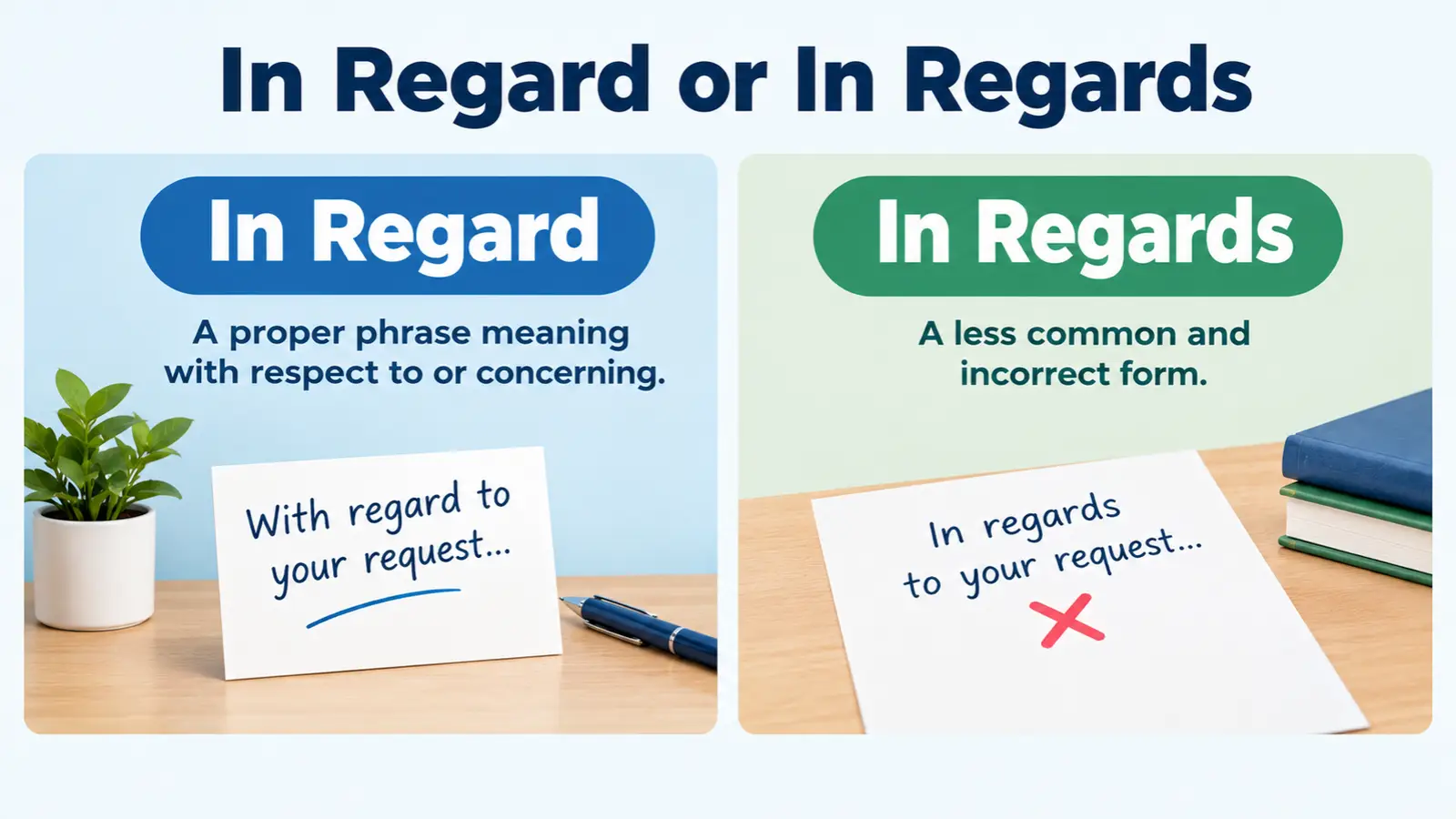
In Regard or In Regards: How to Choose the Correct Phrase
In regard to is the traditional standard phrase meaning “about” or “concerning.” In regards to is widely used, especially in conversation, but it is generally considered nonstandard in formal writing. For polished American English, choose in regard to or the simpler alternative regarding.
The distinction matters most in professional emails, reports, academic assignments, and other edited writing. Although readers will usually understand both forms, using the standard expression helps your writing sound clear and polished.
Related Post: Through or Thru
In Regard vs. In Regards: The Key Difference
| Term | Meaning or status | When to use it | Example |
|---|---|---|---|
| In regard to | Traditional standard expression meaning “about” or “concerning” | Formal, professional, and general writing | I am writing in regard to your request. |
| In regards to | Commonly used variant generally considered nonstandard in formal writing | May occur in casual conversation, but is best avoided in polished prose | Standard alternative: I am writing in regard to your request. |
The main difference is grammatical convention, not meaning. Both expressions are usually understood as referring to a topic, but in regard to is the safer choice for edited writing.
What Does In Regard to Mean?
In regard to is a fixed expression that introduces the subject being discussed. It means about, concerning, or with respect to.
When to Use In Regard to
Use the phrase when you need to identify the topic of a message, question, decision, or statement.
Examples include:
- In regard to your application
- In regard to the recent changes
- In regard to your question
- In regard to the proposed schedule
In Regard to in Example Sentences
- I am contacting you in regard to your recent application. The phrase identifies the subject of the message.
- In regard to your question, we will respond by Friday. It introduces the topic being addressed.
- The committee reached a decision in regard to the new policy. It connects the decision to the policy under discussion.
What Does In Regards to Mean?
In regards to is a widely used variation of in regard to. It generally carries the same meaning, but many editors and style guides recommend avoiding it in formal writing.
When to Avoid In Regards to
For business correspondence, academic work, and other polished writing, use in regard to, regarding, or about instead.
In Regards to in Example Sentences
1. Informal: I called in regards to the appointment.
Preferred: I called in regard to the appointment.
2. Informal: In regards to your email, I have a question.
Preferred: Regarding your email, I have a question.
The revised versions preserve the meaning while following the more widely recommended formal convention.
How to Choose the Right Phrase
Use in regard to when you want a traditional, formal expression. Choose regarding or about when a shorter, more natural phrase will do the job.
A Quick Test You Can Apply
Try replacing the phrase with about or regarding.
- “I am writing in regard to the invoice.”
- “I am writing about the invoice.”
- “I am writing regarding the invoice.”
All three communicate the same general idea. If the replacement works, you probably do not need the longer expression.
When the Quick Test Does Not Work
Do not confuse in regard to with as regards. The latter is also an established expression meaning “concerning,” and it correctly uses regards without adding to afterward.
- Correct: In regard to the schedule, we need an update.
- Correct: As regards the schedule, we need an update.
- Nonstandard in formal writing: In regards to the schedule, we need an update.
Common Mistakes and How to Fix Them
| Original sentence | Corrected sentence | Why it changes |
|---|---|---|
| I am emailing in regards to the invoice. | I am emailing in regard to the invoice. | The standard expression uses singular regard. |
| With regards to your request, we need more time. | With regard to your request, we need more time. | With regard to is the traditional standard form. |
| In regard to your question, I will reply soon. | Regarding your question, I will reply soon. | The revision is a concise style improvement, not a necessary correction. |
| As regards to the new policy, we have concerns. | As regards the new policy, we have concerns. | As regards does not take to in this expression. |
Why These Forms Get Confused
The confusion likely comes from the legitimate expression as regards, along with the separate use of regards to mean good wishes, as in “Give my regards to your family.” Because these forms are familiar, writers may carry the final s into in regard to or with regard to.
Does the Choice Change With Context?
The recommendation depends mainly on the level of formality.
Workplace, Academic, or Everyday Usage
For workplace emails, reports, school assignments, and formal documents, use in regard to or regarding. In casual conversation, you may hear in regards to, and people will generally understand it, but that does not make it the preferred form for edited writing.
In most cases, about is the simplest option.
Can You Use In Regard and In Regards Interchangeably?
The expressions are commonly used with the same intended meaning, but they are not equally preferred in formal writing. In regard to is the traditional standard choice; in regards to is generally treated as nonstandard by formal usage guides.
When Switching Changes the Meaning
Compare these examples:
- In regard to your letter, I have a question. This means “about your letter.”
- Please give my regards to your family. Here, regards means good wishes, not “about.”
The word regards is correct in the second sentence, but it does not make in regards to the preferred formal expression.
Common Phrases With Regard
| Phrase | When to use it | Original example |
|---|---|---|
| In regard to | Introducing a topic | I have a question in regard to the contract. |
| With regard to | Referring to a subject or matter | With regard to the deadline, we need clarification. |
| As regards | Meaning “concerning” | As regards your proposal, the team will meet tomorrow. |
| Regarding | A concise alternative meaning “about” | Regarding the meeting, please confirm your availability. |
| With respect to | A formal alternative for identifying a subject | With respect to the budget, we have several concerns. |
Apply the Rule to a Real Situation
Imagine you’re writing a professional email to ask about an unpaid invoice.
Original Version
“I am contacting you in regards to the invoice that was due last week.”
Improved Version and Explanation
“I am contacting you regarding the invoice that was due last week.”
Why: The revised version uses regarding, a concise and standard alternative. You could also write “I am contacting you in regard to the invoice.” Both are appropriate for professional communication.
Is In Regards to Grammatically Incorrect?
In regards to is common in speech and informal writing, but traditional usage guides generally classify it as nonstandard. For formal or edited writing, use in regard to, with regard to, or regarding.
An Easy Way to Remember the Difference
Remember this simple pattern:
- In regard to — correct standard expression
- With regard to — correct standard expression
- As regards — correct expression without to
- In regards to — avoid in formal writing
The key is to remember which expressions use to and which do not.
Frequently Asked Questions
Is it in regard or in regards?
Use in regard to in formal and professional writing. Although in regards to is widely used, it is generally considered nonstandard by traditional usage guides.
Is with regards to correct?
With regard to is the traditional standard form for introducing a subject. With regards to is common but is best avoided in formal writing.
Can I use regarding instead of in regard to?
Yes. Regarding usually means the same thing and often makes a sentence shorter and more natural. For example, “Regarding your request, we will respond tomorrow.”
Is as regards correct?
Yes. As regards is an established expression meaning “concerning.” Unlike in regard to, it does not take to at the end.
Does in regard to sound too formal?
It can sound formal or wordy in everyday communication. In many situations, about or regarding is a more direct choice.
Which Form Should You Use?
For formal American English, choose in regard to or with regard to. For clearer, more concise writing, consider regarding or about. Although in regards to is common, avoiding it in polished writing is the safest choice.
Sources
- Chicago Manual of Style — “In regard to” vs. “in regards to”
- Language Portal of Canada — In regard to, with regard to, as regards





One Comment