Through or Thru: How to Choose the Right Spelling
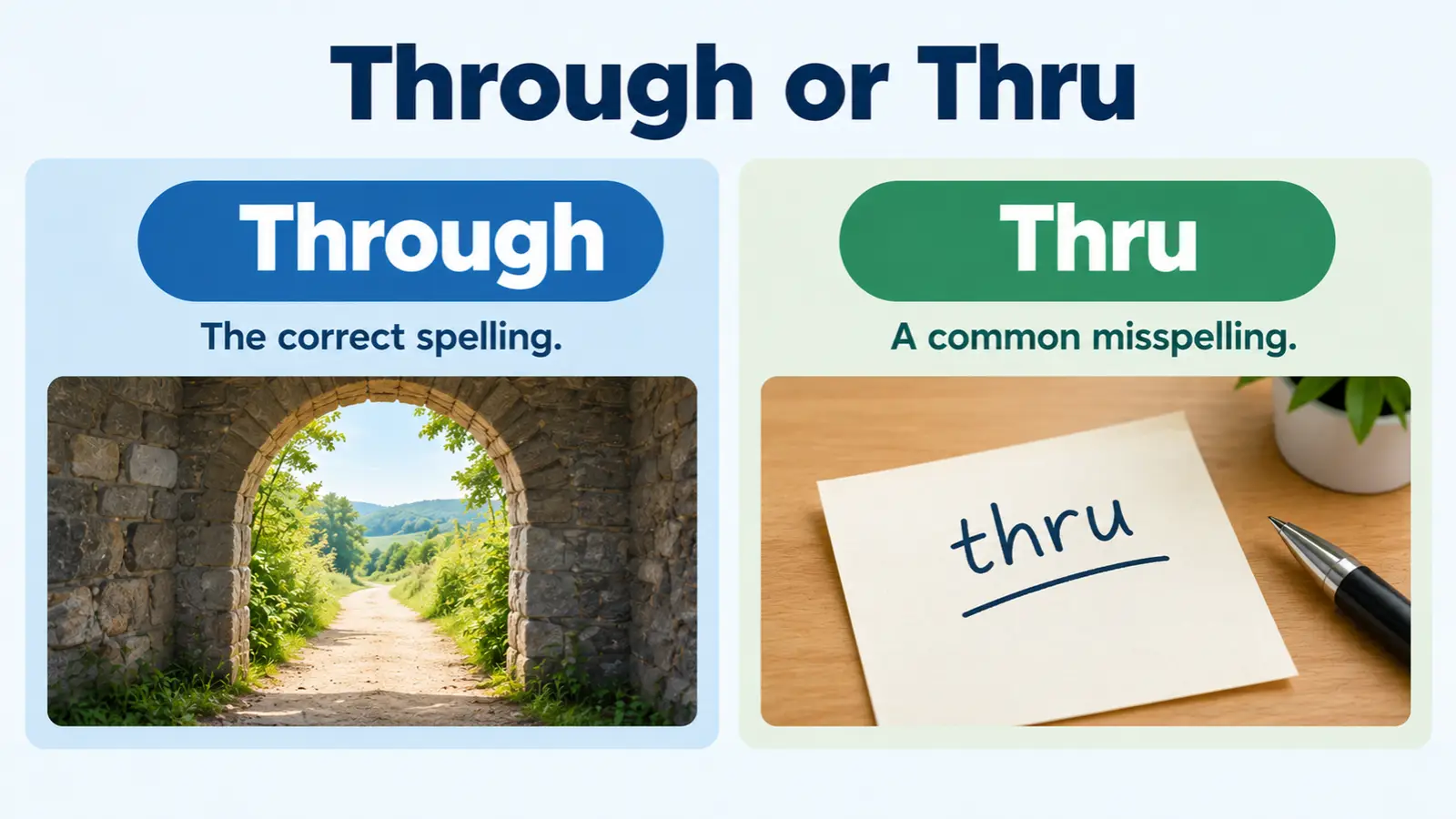
Through is the standard spelling for general English writing. Thru is a recognized alternative spelling used mainly in informal contexts and established expressions such as drive-thru. It is not simply a random misspelling, but it is not the best choice for most formal writing.
For US readers, the distinction usually comes down to tone and context rather than meaning. Use through in school assignments, professional emails, reports, and polished articles. Choose thru when the shorter form is conventional, as in drive-thru, or when an intentionally informal style suits the message.
Related Post: Premise or Premises
Through vs. Thru: The Key Difference
| Term | Meaning or status | When to use it | Example |
|---|---|---|---|
| Through | Standard spelling | Formal, professional, academic, and general writing | We walked through the park. |
| Thru | Informal alternative spelling of through | Casual messages, signs, and established compounds | We ordered food at the drive-thru. |
Both forms can communicate the same basic idea, but through is the safer default when writing for a broad audience. Thru is appropriate in familiar compounds and selected informal contexts.
What Does Through Mean?
Through can function as a preposition, adverb, or adjective. It can describe movement from one side to another, passage across a place, a period lasting from beginning to end, or the completion of a process.
When to Use Through
Use through when describing:
- Movement across or inside a place
- Progress from beginning to end
- An experience or process that someone completes or endures
- A period that continues up to and includes an endpoint, as in “Monday through Friday”
- A route that allows continuous passage
Through in Example Sentences
- The hikers walked through the forest. The word describes movement across an area.
- She worked through the weekend. It describes an activity continuing during a period.
- He finally got through the difficult assignment. Here, it means he managed to complete or deal with the task.
What Does Thru Mean?
Thru is an informal, simplified spelling of through. It generally carries the same meaning, but its shorter form makes it especially suitable for signs, casual messages, and certain familiar compound words.
When to Use Thru
Use thru when the context supports an informal or established shortened spelling, such as:
- Drive-thru: A place where customers receive service without leaving their vehicles.
- Casual texting: Informal messages where shortened spelling fits the tone.
- Signs and brief labels: Situations where concise wording is useful.
Avoid using thru as a blanket replacement for through in formal documents or polished prose.
Thru in Example Sentences
- We picked up dinner at the drive-thru. This uses a familiar compound spelling.
- I’ll get thru the paperwork tonight. This is an informal alternative to “get through.”
- The sign points to a thru lane. This illustrates shortened spelling in a traffic-related context; follow the wording used on the actual sign or in the relevant style guide.
How to Choose the Right Spelling
The simplest rule is to use through by default and reserve thru for contexts where the shorter spelling is conventional or deliberately informal.
A Quick Test You Can Apply
Ask yourself: Would this sentence look appropriate in a formal email, school paper, or business report?
- “I read through the contract.” — Standard and suitable.
- “I read thru the contract.” — Understandable, but informal.
- “We entered the drive-thru.” — Conventional compound spelling.
If you’re unsure, choose through unless you are using an established name or compound that spells it differently.
When the Quick Test Does Not Work
Some compounds and proper names use thru even when the surrounding text is not casual. Drive-thru is a familiar example. In those cases, follow the established spelling rather than mechanically replacing every instance with through.
Common Mistakes and How to Fix Them
| Original sentence | Corrected sentence | Why it changes |
|---|---|---|
| I walked thru the hallway to my office. | I walked through the hallway to my office. | Use the standard spelling in ordinary prose. |
| Please read thru the instructions before starting. | Please read through the instructions before starting. | The full spelling is preferable in professional directions. |
| We stopped at the drive-through window. | We stopped at the drive-thru window. | Both forms are used; the revision adopts a familiar shortened compound, not a required correction. |
| The tunnel runs threw the mountain. | The tunnel runs through the mountain. | Threw is the past tense of throw, not a spelling variant of through. |
Why These Forms Get Confused
Through and thru sound the same, and the shorter form looks like a straightforward spelling simplification. That makes the alternative easy to recognize, but familiarity does not make it equally suitable for every type of writing.
A related source of confusion is threw, which sounds the same but has a different meaning and grammatical function.
Does the Choice Change With Context?
Yes. The main difference is formality and convention rather than the core meaning.
Formal Writing vs. Casual Conversation
For academic essays, job applications, business correspondence, reports, and published articles, use through. In a casual text, thru may fit the tone, although standard spelling is also perfectly natural in messages.
For signs and familiar compounds, use the established form, such as drive-thru or drive-through.
Can You Use Through and Thru Interchangeably?
Sometimes. When thru is used as an informal alternative to through, the basic meaning usually remains the same. However, the shorter spelling changes the tone and may look out of place in formal writing.
When Both Forms Work
- “We drove through the tunnel.”
- “We drove thru the tunnel.”
Both communicate the same movement, but the first is the standard choice for general writing. The second looks informal or abbreviated.
When Switching Changes the Meaning
Compare:
- She walked through the door. This describes movement from one side of the doorway to the other.
- She threw the door open. This means she opened the door forcefully.
Although through and threw sound alike, they are different words. Replacing one with the other changes the meaning.
Common Phrases With Through and Thru
| Phrase | When to use it | Original example |
|---|---|---|
| Through the door | Describing movement across a doorway | The delivery worker came through the door. |
| Through the night | Describing something that continues during the night | The rain continued through the night. |
| Monday through Friday | Indicating a period that includes Monday and Friday | The clinic is open Monday through Friday. |
| Drive-thru | Referring to service provided without leaving a vehicle | We ordered breakfast at the drive-thru. |
| See it through | To continue until a task or commitment is completed | She promised to see the project through. |
Apply the Rule to a Real Situation
Imagine you’re sending instructions to a coworker about reviewing a report.
Original Version
“Please go thru the report and send me your comments by Friday.”
Improved Version and Explanation
“Please go through the report and send me your comments by Friday.”
Why: The revised sentence uses the standard spelling through, which is the better fit for professional communication. The original is understandable, but its shortened spelling gives the message a more casual tone.
Is Thru a Real Word or a Spelling Mistake?
Thru is a recognized spelling variant, not automatically a spelling mistake. However, it is generally considered informal outside established compounds and specific contexts such as signs. For standard written English, through remains the recommended default.
An Easy Way to Remember the Difference
Remember this simple rule:
- Through = the standard spelling for general writing.
- Thru = the shortened form for selected informal uses and familiar compounds.
For example, write “We drove through the city” in an article, but use drive-thru when referring to that familiar type of service.
Frequently Asked Questions
Is through or thru correct?
Both forms are recognized, but through is the standard spelling for general writing. Thru is mainly informal and appears in established compounds such as drive-thru.
Is thru acceptable in formal writing?
Usually, avoid it in formal writing unless it belongs to an established name, compound, or context-specific convention. Use through in essays, reports, and professional documents.
Is drive-thru or drive-through correct?
Both spellings are used. Drive-thru is a familiar shortened form, while drive-through uses the full standard spelling. Follow a business’s official name when referring to that business.
Does thru mean something different from through?
Usually, no. When thru is used as an alternative spelling, it generally has the same meaning as through. The main difference is the writing context and level of formality.
Should I replace every thru with through?
Not necessarily. Use through in ordinary prose, but retain established forms such as drive-thru when that spelling is appropriate.
Which Form Should You Use?
Choose through for most writing, including academic assignments, professional emails, articles, and everyday sentences. Use thru when the informal style or established spelling makes it appropriate. The distinction is primarily about usage and context, not a simple correct-versus-incorrect spelling rule.
Sources