Smelled vs. Smelt: Meaning, Usage, and Key Differences
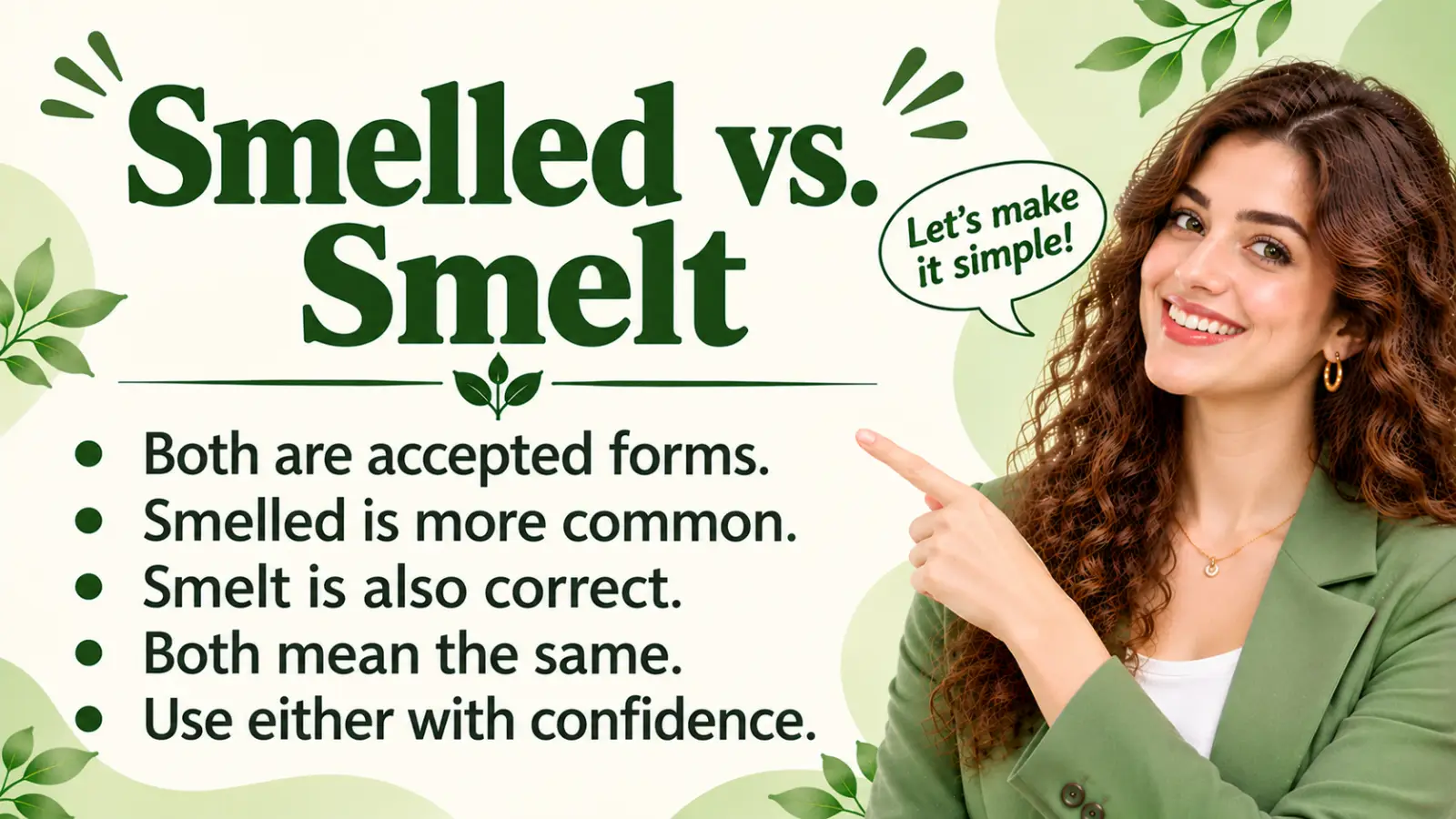
Smelled and smelt are both accepted past-tense and past-participle forms of the verb smell. For a US audience, smelled is the standard, more familiar choice. Smelt is also used as the past form of smell, especially in British English, where both forms are accepted.
The distinction matters when writing for a particular audience or following a consistent style. Also, smelt has separate meanings related to processing metal and a type of fish, so its meaning depends on how it is used in a sentence.
Related Post: Upmost or Utmost
Smelled vs. Smelt: The Key Difference
| Term | Meaning or status | When to use it | Example |
|---|---|---|---|
| Smelled | Past tense and past participle of smell | The usual choice in American English | The flowers smelled wonderful. |
| Smelt | Alternative past tense and past participle of smell | Especially common in British English | The flowers smelt wonderful. |
| Smelt | A verb meaning to extract metal from ore by heating | When discussing metal production | The workers smelt the ore in a furnace. |
| Smelt | A noun naming a type of small fish | When referring to the fish | The smelt swam near the shore. |
The main distinction between smelled and smelt as forms of smell is regional preference, not a difference in the action described. In American English, choose smelled unless you are using smelt in one of its separate meanings or preserving a regional voice.
What Does Smelled Mean?
Smelled is the simple past tense and past participle of smell. It can describe detecting an odor, having a particular scent, or noticing that something has an unpleasant smell.
When to Use Smelled
Use smelled in American English when describing a smell in the past or forming a perfect tense with have, has, or had.
- Detecting an odor: I smelled smoke coming from the kitchen.
- Describing a scent: The freshly baked bread smelled delicious.
- Forming a perfect tense: We had smelled the flowers before the rain started.
The word can describe pleasant, unpleasant, or neutral odors. The surrounding sentence makes the intended meaning clear.
Smelled in Example Sentences
- The coffee smelled rich and sweet.
“Smelled” describes the aroma the coffee had. - I smelled gas near the garage and called for help.
The word means the speaker detected an odor. - She has smelled every candle before choosing one.
Here, “has smelled” uses the past participle to form the present perfect tense.
What Does Smelt Mean?
Smelt has more than one meaning. It is an accepted past-tense and past-participle form of smell, particularly in British English. It is also a separate word used in metalworking and as the name of a fish.
When to Use Smelt
Use smelt as the past form of smell when writing in a British English context or when it matches the voice of the text. For general American English writing, smelled is the safer default.
The other meanings follow different grammatical patterns:
- Past of smell: He smelt the smoke before anyone else noticed it.
- Metalworking verb: Workers smelt iron ore to extract the metal.
- Fish noun: The restaurant served fried smelt.
The metalworking verb is commonly used in the forms smelt, smelted, and smelting. Do not automatically change every instance of smelt to smelled; first check what the word means.
Smelt in Example Sentences
- The hallway smelt of fresh paint.
This is a British English use of “smelt” as the past tense of “smell.” An American English version would usually say “smelled.” - The company smelted the ore to recover valuable metal.
Here, “smelt” refers to metal extraction, and “smelted” is its past-tense form. - The fishermen caught smelt near the coast.
In this sentence, “smelt” is a plural noun referring to fish.
How to Choose the Right Form
The easiest rule is to consider both the meaning and the intended audience.
- For ordinary past-tense descriptions in American English, use smelled.
- For British English, either smelled or smelt can be appropriate.
- For metal extraction, use the verb smelt and its relevant forms.
- For the fish, use the noun smelt.
A Quick Test You Can Apply
Try replacing the word with a phrase that makes the meaning clear.
Example 1: Describing an odor
Original: The kitchen smelt like fresh bread.
US-oriented version: The kitchen smelled like fresh bread.
The change follows the usual American preference.
Example 2: Discussing metal production
Original: The workers smelled the ore to extract the metal.
Corrected: The workers smelted the ore to extract the metal.
Here, the intended meaning is metal extraction, not detecting an odor. The verb must change to fit that meaning.
When the Quick Test Does Not Work
A sentence can be grammatically correct with either smelled or smelt when the word means the past of smell. The choice may reflect regional English, a character’s voice, or a publication’s style guide.
For example, “The room smelled damp” and “The room smelt damp” can express the same idea. The second version is more associated with British usage. A spelling or grammar checker may flag one form based on its language settings, so check the intended variety before making a correction.
Common Mistakes and How to Fix Them
| Original sentence | Corrected sentence | Why it changes |
|---|---|---|
| The cookies smelt wonderful. | The cookies smelled wonderful. | For standard US-oriented writing, “smelled” is the usual choice. The original form is acceptable in British English. |
| I have smelt smoke twice today. | I have smelled smoke twice today. | “Smelled” is the standard US form of the past participle. The original is also used in British English. |
| The factory smelled the ore to get the metal out. | The factory smelted the ore to extract the metal. | The original uses the wrong verb for the intended metalworking process. |
| We saw several smelted near the pier. | We saw several smelt near the pier. | When referring to the fish, “smelt” is the noun; “smelted” is not its plural form. |
Why These Forms Get Confused
Both forms are short, familiar, and connected to the same base verb. English has several verbs with alternative past forms ending in -ed or -t, including learned/learnt and burned/burnt. That pattern can make the choice seem like a question of correctness when it is often a matter of regional usage.
The additional meanings of smelt can create confusion, too. Its role as a past-tense verb, a metalworking verb, or a fish noun must be identified from the sentence.
Does the Choice Change With Context?
Yes. The meaning can stay the same while the preferred form changes by region. In other cases, smelt refers to a completely different thing.
American vs. British English
In American English, smelled is the normal past-tense and past-participle form of smell. It is appropriate for school assignments, workplace writing, news articles, and most other US-oriented content.
In British English, smelled and smelt are both established forms. Writers may use either, though individual publications can have their own preferences. If you are writing for a British audience, follow the style used by the publication or keep your choice consistent.
Formal Writing vs. Casual Conversation
The regional distinction applies to both formal and casual writing. For an American business email, for example, “I smelled smoke near the equipment” is the straightforward choice. In a British novel or dialogue, “I smelt smoke near the equipment” may sound natural.
Neither form is inherently more formal. Audience and consistency matter more than formality alone.
Can You Use Smelled and Smelt Interchangeably?
Yes, when both words are used as the past tense or past participle of smell. They can describe the same action or scent, although the preferred form varies by region.
They are not interchangeable when smelt refers to metal processing or a fish.
When Both Forms Work
Both forms can be correct in sentences such as these:
- The milk smelled sour.
- The milk smelt sour.
Both sentences describe the milk’s odor. The first is the usual choice for American English; the second is especially associated with British English.
When Switching Changes the Meaning
Compare these sentences:
- The workers smelled the substance. They detected its odor.
- The workers smelt the ore. They processed the ore to extract metal.
Changing the verb changes the action. In the second sentence, smelt is not an alternative past form of smell; it is a different verb with a metalworking meaning.
Common Phrases With Smelled and Smelt
| Phrase | When to use it | Original example |
|---|---|---|
| Smelled like roses | To describe a scent resembling roses | The garden smelled like roses after the rain. |
| Smelled of smoke | To say that something carried a smoke odor | His jacket smelled of smoke after the campfire. |
| Smelled something burning | To describe detecting a burning odor | We smelled something burning and checked the oven. |
| Smelt of damp | A British-style phrase describing a musty or wet odor | The old basement smelt of damp after the storm. |
| Smelt the ore | To describe extracting metal from ore by heating | The plant smelted the ore before refining the metal. |
The first four examples concern odors, while the last uses the separate metalworking verb. In US-oriented prose, smelled is generally the most natural choice for the past of smell.
Apply the Rule to a Real Situation
Original Version
Subject: Strange Odor Near the Storage Room
Hi Team,
I smelt a strong chemical odor near the storage room this morning. I have checked the area, but I could not identify the source.
Improved Version and Explanation
Subject: Strange Odor Near the Storage Room
Hi Team,
I smelled a strong chemical odor near the storage room this morning. I have checked the area, but I could not identify the source.
For an American workplace email, smelled is the standard choice. The rest of the message is grammatically sound, so no other correction is necessary. If the email were written in a British English context, smelt could also be appropriate.
Is Smelted the Past Tense of Smell?
No. Smelted is the past tense and past participle of the metalworking verb smelt, meaning to extract metal from ore by heating it. The ordinary past-tense forms of the verb smell are smelled and smelt.
Compare:
- I smelled smoke. I detected an odor.
- The workers smelted the ore. They extracted metal from it.
The spelling is similar, but the verbs have different meanings.
An Easy Way to Remember the Difference
For American English, remember this simple pairing: smell → smelled.
- Today, I smell coffee.
- Yesterday, I smelled coffee.
- I have smelled coffee here before.
If you are reading British English, you may also encounter smelt in the last two examples. For the metalworking meaning, remember smelt → smelted: the workers smelted the ore.
Frequently Asked Questions
Is smelled or smelt correct in American English?
Smelled is the usual form in American English. Smelt is a recognized alternative in British English and may appear in American writing, but it is less typical for the past of smell.
Is smelt a misspelling of smelled?
No. Smelt is an accepted past-tense and past-participle form of smell, particularly in British English. It is not simply a misspelling, though smelled is the standard choice for most US-oriented writing.
Are smelled and smelt pronounced the same way?
No. They are generally pronounced differently: smelled has an ending like “-eld,” while smelt ends with a “-elt” sound. Both refer to the past of smell when used in that sense.
Is smelted a word?
Yes. Smelted is the past tense and past participle of the metalworking verb smelt. It means that metal was extracted from ore by heating it.
Should I use smelled or smelt in a school essay?
For a US school essay, use smelled when describing an odor detected in the past. If the assignment calls for British English or follows a particular style guide, use the form that matches those requirements.
Which Form Should You Use?
For a US audience, choose smelled when writing about detecting or having an odor. Smelt is also a valid past form, especially in British English, and it has separate meanings related to metal extraction and fish.
The practical rule is simple: use smelled for ordinary American English, and check the sentence carefully whenever smelt appears so that its intended meaning stays clear.
Sources