Whether or Not vs. Whether: Understand the Difference
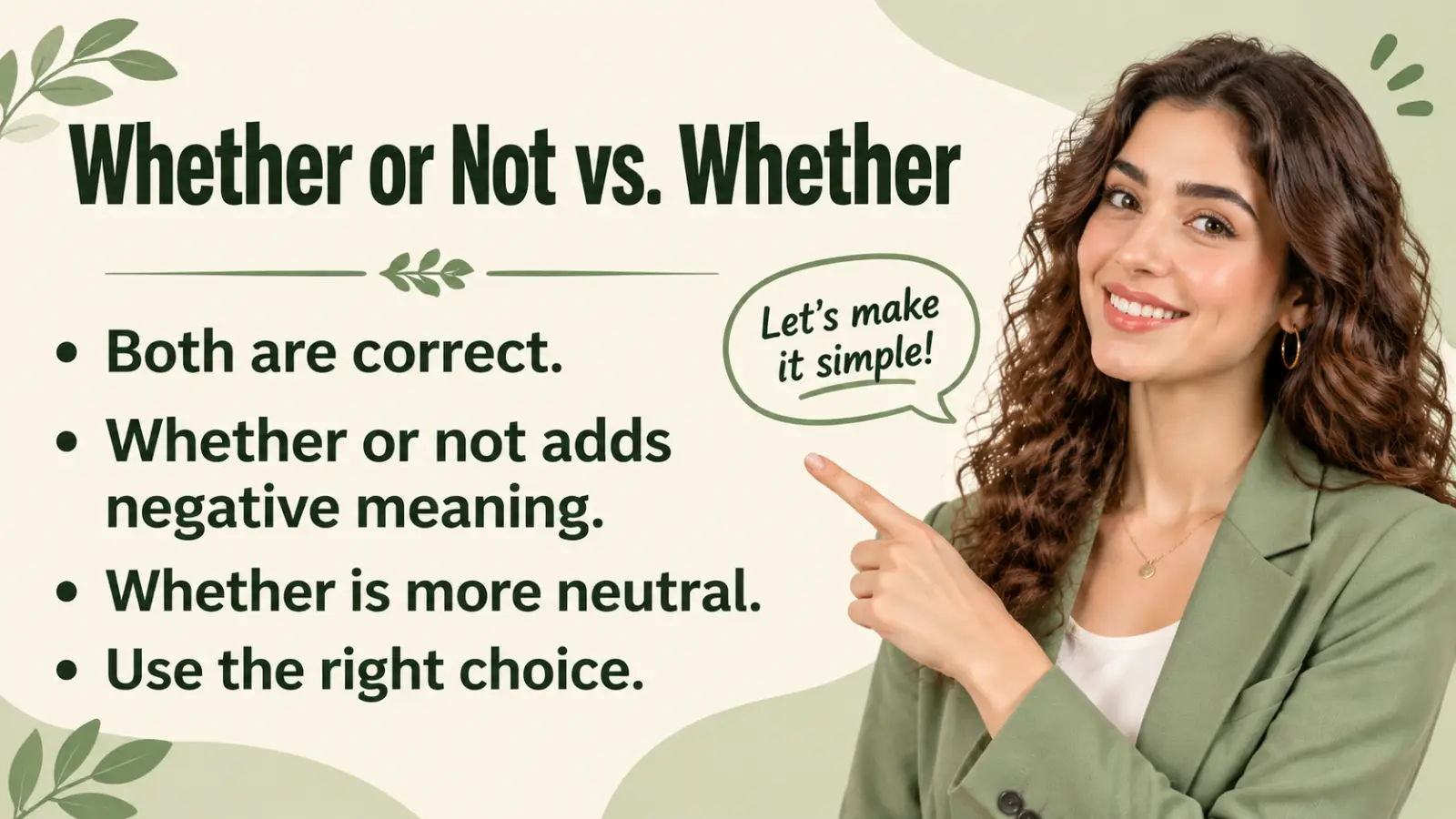
Whether and whether or not are both correct English expressions. They can introduce uncertainty, alternatives, or an indirect question. The difference is that adding or not makes the negative possibility explicit or emphasizes that an outcome will remain the same regardless of a condition.
In many sentences, those extra words are optional. Knowing when to include them helps you write more clearly and avoid unnecessary wording. It also helps distinguish whether from if, which can have similar meanings but do not work in every grammatical situation.
Whether or Not vs. Whether: The Key Difference
| Term | Meaning or status | When to use it | Example |
|---|---|---|---|
| Whether or not | Correct expression that presents two possibilities or means regardless of a condition | When both outcomes matter or a result will stay the same either way | “We will go whether or not it rains.” |
| Whether | Conjunction introducing uncertainty, an indirect question, or alternatives | When presenting a choice or asking an indirect yes-or-no question | “I don’t know whether it will rain.” |
Both forms are grammatical. The longer expression explicitly includes the negative possibility, while the shorter one often communicates the same basic uncertainty without stating it separately.
What Does Whether Mean?
Whether is a conjunction that introduces an indirect question, uncertainty, or a choice between alternatives. It is useful when someone needs to determine which possibility is true or appropriate.
For example, you can use it when discussing a decision, asking about an uncertain situation, or presenting two possible outcomes.
When to Use Whether
Use this conjunction in several common situations:
- To introduce an indirect yes-or-no question: “She asked whether the store was open.”
- To present alternatives: “I can’t decide whether to drive or take the train.”
- Before a to-infinitive: “He hasn’t decided whether to apply.”
- After a preposition: “We talked about whether the plan was realistic.”
- In a subject clause: “Whether she agrees remains unclear.”
Examples With Whether
- “I wonder whether the package has arrived.” The speaker is uncertain about the delivery.
- “They must decide whether to accept the offer.” The sentence presents a decision.
- “Whether she agrees remains unclear.” The entire clause functions as the subject.
What Does Whether or Not Mean?
The complete expression presents two possible outcomes, including the possibility that something does not happen. It can also mean regardless of whether or it does not matter if.
This wording is particularly useful when a result will remain unchanged despite a condition or someone’s preference.
When to Use the Complete Expression
Choose the longer form when:
- The outcome will remain the same regardless of what happens.
- You want to emphasize that both possibilities have been considered.
- You are expressing determination despite another person’s opinion or preference.
- You need to make the negative alternative explicit.
For example, “We will continue whether or not the weather improves” means the decision will not change if the weather stays poor.
Examples With the Complete Expression
- “I’ll attend the meeting whether or not my manager is there.” The speaker plans to attend either way.
- “Whether or not you agree, we need to make a decision.” Someone’s opinion will not change the need to decide.
- “She hasn’t decided whether or not to move.” The sentence presents two possible choices: moving or staying.
How to Choose the Right Form
The main rule depends on the relationship between the possible outcomes.
Use whether to introduce an indirect question or a choice. Add or not when you need to state the negative alternative or emphasize that the result will be the same either way.
Compare these examples:
- “I don’t know whether he is coming.” The speaker is uncertain about his plans.
- “He is coming whether or not you invite him.” His decision does not depend on receiving an invitation.
A Quick Test You Can Apply
Try replacing the longer expression with regardless of whether:
- “We will play whether or not it rains.”
- “We will play regardless of whether it rains.”
The meaning stays essentially the same. This indicates that the sentence describes an outcome that does not depend on the condition.
For a sentence such as “I don’t know whether the office is open,” try replacing whether with if:
“I don’t know if the office is open.”
The sentence still works because both conjunctions can introduce an indirect yes-or-no question in this construction.
When the Quick Test Does Not Work
The substitution test is helpful, but if and whether are not interchangeable in every grammatical position.
For example:
- Correct: “She hasn’t decided whether to stay.”
- Not standard: “She hasn’t decided if to stay.”
Use whether, not if, before a to-infinitive. Similarly, the former is preferred after a preposition and when a clause functions as the subject of a sentence.
Common Mistakes and How to Fix Them
| Original sentence | Corrected sentence | Why it changes |
|---|---|---|
| “We will go whether it rains.” | “We will go whether or not it rains.” | Add the negative alternative when you mean the plan will continue regardless of the weather. |
| “I don’t know if or not she is coming.” | “I don’t know whether or not she is coming.” | Use the complete expression in this construction, or place “or not” after the clause introduced by “if.” |
| “He can’t decide if to accept the offer.” | “He can’t decide whether to accept the offer.” | Use “whether” before a to-infinitive. |
| “Whether or not you agree we should begin.” | “Whether or not you agree, we should begin.” | Add a comma after the introductory dependent clause. |
Why These Forms Get Confused
Whether and if can both introduce indirect yes-or-no questions. As a result, writers sometimes assume they can replace one with the other in every situation.
The words or not can also seem unnecessary when the negative possibility is already understood. In many indirect questions, they are optional. However, when the intended meaning is “regardless of whether,” including the negative alternative can make the relationship between the condition and the result clearer.
Does the Choice Change With Context?
Formal Writing vs. Casual Conversation
Both forms are appropriate in formal and informal American English. The choice depends more on meaning and sentence structure than on formality.
In professional or academic writing, avoid adding extra words automatically when they contribute no useful meaning.
For example:
- Wordier: “The committee will decide whether or not the proposal is acceptable.”
- More concise: “The committee will decide whether the proposal is acceptable.”
Both sentences are understandable. The shorter version communicates the uncertainty without explicitly repeating the negative possibility.
By contrast, keep the complete expression when the decision or result will not depend on the condition:
“The committee will proceed whether or not the proposal is accepted.”
Can You Use Both Forms Interchangeably?
Sometimes. In indirect questions and noun clauses, or not is often optional because the negative possibility is already implied.
For example:
- “I don’t know whether she called.”
- “I don’t know whether or not she called.”
Both sentences communicate uncertainty about the call. The second makes the negative possibility more explicit.
However, removing those words can change the meaning or make a sentence sound incomplete when the intended message is that something applies regardless of the outcome.
When Both Forms Work
Both versions can introduce an indirect question:
- “Please tell me whether you received the email.”
- “Please tell me whether or not you received the email.”
The second version makes the negative alternative more explicit, but both are grammatical.
When Switching Changes the Meaning
Compare these sentences:
- “I’ll support you whether you succeed or fail.” The support applies under either stated condition.
- “I’ll support you whether you succeed.” This does not clearly express the second possibility and sounds incomplete for the intended meaning.
When something applies regardless of the outcome, include the negative alternative or state both possibilities clearly.
Common Expressions and Their Uses
| Phrase | When to use it | Example |
|---|---|---|
| Whether or not you agree | To show that a decision does not depend on someone’s agreement | “Whether or not you agree, the deadline remains Friday.” |
| Whether or not it rains | To describe a plan that will continue under either weather condition | “The festival will open whether or not it rains.” |
| Whether or not to go | To discuss uncertainty about attending or leaving | “I’m still deciding whether or not to go.” |
| Whether you like it or not | To emphasize that someone’s preference will not change a situation | “Whether you like it or not, the rules apply to everyone.” |
| Whether or not it works | To explain that an action will happen regardless of its success | “We’ll test the design whether or not it works perfectly.” |
Apply the Rule to a Real Situation
Imagine you are writing an email to your team about a scheduled presentation. You want to explain that the presentation will happen even if a key participant cannot attend.
Original version:
“The presentation will take place whether the client attends or not, so please arrive on time.”
Alternative version:
“The presentation will take place whether or not the client attends, so please arrive on time.”
Both sentences are grammatically correct. The alternative places or not immediately after the conjunction, creating a compact expression. The original places the negative alternative at the end of the clause, which is also acceptable.
Can You Use If Instead?
Sometimes, but not in every construction. If can introduce an indirect yes-or-no question, as in “I don’t know if she is available.” However, whether is required before a to-infinitive and is preferred after a preposition.
Also, when you mean “regardless of whether,” use the complete expression rather than if or not before the clause.
Compare:
- Correct: “We will continue whether or not they approve.”
- Correct: “We will continue whether they approve or not.”
- Not standard: “We will continue if or not they approve.”
An Easy Way to Remember the Difference
Keep this simple guide in mind:
- Whether introduces uncertainty, an indirect question, or a choice.
- Whether or not can emphasize that both outcomes are possible or that the result does not depend on the condition.
For example:
“I don’t know whether the store is open, but I’ll go whether or not it is.”
The first use introduces uncertainty. The second shows that the speaker will go either way.
Practice: Choose the Right Form
Choose the most suitable expression for each sentence.
- “She hasn’t decided ___ to accept the invitation.”
- “We will finish the project ___ the client approves the changes.”
- “I wonder ___ the package has arrived.”
Answers and Explanations
- Whether — Use it before a to-infinitive.
- Whether or not — The project will be completed regardless of the client’s approval.
- Whether or if — Both can introduce this indirect yes-or-no question.
Frequently Asked Questions
Is whether or not grammatically correct?
Yes. It is a standard English expression. It introduces alternatives or emphasizes that something will happen regardless of a condition.
Is or not always necessary after whether?
No. In many indirect questions, those words are optional because the negative possibility is already implied. However, include them when you mean “regardless of whether” and the alternative is not otherwise stated.
Is whether or not one word or three?
The expression consists of three separate words. Do not combine them into one word or hyphenate the phrase.
What is the difference between whether and if?
Both can introduce indirect yes-or-no questions, such as “I wonder whether she is coming” and “I wonder if she is coming.” However, use whether before a to-infinitive, after a preposition, and when introducing a subject clause.
Should I use whether or not in formal writing?
Yes, when the complete expression is needed to convey your meaning. If the additional words contribute no useful information, removing them can make your sentence more concise.
Which Form Should You Use?
Use whether when introducing uncertainty, an indirect question, or a choice. Choose whether or not when you want to include the negative alternative or show that something will happen regardless of a condition.
The practical rule is simple: do not add or not automatically. Include it when it clarifies or completes the meaning you intend to express.
Sources