Bougie vs. Boujee: Meaning, Spelling, and How to Use Each
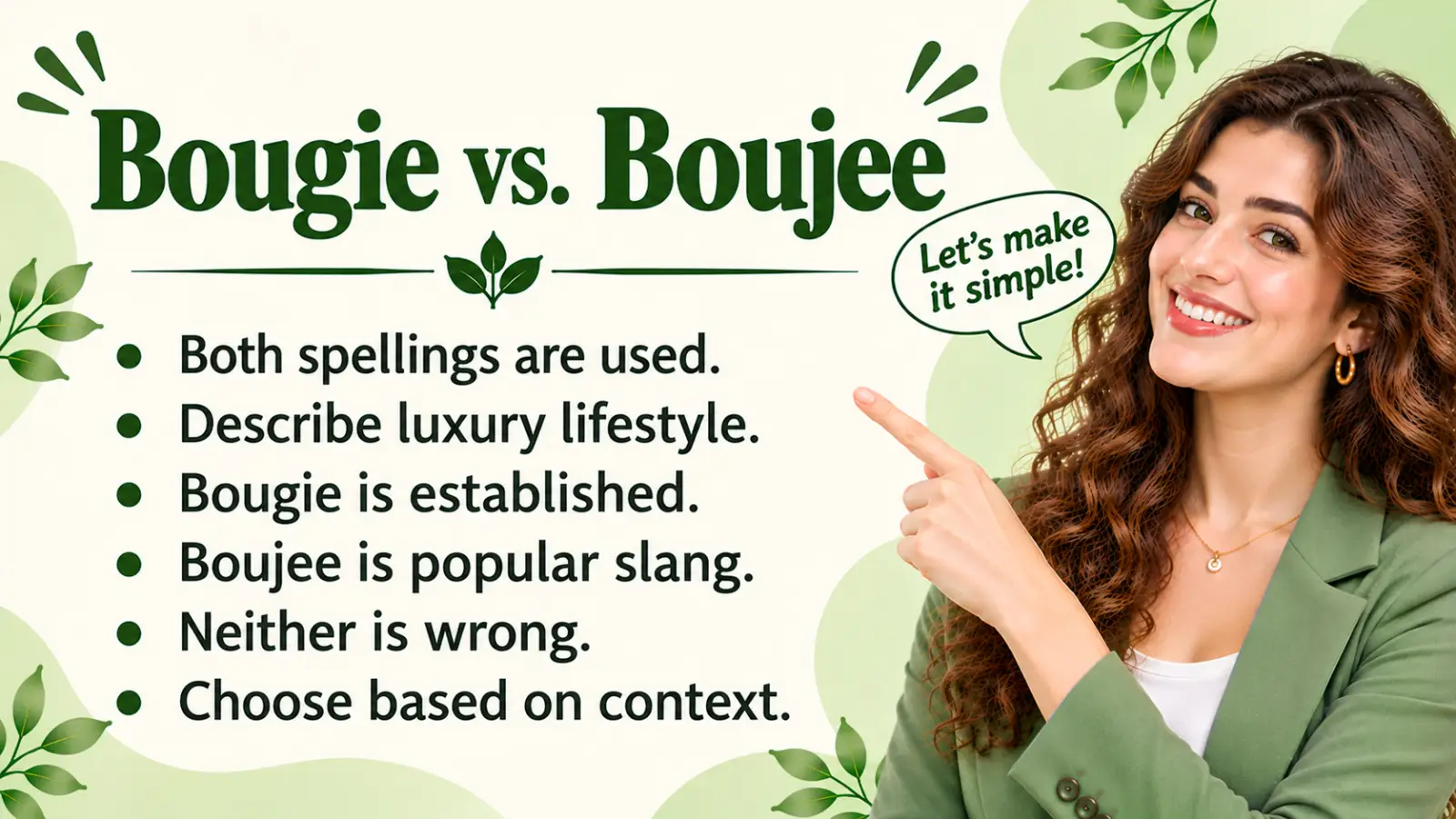
Bougie and boujee are both used in American slang to describe someone or something associated with luxury, expensive tastes, or an upscale lifestyle. Bougie is the more established spelling, while boujee is a popular informal variant associated with contemporary slang and hip-hop culture. Neither spelling is automatically wrong in casual conversation.
The choice depends on your audience and intended tone. Bougie can sound critical or teasing, while boujee may feel more playful or celebratory. However, these connotations overlap, so context matters more than a rigid spelling rule.
Related Post: Naive vs. Nieve
Bougie vs. Boujee: The Key Difference
| Term | Meaning or status | When to use it | Example |
|---|---|---|---|
| Bougie | Established slang adjective for something fancy, upscale, or status-conscious | General informal writing and conversation | “That restaurant is pretty bougie.” |
| Boujee | Informal variant with similar meaning, often associated with pop culture | Casual messages, social media, and playful slang | “We booked a boujee hotel.” |
Both spellings can describe expensive tastes, luxurious experiences, or behavior perceived as pretentious. The distinction is not absolute: some speakers use the words interchangeably, while others associate them with different attitudes toward wealth and status.
What Does Bougie Mean?
Bougie is an informal slang adjective derived from bourgeois, a word associated with the middle class and its social values. In contemporary American English, it often describes someone who enjoys luxury, prefers expensive things, or seems overly concerned with status.
Depending on the speaker’s intent, bougie can be affectionate, humorous, admiring, or insulting. Calling a café bougie might simply mean that it serves expensive coffee in a stylish setting. Describing someone as bougie may suggest that the person acts snobbish or tries to appear more sophisticated.
When to Use Bougie
Use bougie when describing:
- Expensive tastes: Someone prefers upscale restaurants, designer clothing, or premium products.
- Fancy experiences: A hotel, café, spa, or dinner feels luxurious.
- Status-conscious behavior: A person seems overly concerned with appearances or social standing.
- Playful indulgence: Someone enjoys small luxuries and jokes about them.
The word does not necessarily mean that someone is wealthy. It can describe a lifestyle, preference, or attitude rather than a person’s actual income.
Bougie in Example Sentences
- “That little café is too bougie for my budget.” The speaker thinks the café is fancy or expensive.
- “She bought a bougie skincare set for her birthday.” The word suggests a premium or indulgent purchase.
- “He acts bougie whenever his old friends suggest a casual restaurant.” Here, the term criticizes behavior that seems snobbish or overly status-conscious.
What Does Boujee Mean?
Boujee is a recognized informal slang variant of bougie. It generally describes someone or something that appears luxurious, stylish, expensive, or high-end.
The spelling became especially visible in mainstream American culture through the 2016 hit song “Bad and Boujee” by Migos featuring Lil Uzi Vert. The song helped popularize the term, although it did not create the broader slang concept from scratch.
Boujee can suggest success, fashionable taste, or enjoying the finer things in life. It can also be used sarcastically to poke fun at extravagant spending.
When to Use Boujee
Choose boujee when its casual, expressive style suits the situation, such as:
- Social media captions and comments
- Text messages among friends
- Playful descriptions of luxury or indulgence
- References to hip-hop culture or the phrase “bad and boujee”
For example, “We had a boujee brunch” conveys a casual, slang-heavy description of an upscale meal.
In professional or academic writing, consider replacing either slang term with a more precise word, such as luxurious, upscale, pretentious, or status-conscious.
Boujee in Example Sentences
- “Our hotel room had a rooftop pool and a boujee minibar.” The word adds a casual, playful sense of luxury.
- “That was a boujee way to celebrate graduation.” The celebration was elaborate or indulgent.
- “He calls himself boujee because he refuses to drink anything but specialty coffee.” The term humorously describes someone with expensive or particular tastes.
How to Choose the Right Word
There is no universal rule that makes bougie negative and boujee positive. The words overlap in meaning, and their emotional tone depends on the speaker, audience, and situation.
Use this simple guide:
- Choose bougie for the more established spelling of the slang adjective.
- Choose boujee when you want a casual, stylized form associated with contemporary pop culture.
- Choose a more formal synonym when clarity and professionalism matter more than slang.
A Quick Test You Can Apply
Ask yourself two questions:
- Am I describing something fancy, expensive, luxurious, or status-conscious? If so, either spelling may work in casual slang.
- Does my context call for a more established spelling or a deliberately playful style? Bougie is the safer general choice; boujee is more stylized.
Worked example
Original: “The new restaurant is very boujee.”
Alternative: “The new restaurant is very bougie.”
Both sentences work in informal American English. The first may sound more playful or pop-culture-oriented to some readers, while the second uses the more established spelling. Neither sentence is inherently more correct.
When the Quick Test Does Not Work
The test cannot determine the speaker’s exact attitude. One person may use bougie as a compliment, while another uses it as criticism. Similarly, boujee does not always imply that someone has earned their wealth or remained connected to their roots.
Treat differences in tone as tendencies, not fixed definitions.
Common Mistakes and How to Fix Them
| Original sentence | Corrected sentence | Why it changes |
|---|---|---|
| “Boujee is always the wrong spelling.” | “Boujee is an informal slang variant of bougie.” | Boujee is an established variant in contemporary usage, not simply a typo. |
| “She is bougie, so she must be rich.” | “She is bougie, so she seems to enjoy upscale things.” | The slang describes tastes or attitudes; it does not prove someone’s income. |
| “Bougie is always an insult.” | “Bougie can be critical, playful, or admiring.” | The intended tone depends on context. |
| “The hotel was boujee and luxurious.” | “The hotel was boujee.” | This is a style improvement, not a grammatical correction. “Luxurious” and “boujee” can overlap in meaning, so using both may be repetitive. |
Why These Forms Get Confused
The two words sound similar and share much of their meaning. Both are connected to bourgeois, and both are used in casual descriptions of luxury, social status, and expensive tastes.
The extra letters in boujee give the word a distinctive written style that is recognizable in pop culture. That visual difference can suggest a change in tone, but it does not create a strict grammatical or semantic boundary between the terms.
Does the Choice Change With Context?
Formal Writing vs. Casual Conversation
In texts, captions, and friendly conversations, either spelling can fit. Your choice may depend on personal style or the tone you want to convey.
For a résumé, academic paper, business proposal, or formal report, avoid relying on either slang term unless you are discussing the word itself or quoting someone. Use a more specific alternative, such as luxurious, expensive, ostentatious, or pretentious.
Cultural Context and Slang
Bougie has a history in African American English, and boujee is strongly associated with contemporary Black American popular culture and hip-hop. As these terms have spread into wider usage, their meanings and tones have broadened.
That cultural background is relevant because slang can carry associations beyond its dictionary definition. Use the terms thoughtfully, especially when describing people or communities. Avoid assuming that everyone uses them with the same meaning or that a person’s race, income, or background can be inferred from the label.
Can You Use Bougie and Boujee Interchangeably?
Usually, yes, when both are used as slang adjectives describing luxury or expensive tastes. For instance, “a bougie restaurant” and “a boujee restaurant” can communicate essentially the same idea.
However, the spelling may affect the tone. Boujee can feel more playful or tied to pop culture, while bougie may more readily carry a critical or snobbish implication for some readers.
When Both Forms Work
Both spellings fit naturally in these examples:
- “They booked a bougie hotel.”
- “They booked a boujee hotel.”
Both describe an upscale hotel. The second sentence may sound more stylized, but the meaning remains similar.
When Switching Changes the Meaning
There is no reliable rule that switching the spelling changes the literal meaning. Consider the following pair:
- “That restaurant is bougie.” — The speaker may be criticizing its prices or pretentious atmosphere.
- “That restaurant is boujee.” — The speaker may be playfully celebrating its upscale feel.
These are possible interpretations, not guaranteed differences. Either sentence can be complimentary or critical depending on context.
Common Phrases With Bougie and Boujee
| Phrase | When to use it | Original example |
|---|---|---|
| Bougie lifestyle | Describing a preference for upscale experiences and comforts | “Her bougie lifestyle includes boutique hotels and tasting menus.” |
| Bougie restaurant | Describing a restaurant that feels fancy, expensive, or pretentious | “The bougie restaurant required a reservation weeks in advance.” |
| Bougie coffee | Joking about specialty coffee or an elaborate coffee order | “My five-ingredient latte is basically bougie coffee.” |
| Boujee brunch | Casually describing an indulgent or upscale brunch | “We planned a boujee brunch to celebrate her promotion.” |
| Bad and boujee | Referring to a well-known pop-culture phrase or using it playfully | “Her caption said ‘bad and boujee’ beside a photo of her new outfit.” |
These are natural combinations and informal expressions, not fixed idioms that must always appear in the same form.
Apply the Rule to a Real Situation
Imagine you are writing a social media caption about an expensive birthday dinner.
Original Version
“We went to a boujee restaurant last night. I guess boujee is the only correct spelling now.”
Improved Version and Explanation
“We went to a boujee restaurant last night. I like this spelling because it gives the caption a playful, slang-heavy tone.”
The first sentence uses boujee appropriately in casual writing. The problem is the claim in the second sentence: boujee is not the only correct form. Bougie remains an established spelling, so the choice is a matter of style and context rather than a universal right-or-wrong rule.
Is Boujee a Misspelling of Bougie?
No. Although bougie is the more established spelling, boujee is a recognized informal variant used in contemporary slang. Its association with hip-hop and popular culture gives it a distinctive style, but that does not make it automatically incorrect.
If you are editing formal prose, you may prefer bougie or replace the slang with a more precise adjective. In a casual caption or quotation, boujee can be entirely appropriate.
An Easy Way to Remember the Difference
Think of bougie as the established spelling and boujee as the stylized slang variant.
- Bougie: “That café is bougie.”
- Boujee: “That café is boujee!”
The exclamation mark in the second example adds excitement; the extra letters give the word a different visual style. Neither punctuation nor spelling guarantees a particular emotional tone, so use the surrounding sentence to communicate your meaning.
Frequently Asked Questions
Is bougie or boujee more correct?
Bougie is the more established spelling, while boujee is a recognized informal variant. Both are used in American slang, so the better choice depends on your audience and style.
Does boujee mean richer than bougie?
Not as a universal rule. Some informal explanations distinguish boujee as successful or upwardly mobile and bougie as pretentious, but everyday usage does not consistently preserve that distinction.
Is bougie a compliment or an insult?
It can be either. Someone might use it affectionately to describe a favorite luxury, or critically to suggest that a person is snobbish or overly concerned with status.
How do you pronounce bougie and boujee?
Pronunciation varies. In American English, bougie is commonly pronounced approximately “BOO-zhee,” while boujee is often said as “BOO-jee.” Speakers may vary, so the spelling does not always predict pronunciation.
Can I use bougie or boujee in professional writing?
You can use either when discussing slang, quoting a source, or writing in a deliberately casual voice. For most formal documents, a precise alternative such as upscale, luxurious, or pretentious will communicate the intended meaning more clearly.
Which Form Should You Use?
Use bougie as your default when you want the more established spelling of this slang adjective. Choose boujee when its playful, contemporary style fits your message, especially in casual conversation or pop-culture contexts.
Both can describe luxury, expensive tastes, or perceived pretentiousness. Rather than treating one as correct and the other as wrong, consider your audience, the tone you want, and whether a more precise word would serve your readers better.
Sources
- Dictionary.com — Boujee: Slang meaning and cultural context
- Cambridge Dictionary — Bougie: Meaning and usage