Wracking or Racking: Learn Which Spelling to Use
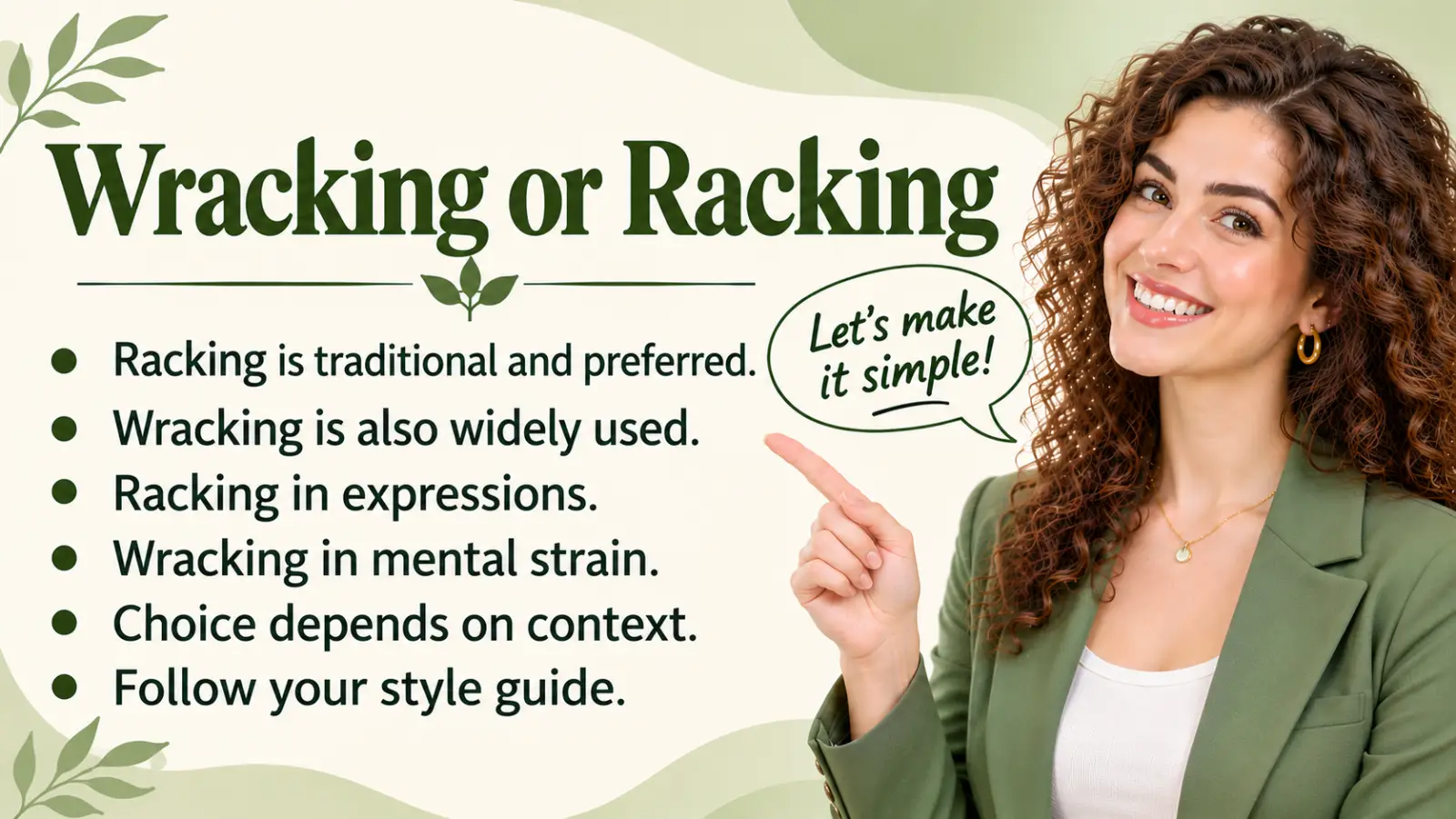
Racking is the traditional and generally preferred spelling in expressions such as racking your brain and nerve-racking. However, wracking is also widely used and accepted as a variant in several expressions involving mental strain, pain, or distress. The best choice depends on the phrase and the style guide you follow.
This distinction matters when writing essays, emails, articles, and professional documents. Choosing the more established form can help you avoid distracting spelling debates, but it is important to recognize that wracking is not always incorrect.
Related Post: Therefore vs. Therefor
Wracking vs. Racking: The Key Difference
| Term | Meaning or status | When to use it | Example |
|---|---|---|---|
| Racking | The traditional form associated with strain, torment, or intense effort | In expressions such as “racking your brain” and “nerve-racking” | I was racking my brain for an answer. |
| Wracking | An accepted variant in some expressions; also related to wrecking or destruction | When following a usage that accepts this variant, or in established forms such as “storm-wracked” | The storm-wracked coastline needed repairs. |
The simplest rule is to use racking for mental effort and nerve-related stress when you want the most conventional choice. Use wracking when it fits an established expression or when your preferred style guide accepts it.
What Does Racking Mean?
Racking is the -ing form of the verb rack. As a verb, rack can mean to strain, torment, or cause physical or mental suffering. It can also describe the effort involved in thinking hard about a problem or trying to remember something.
When to Use Racking
Use racking when describing:
- Making a strong mental effort to remember or solve something.
- Experiencing intense worry, stress, or discomfort.
- Suffering from pain, guilt, or another difficult emotion.
- A situation that places someone under considerable strain.
Racking in Example Sentences
- I was racking my brain to remember where I left my keys.
The person is thinking hard to retrieve a memory. - Waiting for the interview results was nerve-racking.
The wait caused anxiety and stress. - She was racked with guilt after the argument.
The sentence uses racked, the past participle of rack, to describe intense emotional distress.
What Does Wracking Mean?
Wracking is the -ing form of wrack, a verb associated with wrecking, ruining, or causing destruction. It is also used as a variant of racking in several expressions involving pain, strain, or mental effort.
Because the meanings of rack and wrack overlap in modern usage, writers may encounter both spellings in expressions such as wracking your brain and wracked with guilt. Some editors prefer the traditional forms with rack, while other dictionaries recognize both versions in these contexts.
When to Use Wracking
Use wracking when it appears in an established expression accepted by your dictionary or style guide. It can also be used in words and phrases associated with destruction, such as storm-wracked.
Wracking in Example Sentences
- He spent the afternoon wracking his brain for a solution.
This spelling is an established variant of “racking his brain,” although “racking” is the safer conventional choice. - The coastline was battered by a storm, leaving a storm-wracked landscape.
Here, wracked conveys damage caused by the storm. - The family was wracked with grief after their loss.
This spelling is used in modern English, although some usage guides prefer “racked with grief.”
How to Choose the Right Spelling
Choose racking when you mean straining, tormenting, or thinking hard. It is the conventional choice for expressions such as “racking your brain” and “nerve-racking.”
Choose wracking when you are using a recognized variant or a form associated with destruction, such as “storm-wracked.” Because dictionaries and style guides do not always treat these expressions identically, check your preferred reference when precision matters.
A Quick Test You Can Apply
Ask what the sentence means:
- Thinking hard or feeling stressed? Prefer racking: “I am racking my brain.”
- Describing destruction caused by a storm? Use wracked in the established compound “storm-wracked.”
- Writing a phrase such as “wracking my brain” or “wracked with guilt”? Recognize that both spellings occur, but choose racking if you want the more conventional form.
When the Quick Test Does Not Work
The meanings of rack and wrack have overlapped over time. As a result, meaning alone cannot determine the spelling in every expression. When a phrase has competing established forms, a current dictionary or the style guide for your publication is the most reliable deciding factor.
Common Mistakes and How to Fix Them
| Original sentence | Preferred version | Why it changes |
|---|---|---|
| I am wracking my brain to remember his name. | I am racking my brain to remember his name. | “Racking your brain” is the conventional form, although “wracking” is also used. |
| It was a very nerve-wracking experience. | It was a very nerve-racking experience. | “Nerve-racking” is the traditional, generally preferred form. |
| The village was racking by the storm. | The village was wrecked by the storm. | “Racking” does not fit this sentence. “Wrecked” clearly conveys physical damage. |
| She was wracked with guilt over the mistake. | She was racked with guilt over the mistake. | “Racked with guilt” is the conventional choice, though “wracked” is also used. |
The first, second, and fourth examples illustrate preferred usage rather than absolute rules that make every alternative incorrect. The third is a genuine word-choice correction because the sentence needs a verb that clearly describes damage.
Why These Forms Get Confused
Rack and wrack sound the same because the w in wrack is silent. Both forms are also associated with ideas such as strain, pain, and destruction, which helps explain why writers sometimes use them interchangeably.
Their meanings and historical usage have become intertwined. This is why reputable references may acknowledge both spellings in certain expressions while still recommending racking for conventional phrases such as “racking your brain.”
Does the Choice Change With Context?
The main difference is not American versus British spelling. It is the specific expression and the usage convention you choose to follow.
Formal Writing vs. Casual Conversation
In formal writing, use racking for “racking your brain,” “nerve-racking,” and “racked with guilt” unless your publication’s style guide specifies otherwise.
In casual writing, readers may encounter wracking your brain or wracked with guilt. These variants are established in modern usage, but choosing the conventional forms can make your writing more consistent.
Can You Use Wracking and Racking Interchangeably?
Not in every context. They can be alternatives in some expressions involving mental effort or distress, but they are not universally interchangeable.
Compare these examples:
- I was racking my brain for an answer. This uses the conventional expression for thinking hard.
- The coast was storm-wracked after the hurricane. This describes a coastline damaged by a storm.
Replacing storm-wracked with storm-racked would not be the usual choice for this established compound. Likewise, racking your brain is the safer conventional form when you want to avoid questions about spelling.
Common Phrases With Racking and Wracking
| Phrase | When to use it | Original example |
|---|---|---|
| Racking your brain | When trying hard to remember or solve something | I was racking my brain to find a suitable name for the project. |
| Nerve-racking | When something causes anxiety or tension | Giving the presentation to the board was nerve-racking. |
| Racked with guilt | When someone experiences intense guilt | He was racked with guilt after admitting the truth. |
| Wracked with grief | A variant used to describe overwhelming sadness | She was wracked with grief after the loss. |
| Storm-wracked | When describing something damaged or battered by a storm | The storm-wracked harbor required extensive repairs. |
For the first three expressions, the forms with rack are the conventional choices. The fourth illustrates a variant that appears in modern usage, while the fifth uses the established compound storm-wracked.
Apply the Rule to a Real Situation
Imagine you are writing a work email about a difficult decision that took hours of thought.
Original Version
“I spent all morning wracking my brain over the best way to respond to the client.”
Improved Version and Explanation
“I spent all morning racking my brain over the best way to respond to the client.”
The change from wracking to racking follows the conventional spelling of the expression. The original wording is also encountered in modern English, so this is a preference for standard usage rather than proof that every use of “wracking your brain” is wrong.
Is It Nerve-Racking or Nerve-Wracking?
Nerve-racking is the traditional and generally preferred spelling for something that causes anxiety, tension, or worry. Nerve-wracking is also widely used and is recognized as a variant by some references.
For schoolwork, professional writing, or edited content, nerve-racking is a reliable default. The important point is to use the same form consistently throughout a document.
An Easy Way to Remember the Difference
Remember this practical pairing:
- Rack your brain when you stretch your mental effort to remember or solve something.
- Storm-wracked when something has been damaged by a storm.
This memory aid helps with two common expressions, but it does not cover every phrase in which rack and wrack overlap. For expressions such as “wracked with guilt,” check the conventions of your dictionary or style guide if you need a definitive editorial choice.
Frequently Asked Questions
Is wracking a real word?
Yes. Wracking is a real word derived from wrack, and it is used in expressions involving destruction and as a variant in some phrases involving distress or mental effort. It is not automatically a spelling mistake.
Is racking my brain or wracking my brain correct?
Racking my brain is the conventional and generally preferred form. Wracking my brain is also found in modern usage and is accepted by some references, so it is better described as a variant than as universally incorrect.
Is it nerve-racking or nerve-wracking?
Nerve-racking is the traditional preferred form. Nerve-wracking is a widely used variant, but if you are following a strict style guide, use the spelling that guide recommends.
What does wracked with guilt mean?
It means experiencing intense guilt or emotional distress. Racked with guilt is the conventional form, but wracked with guilt is also used.
Does American English use a different spelling from British English?
There is no simple American-versus-British rule that resolves every instance of rack and wrack. The distinction mainly concerns particular expressions and editorial preferences, so consult the relevant dictionary or style guide when necessary.
Which Form Should You Use?
For most English writing, choose racking in expressions such as racking your brain, nerve-racking, and racked with guilt. These are conventional forms that help keep your writing clear and consistent.
Use wracking where it fits an established expression, especially when describing destruction or following a reference that accepts the variant. Since both spellings occur in some contexts, judge the phrase rather than assuming that one spelling is always wrong.
Sources