Either-Or Questions Explained: Meaning, Rules, and Examples
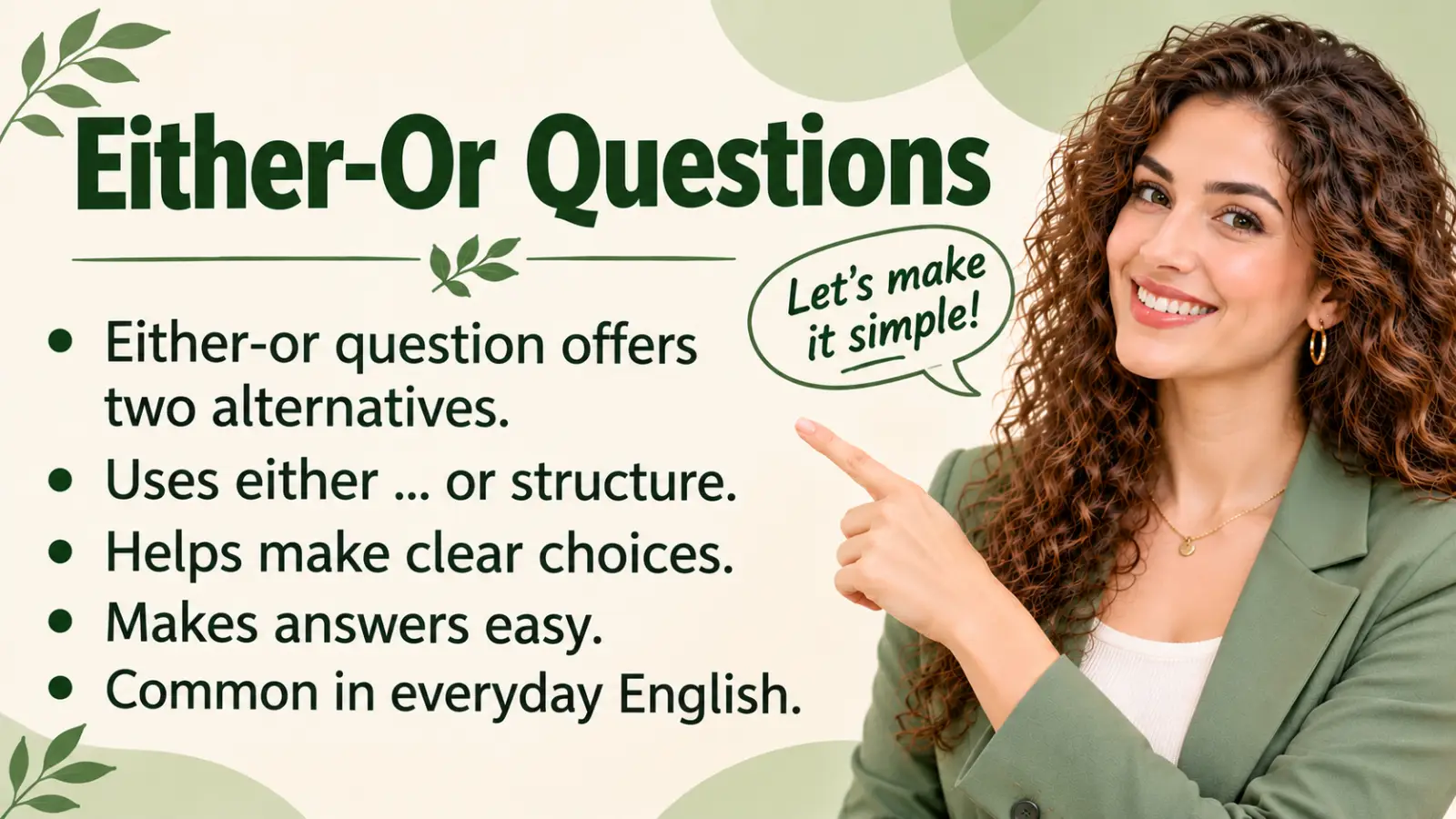
An either-or question presents two alternatives and asks someone to choose between them. It usually uses the conjunction either … or to connect the options, as in “Would you rather have tea or coffee?” The construction helps make choices clear, direct, and easy to answer.
Either-or questions are useful in everyday conversation, surveys, interviews, classroom activities, and workplace communication. To write them correctly, you need to connect the alternatives clearly and make sure the sentence structure is grammatically balanced.
Related Post: Leaves or Leafs
What Is an Either-Or Question?
An either-or question asks someone to select between two choices. The choices may be people, objects, actions, places, or ideas.
Examples:
- Would you like either tea or coffee?
- Should we travel by car or by train?
- Is the meeting scheduled for Monday or Tuesday?
In ordinary questions, or often connects the alternatives without an additional either. The paired construction either … or gives extra emphasis to the two available options. Both patterns can be grammatical, depending on the sentence.
How to Form an Either-Or Question
The basic pattern is:
Question structure + either + option 1 + or + option 2
The exact word order depends on the type of question. The alternatives should be easy to identify, and the words or phrases connected by either … or should have matching grammatical forms.
Either-Or Questions With Two Nouns
Use this pattern when asking someone to choose between two people, objects, places, or ideas.
- Would you like either coffee or tea?
- Is the appointment on either Monday or Tuesday?
- Should we invite either Daniel or Michael?
In many everyday questions, you can leave out either without changing the basic meaning:
- Would you like coffee or tea?
- Is the appointment on Monday or Tuesday?
Either-Or Questions With Two Actions
Use either … or to present two possible actions.
- Should we either walk to the store or take the bus?
- Would you rather study at home or work at the library?
- Can we either reschedule the meeting or shorten it?
Keep the two actions in the same grammatical form. For example, use two base verbs, two infinitive phrases, or two matching clauses.
Either-Or Questions With Two Complete Clauses
You can also connect two complete alternatives, each with its own subject and verb.
- Will you cook dinner, or will I order takeout?
- Either we leave now, or we wait until the rain stops. Which would you prefer?
- Should we either book the hotel today or wait for a better price?
The final example is a direct question with either … or connecting two actions. The first two show other natural ways to ask about alternatives.
Either-Or Questions: Key Rules and Examples
| Feature | Rule | Example |
|---|---|---|
| Two alternatives | Use or to separate the choices | Do you want rice or pasta? |
| Paired conjunction | Use either … or for emphasis | Would you like either rice or pasta? |
| Parallel structure | Keep both alternatives grammatically similar | Should we drive or take the train? |
| Subject-verb agreement | With joined subjects, the verb generally agrees with the nearer subject | Either the manager or the employees are attending |
| Question punctuation | End a direct question with a question mark | Would you prefer tea or coffee? |
How to Choose the Right Either-Or Structure
The main rule is to make the alternatives clear and grammatically balanced. You do not need to use either in every question that offers two choices. Often, or alone is enough.
A Quick Test You Can Apply
Check your question with these three steps:
- Find the alternatives: Identify the two choices the reader or listener must consider.
- Check the connection: Make sure or separates the alternatives and that either appears before the first alternative when you use the paired construction.
- Check parallel structure: Make sure both alternatives follow the same grammatical pattern.
For example:
- Less balanced: Should we either go by car or the train?
- Improved: Should we travel either by car or by train?
The improved version connects two matching prepositional phrases: by car and by train.
When the Quick Test Does Not Work
Not every either-or question requires exactly two words or two short phrases. The alternatives can be longer clauses, and a question can offer more than two choices using or.
For example:
- Would you like tea, coffee, or juice?
- Should we leave now, or would you prefer to wait until tomorrow?
The goal is clarity and grammatical balance, not forcing every question into the same formula.
Common Mistakes and How to Fix Them
| Original sentence | Corrected sentence | Why it changes |
|---|---|---|
| Do you want either pizza and pasta? | Do you want either pizza or pasta? | Use or, not and, to connect alternatives in this construction. |
| Should we either going now or wait? | Should we either go now or wait? | Use matching base verb forms: go and wait. |
| Either do you want tea or coffee? | Would you like either tea or coffee? | Put the question’s auxiliary before the subject; do not place either in that position. |
| Is either the teachers or the principal available? | Is either the principal or the teachers available? | The verb agrees with the nearer subject, teachers, so a more natural correction is: Are either the principal or the teachers available? |
Why These Forms Get Confused
The word either can serve several grammatical functions. It can refer to one of two choices, stand alone as a pronoun, or work with or as a paired conjunction. This flexibility can make sentence structure harder to recognize.
Another source of confusion is that ordinary questions often use or without either. Both “Would you like tea or coffee?” and “Would you like either tea or coffee?” can be correct, although the first is usually more concise.
Are Either-Or Questions Always Limited to Two Choices?
The paired construction either … or usually presents two alternatives, but everyday questions can offer more than two choices with or.
- Would you like tea, coffee, or hot chocolate?
- Should we meet on Friday, Saturday, or Sunday?
If you use either … or, readers generally expect two main alternatives. When listing three or more options, simply using or is often clearer.
Either-Or Questions and False Choices
An either-or question can sometimes make a situation seem more limited than it really is. This is known as a false dilemma when the question presents only two possibilities even though other reasonable options exist.
For example:
- Misleading: Are you going to accept this job or remain unemployed?
- More balanced: Are you going to accept this job, look for another position, or consider a different plan?
The first question assumes there are only two possible outcomes. The second allows for other choices.
Either-Or Questions for Everyday Situations
Here are practical examples showing how the structure works in different settings.
| Situation | Either-or question |
|---|---|
| Food | Would you prefer pizza or burgers? |
| Travel | Should we go by train or by car? |
| Work | Would you rather work remotely or in the office? |
| Study | Should I review my notes or complete a practice test first? |
| Scheduling | Is the appointment available on Tuesday or Wednesday? |
| Entertainment | Should we watch a comedy or a documentary? |
These questions work because they make the available alternatives clear. If the answer may involve a third option, you can invite the person to suggest another choice.
Can You Use Either and Or Without Each Other?
Yes. Either and or do not always have to appear together.
- Either on its own: “You can choose either.” Here, either means one of two previously mentioned options.
- Or on its own: “Would you like tea or coffee?” Here, or connects the alternatives without either.
- Either … or together: “You can choose either tea or coffee.” Here, the paired conjunction emphasizes the choice.
Do not confuse either … or with neither … nor. The first presents alternatives; the second connects two negative alternatives.
An Easy Way to Remember the Difference
Remember this simple pattern:
Either = introduces the first choice.
Or = introduces the alternative.
For example:
“Would you like either a morning appointment or an afternoon appointment?”
- First choice: a morning appointment
- Second choice: an afternoon appointment
You can also remove either and keep the question grammatical: “Would you like a morning appointment or an afternoon appointment?”
Practice: Can You Choose the Right Form?
Complete each sentence with the correct word or phrase.
- Would you like either tea ___ coffee?
- Should we drive or ___ the train?
- Is either the teacher or the students ___ for the event?
Answers and Explanations
- or — The paired construction is either … or.
- take — The verbs drive and take are in matching base forms.
- are — When either … or connects subjects, the verb generally agrees with the nearer subject. Here, students is plural.
Frequently Asked Questions
What is an either-or question?
An either-or question asks someone to choose between two alternatives, usually connected by or or either … or.
Do either-or questions always need the word either?
No. You can use or alone to present choices. Adding either simply emphasizes the alternatives.
Is either-or hyphenated?
Yes. Either-or is hyphenated when used as a noun or compound modifier, but either … or is written separately.
What is the difference between either-or and neither-nor?
Either … or presents choices, while neither … nor expresses that both options are rejected.
Can an either-or question have more than two answers?
Yes, but either … or usually introduces two choices. For three or more options, use or in a list.
Sources
- Cambridge Dictionary – Either … or …
- Language Portal of Canada – Correlative Conjunctions: Either … or