Leaves or Leafs: Learn the Correct Form and When to Use It
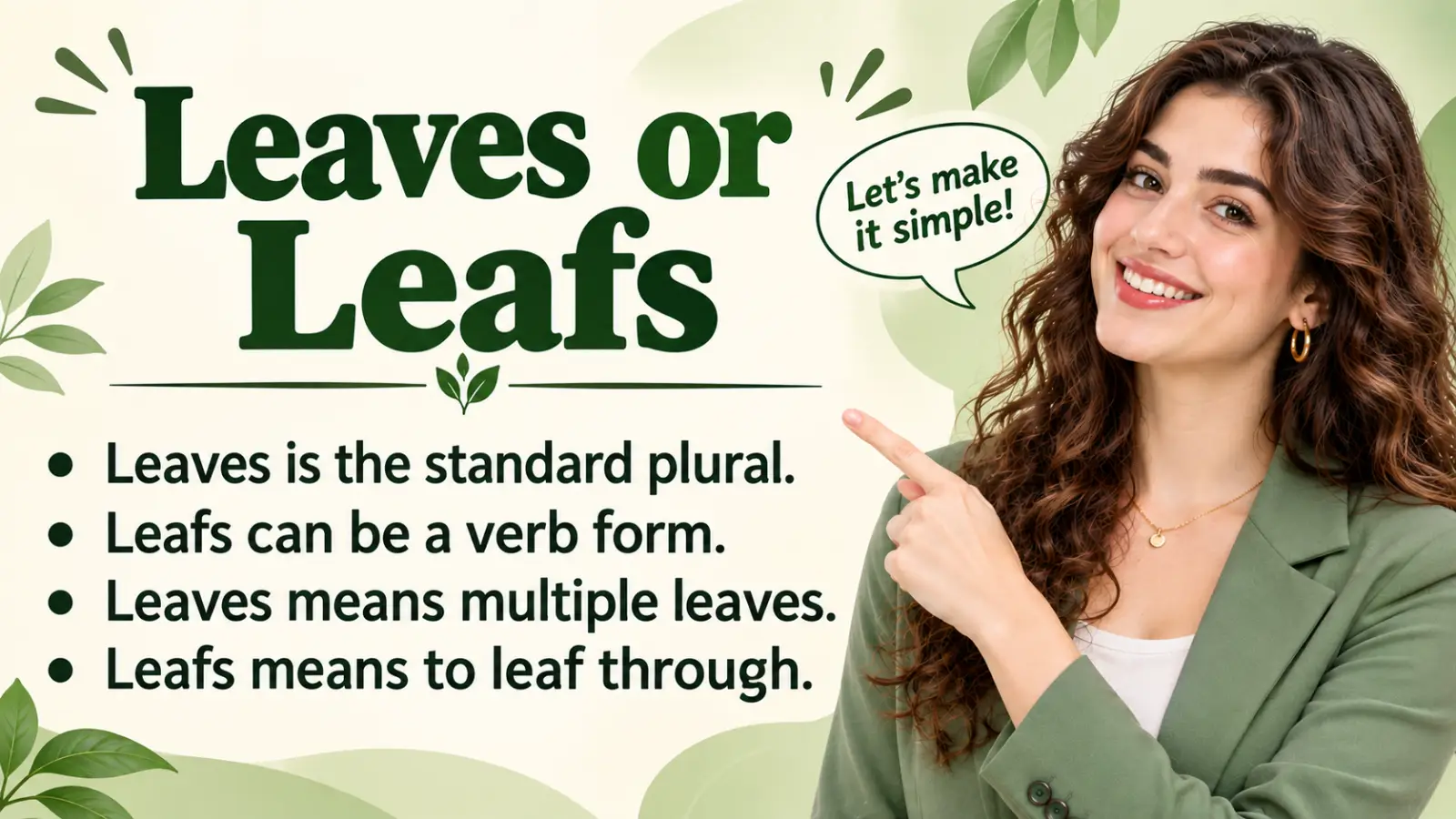
Leaves is the standard plural of leaf, meaning more than one leaf on a plant, tree, or other object. However, leafs is also a valid English form when used as a verb, such as “She leafs through a magazine.” The two spellings are not interchangeable because their grammatical uses differ.
Understanding the difference helps you write accurately about plants, books, table extensions, and everyday actions. The key is to identify whether the sentence needs a plural noun or a verb.
Related Post: Sence or Sense
Leaves vs. Leafs: The Key Difference
| Term | Meaning or status | When to use it | Example |
|---|---|---|---|
| Leaves | Standard plural of the noun “leaf” | When referring to multiple leaves | The leaves turned yellow. |
| Leaves | Present-tense verb form of “leave” | When someone or something departs or leaves something behind | She leaves work at five. |
| Leafs | Present-tense verb form of “leaf” | When someone turns through pages or a plant produces leaves | He leafs through the catalog. |
| Leafs | Part of a proper name | When writing the official name of a team, such as the Toronto Maple Leafs | The Toronto Maple Leafs played last night. |
The main rule is straightforward: use leaves for the plural of “leaf.” Use leafs when the grammar calls for the verb “leaf” or when it appears in a proper name. Some specialized uses may vary, but “leaves” is the usual plural form in standard writing.
What Does Leaves Mean?
Leaves has two common grammatical functions. It is the plural of the noun “leaf,” and it is the third-person singular present-tense form of the verb “leave.”
When to Use Leaves
Use “leaves” as a noun when referring to multiple plant parts or other objects called leaves, such as pages or removable panels on a table.
Use it as a verb when describing someone departing, abandoning something, or allowing something to remain.
Leaves in Example Sentences
1. The leaves fell from the maple tree.
“Leaves” is the plural noun referring to the parts of the tree.
2. She leaves for work at seven every morning.
Here, “leaves” is a verb meaning “departs.”
3. The dining table has two extra leaves.
In this example, “leaves” refers to removable panels that extend the table’s surface.
What Does Leafs Mean?
Leafs is a legitimate English word, but it is not the usual plural of the noun “leaf.” It is the third-person singular present-tense form of the verb “leaf,” which can mean to turn through pages or, in botanical use, to produce leaves.
When to Use Leafs
Use “leafs” when the subject is singular and performs the action described by the verb “leaf.”
For example, “She leafs through her notes” means she turns through the pages to look for information. A plant may also be described as leafing or leafing out as new leaves develop.
Leafs in Example Sentences
1. He leafs through the magazine while waiting.
“Leafs” describes the action of turning pages.
2. The gardener watches as the plant leafs out in spring.
Here, the verb refers to the plant developing leaves.
3. The Toronto Maple Leafs have a long history.
“Leafs” is part of the official name of a hockey team, so the spelling must be preserved.
How to Choose the Right Form
Look at the word’s role in the sentence rather than choosing based only on how it looks.
- If you mean more than one leaf, use leaves.
- If you mean someone departs or leaves something behind, use leaves.
- If you mean someone turns through pages, use leafs.
- If you are writing an official name such as the Toronto Maple Leafs, preserve Leafs as part of that name.
A Quick Test You Can Apply
Ask yourself: Is the word naming several objects, or describing an action?
- “The tree has many ___.” → leaves because the sentence needs a plural noun.
- “She ___ through the book.” → leafs because the sentence describes turning pages.
- “The bus ___ at noon.” → leaves because the verb means “departs.”
This test separates the most common uses without requiring you to memorize every sentence.
Common Mistakes and How to Fix Them
| Original sentence | Corrected sentence | Why it changes |
|---|---|---|
| The tree has green leafs. | The tree has green leaves. | “Leaves” is the standard plural of “leaf.” |
| She leaves through the magazine. | She leafs through the magazine. | “Leafs through” means turns pages to look through them. |
| The bus leafs at six. | The bus leaves at six. | “Leaves” is the correct form of “leave” for a singular subject. |
| The Toronto Maple Leaves won the game. | The Toronto Maple Leafs won the game. | The team’s official name uses “Leafs.” |
Why These Forms Get Confused
Both words come from the same spelling, “leaf,” but English uses different forms depending on grammar. The plural noun changes from leaf to leaves, while the verb leaf takes -s in the third-person singular present tense: “he leafs.”
The confusion is understandable because “leaves” is also a verb form, but it comes from “leave,” not “leaf,” when it means “departs” or “allows to remain.”
Does the Choice Change With Context?
Yes. The correct spelling depends on the intended meaning and grammatical function, not on whether you are writing American or British English.
Workplace, Academic, or Everyday Usage
In most everyday and formal writing, use leaves for multiple plant parts, pages, or table extensions.
Examples:
- Academic writing: “The leaves were examined under a microscope.”
- Workplace writing: “She leaves the office at five.”
- Everyday conversation: “The sidewalk is covered with leaves.”
Use leafs when it is the appropriate verb form, as in “He leafs through the paperwork before the meeting.”
Can You Use Leaves and Leafs Interchangeably?
No. The forms serve different grammatical functions in standard usage.
When Switching Changes the Meaning
Compare these sentences:
- The leaves covered the ground. The noun refers to multiple plant parts.
- He leafs through the papers. The verb describes turning pages.
Switching the spellings would create an error in these sentences because each word has a different grammatical role.
A useful distinction is that leaves can be either a plural noun or a form of “leave,” while leafs is generally a verb form of “leaf” in ordinary sentences.
Common Phrases With Leaves and Leafs
| Phrase | When to use it | Original example |
|---|---|---|
| Fallen leaves | Leaves that have dropped from plants or trees | We raked the fallen leaves into a pile. |
| Green leaves | Leaves that are green, often fresh or healthy | The plant has bright green leaves. |
| Leaves behind | When someone departs and something remains | She leaves behind a detailed set of instructions. |
| Leafs through | When someone quickly looks through pages | He leafs through the report before the meeting. |
| Turns over a new leaf | An idiom meaning to make a fresh start or change one’s behavior | After the move, he decided to turn over a new leaf. |
Apply the Rule to a Real Situation
Original Version
“Several leafs fell from the tree, and Maya leafs through a gardening book to identify them.”
Improved Version and Explanation
“Several leaves fell from the tree, and Maya leafs through a gardening book to identify them.”
Both words are needed, but for different reasons. Leaves is the plural noun for the plant parts. Leafs is the verb describing Maya turning through the book’s pages.
Why Does Leaf Change to Leaves?
Some English nouns ending in -f or -fe form their plurals by changing the final sound and spelling to -ves. Examples include:
- leaf → leaves
- knife → knives
- wolf → wolves
- shelf → shelves
However, this is not a universal rule. Words such as “roof” and “chief” usually form their plurals with -s: “roofs” and “chiefs.” Learn the plural form of each word rather than assuming every word ending in -f changes to -ves.
An Easy Way to Remember the Difference
Remember this simple sentence:
Trees have leaves, and readers leaf through books.
- Leaves = multiple plant parts.
- Leafs = turns pages, as in “She leafs through a book.”
- Leaves = also means departs, as in “She leaves at noon.”
This memory aid covers the most common uses, though proper names such as the Toronto Maple Leafs also use “Leafs.”
Practice: Can You Choose the Right Form?
Complete each sentence with leaves or leafs.
- The oak tree loses its ______ every fall.
- Marcus ______ through the manual to find the instructions.
- Our train ______ the station at 8:30 a.m.
Answers and Explanations
- Leaves — The sentence refers to multiple parts of a tree.
- Leafs — The verb describes turning through pages.
- Leaves — The verb means “departs.”
Frequently Asked Questions
Is leafs ever correct?
Yes. “Leafs” is correct as the third-person singular present-tense form of the verb “leaf,” as in “She leafs through a magazine.” It also appears in proper names such as the Toronto Maple Leafs.
What is the plural of leaf?
The standard plural is leaves. For example, “One leaf fell from the branch” becomes “Several leaves fell from the branch.”
Is leaves a noun or a verb?
It can be either. As a noun, it is the plural of “leaf.” As a verb, it is a form of “leave,” as in “He leaves early.”
Why is the Toronto team called the Maple Leafs instead of the Maple Leaves?
Toronto Maple Leafs is the team’s official name. Proper names retain their established spelling, even when that spelling differs from the usual plural form of a common noun.
Which Form Should You Use?
Use leaves when referring to multiple leaves on a tree, plant, table, or other object. Use leafs when describing someone turning through pages or when writing a proper name such as the Toronto Maple Leafs.
The easiest rule to remember is: leaves is the usual plural noun; leafs is a verb form or part of a name.
Sources