
Discrete vs. Discreet: Meaning, Difference, and Examples
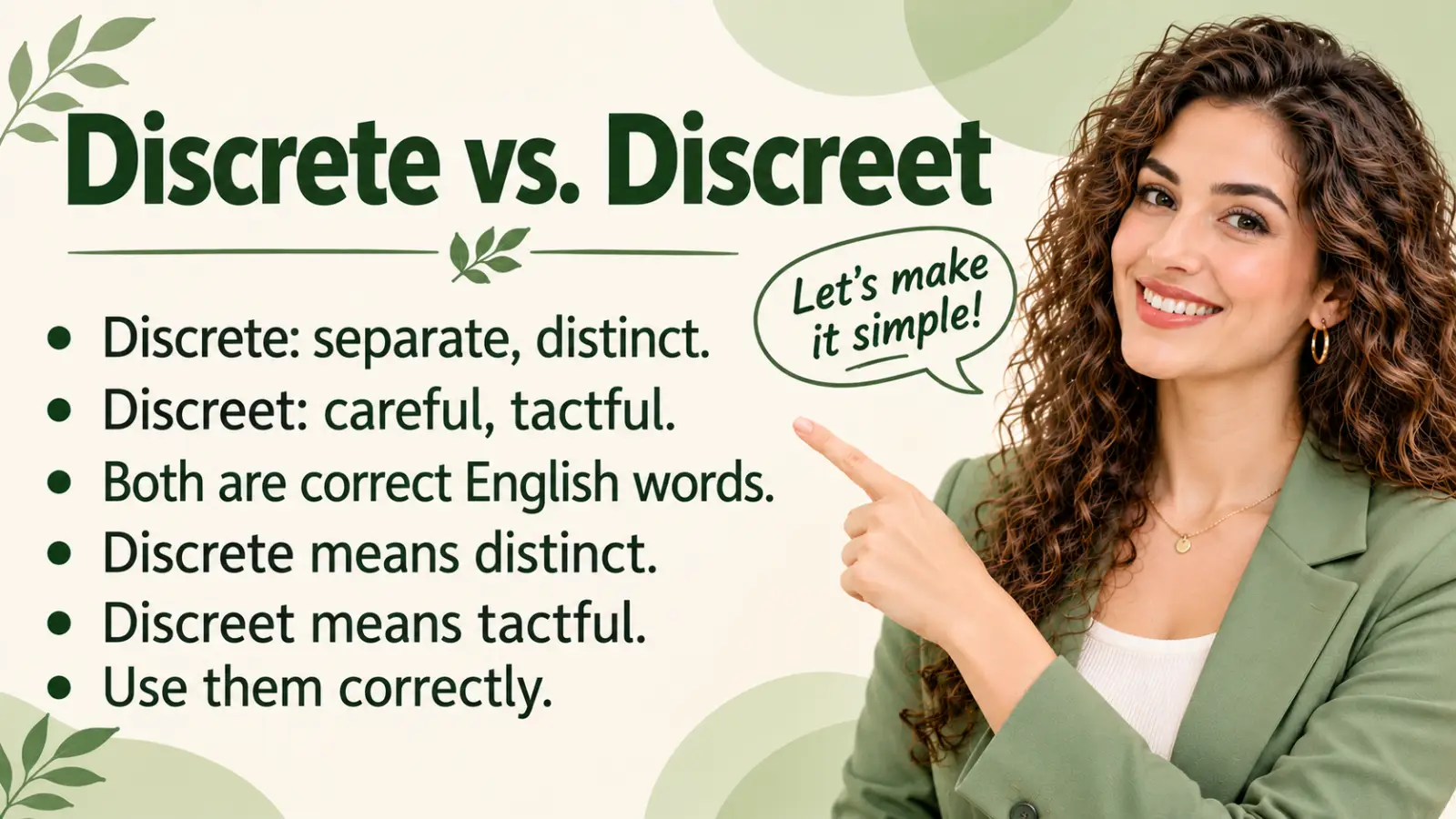
Discrete and discreet are both correct English words, but they have different meanings. Discrete means separate, distinct, or individually identifiable. Discreet means careful, tactful, or unlikely to attract attention, especially when handling private information.
The distinction matters because the words sound the same but communicate different ideas. Choosing the wrong one can change a sentence’s meaning, particularly in professional, academic, and everyday writing.
Related Post: Either-Or Questions Explained
Discrete vs. Discreet: The Key Difference
| Term | Meaning | When to use it | Example |
|---|---|---|---|
| Discrete | Separate, distinct, or individually identifiable | Describing independent parts, categories, units, or values | The report contains three discrete sections. |
| Discreet | Tactful, careful, private, or unobtrusive | Describing someone’s behavior or an action that avoids attention | Please be discreet about the conversation. |
Both words are adjectives and are pronounced the same way in standard American English. However, they are not interchangeable.
What Does Discrete Mean?
Discrete is an adjective that describes things that are separate, distinct, or individually distinguishable. It is useful when discussing parts, objects, categories, events, or values that can be identified separately.
The word is common in academic, scientific, mathematical, and technical writing. For example, a set of discrete values contains separate, identifiable values rather than a continuous range.
When to Use Discrete
Use discrete when you want to communicate that something is separate from other things or has its own individual identity.
Common situations include:
- Separate parts: A project divided into individual stages.
- Distinct categories: Groups with clearly different characteristics.
- Independent units: Components that can be identified separately.
- Mathematics and statistics: Values or variables that are separate and countable rather than continuous.
Discrete in Example Sentences
1. The course is divided into five discrete modules.
Each module is a separate part of the course.
2. Researchers identified three discrete groups within the study.
The groups had distinguishable characteristics.
3. The number of visitors is a discrete variable.
Visitors are counted in whole numbers rather than measured along a continuous scale.
What Does Discreet Mean?
Discreet is an adjective describing someone or something that shows good judgment, avoids unnecessary attention, or handles private matters carefully.
It often relates to confidentiality, tact, modesty, and privacy. A discreet person knows when to speak, when to remain silent, and how to avoid embarrassing others.
When to Use Discreet
Use discreet when describing behavior or actions that are careful, tactful, private, or unobtrusive.
Common situations include:
- Private conversations: Keeping sensitive information confidential.
- Professional behavior: Handling delicate matters with good judgment.
- Tactful actions: Avoiding embarrassment or unnecessary attention.
- Unobtrusive objects or designs: Something that does not attract notice.
Discreet in Example Sentences
1. Please be discreet about the company’s upcoming changes.
The speaker wants the information kept private.
2. The manager made a discreet inquiry about the applicant.
The manager asked questions carefully without drawing unnecessary attention.
3. She wore a discreet necklace to the formal event.
The necklace was simple and did not attract much attention.
How to Choose Between Discrete and Discreet
The easiest way to choose is to identify what you are describing.
- Use discrete when you mean separate, distinct, or individually identifiable.
- Use discreet when you mean tactful, private, cautious, or unobtrusive.
For example:
- The company operates through several discrete departments.
- The employee was discreet about the confidential discussion.
The first sentence describes separate departments. The second describes careful behavior.
A Quick Test You Can Apply
Try replacing the word with a synonym:
- If separate or distinct fits, choose discrete.
- If tactful, private, or unobtrusive fits, choose discreet.
Example:
“Please be ______ when discussing the customer’s personal information.”
Try the substitutions:
- Please be separate when discussing the customer’s personal information.
- Please be tactful when discussing the customer’s personal information.
The second sentence makes sense, so discreet is the correct choice.
When the Quick Test Does Not Work
Some sentences need more context because a word’s meaning depends on what it describes. For example, a discreet design is one that does not attract attention, while discrete design elements are separate components.
When both substitutions seem possible, consider the intended meaning rather than relying on the sentence structure alone.
Common Mistakes and How to Fix Them
| Original sentence | Corrected sentence | Why it changes |
|---|---|---|
| Please keep this information discrete. | Please keep this information discreet. | The intended meaning is to keep the information private. |
| The report has four discreet sections. | The report has four discrete sections. | The sections are separate parts of the report. |
| The assistant was discrete during the meeting. | The assistant was discreet during the meeting. | The intended meaning is that the assistant acted carefully and avoided attention. |
| The experiment used several discreet variables. | The experiment used several discrete variables. | The variables are individually distinguishable or countable. |
Why These Forms Get Confused
The main reason discrete and discreet are confused is that they have nearly identical spellings and the same pronunciation. Both words also share a historical connection, which helps explain their similar appearance.
However, their modern meanings have become distinct. The letter t in discrete separates the two e’s, making it a useful reminder of separate things. Discreet, with its two e’s together, connects naturally to secrecy and discretion.
Does the Choice Change With Context?
The meanings remain distinct in American and British English. However, the context can help determine which word is appropriate.
Workplace, Academic, or Everyday Usage
For workplace writing, use discreet when discussing confidentiality, sensitive conversations, or tactful behavior.
- Please be discreet when handling employee records.
- The supervisor handled the complaint discreetly.
For academic and technical writing, discrete often describes separate categories, units, or values.
- The research examined four discrete populations.
- The model uses discrete numerical values.
During everyday conversations, both words are useful:
- We live in two discrete neighborhoods.
- He tried to be discreet about the surprise party.
Can You Use Discrete and Discreet Interchangeably?
No. Although discrete and discreet sound alike, they have different meanings. Replacing one with the other can make a sentence incorrect or communicate an unintended idea.
When Switching Changes the Meaning
Consider these two sentences:
– The company has discrete departments.
The departments are separate from one another.
– The company has discreet departments.
This suggests the departments are unobtrusive or careful, which is probably not the intended meaning.
Another comparison:
– She gave a discreet response.
Her response was tactful or careful.
– She gave a discrete response.
This suggests the response was separate or distinct, not that she was being tactful.
The correct choice depends on the meaning you want to express.
Common Phrases With Discrete and Discreet
These common combinations show how each word naturally appears in sentences.
| Phrase | When to use it | Original example |
|---|---|---|
| Discrete categories | Separate groups or classifications | The survey results were organized into discrete categories. |
| Discrete variables | Countable or separately identifiable values in mathematics and statistics | The analyst studied several discrete variables. |
| Discrete units | Individual, separate components | The machine is made up of several discrete units. |
| Discreet conversation | A private or tactful discussion | They arranged a discreet conversation after the meeting. |
| Discreet inquiry | A careful question or investigation that avoids attention | The recruiter made a discreet inquiry about the candidate. |
An Easy Way to Remember the Difference
Remember these two simple connections:
- Discrete = separate. The letter t separates the two e’s, just as discrete things are separate.
- Discreet = discretion. If someone uses discretion, they show good judgment and handle information carefully.
For example, a business may have discrete departments, but its employees should be discreet when discussing confidential matters.
Frequently Asked Questions
What is the main difference between discrete and discreet?
Discrete means separate or distinct, while discreet means tactful, careful, or private. They sound alike but have different meanings.
Are discrete and discreet pronounced the same?
Yes. In standard American English, both are pronounced the same way, usually represented as /dɪˈskriːt/. They are homophones, meaning they sound alike but have different spellings and meanings.
Is discreet related to the word discretion?
Yes. Discreet is closely related to discretion, which refers to good judgment, tact, or the ability to handle information carefully.
What is the opposite of discreet?
The opposite is indiscreet, meaning careless or lacking good judgment, especially when speaking or sharing private information.
What is the opposite of discrete?
In many mathematical and technical contexts, the opposite of discrete is continuous. In everyday contexts, words such as connected or combined may express the opposite, depending on the sentence.
Which Form Should You Use?
Choose discrete when describing separate parts, distinct categories, or individually identifiable values. Choose discreet when describing someone who acts carefully, respects privacy, or avoids attracting attention.
Neither word is a misspelling. Both are standard English words, but they serve different purposes. Remember discrete = separate and discreet = tactful, and you can use the correct form confidently.
Sources


One Comment