Lie Down vs. Lay Down: Learn the Correct Usage
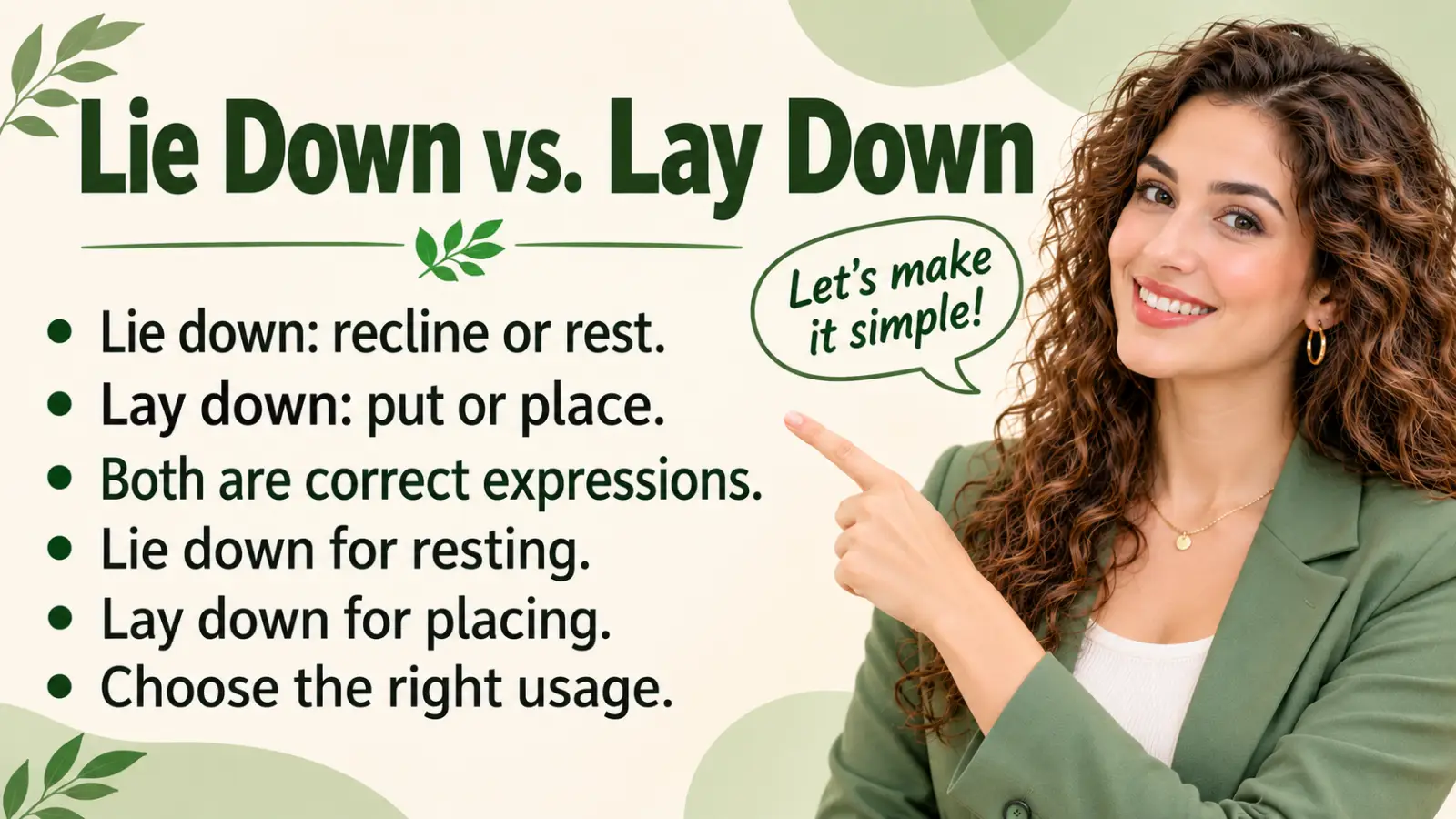
Lie down and lay down are both correct expressions, but they have different grammatical uses. Use lie down when you mean to recline or rest your body. Use lay down when you mean to put or place someone or something somewhere.
The confusion becomes more complicated when discussing the past tense because lay is also the past tense of lie. Understanding this difference helps you write correctly in emails, assignments, professional documents, and everyday conversations.
Related Post: Discrete vs. Discreet
Lie Down vs. Lay Down: The Key Difference
| Term | Meaning or status | When to use it | Example |
|---|---|---|---|
| Lie down | Recline or move into a horizontal position | When someone or something rests without a direct object | I need to lie down. |
| Lay down | Put or place something or someone down | When an object or person receives the action | Please lay the blanket down. |
| Lay down (past tense of lie down) | Reclined or rested | When describing a past action of reclining | I lay down yesterday. |
The important distinction is that lie does not require a direct object, while lay normally requires one when it means to put or place something.
What Does Lie Down Mean?
Lie down means to recline, rest, or move your body into a horizontal position. It is an intransitive verb phrase, meaning it does not require a direct object.
Use it when someone wants to rest on a bed, sofa, floor, or another surface.
When to Use Lie Down
Choose lie down when:
- You want to take a nap or rest.
- Someone is reclining on a bed or couch.
- A person needs to rest because of tiredness.
- An animal or person moves into a horizontal position.
Lie Down in Example Sentences
1. I need to lie down after working all afternoon.
The speaker wants to rest their body.
2. The doctor advised him to lie down for a few minutes.
The doctor recommends resting in a horizontal position.
3. The dog likes to lie down beside the fireplace.
The dog rests without placing another object somewhere.
What Does Lay Down Mean?
Lay down means to put, place, or set someone or something onto a surface. It is a transitive verb phrase, so it normally requires a direct object.
Use it when someone places an item, such as a book, blanket, or phone, somewhere.
When to Use Lay Down
Choose lay down when:
- You are putting an object onto a surface.
- Someone places a baby or another person somewhere.
- You are setting something aside.
- You are establishing a rule, condition, or principle.
Lay Down in Example Sentences
1. Please lay down your phone before dinner.
The phone is the object being placed somewhere.
2. She decided to lay down the blanket near the window.
She is placing the blanket on a particular surface.
3. The manager will lay down new workplace rules.
Here, lay down means to establish or introduce rules.
How to Choose Between Lie Down and Lay Down
The easiest way to choose is to ask whether someone is reclining or placing something somewhere.
- Use lie down when the subject is resting or reclining.
- Use lay down when the subject places an object or person somewhere.
For example:
- I want to lie down before dinner.
- I want to lay down the newspaper before dinner.
The first sentence describes resting. The second describes placing an object.
A Quick Test You Can Apply
Check whether the verb has a direct object.
Question: What is being placed?
- If the sentence identifies something being placed, use lay.
- If the subject is simply reclining, use lie.
Compare:
| Sentence | Correct choice | Reason |
|---|---|---|
| I want to ___ down. | lie | The speaker is reclining. |
| Please ___ the book down. | lay | The book is being placed. |
| She needs to ___ down and rest. | lie | She wants to rest her body. |
| He will ___ the tools down. | lay | The tools are receiving the action. |
When the Quick Test Does Not Work
The test becomes confusing when you discuss past actions because lay has two grammatical roles.
- Lie → lay → lain: Recline.
- Lay → laid → laid: Put or place something.
For example:
- Today, I lie down after lunch.
- Yesterday, I lay down after lunch.
- Today, I lay the book down.
- Yesterday, I laid the book down.
The sentence “I lay down yesterday” is grammatically correct because lay is the past tense of lie.
Common Mistakes and How to Fix Them
| Original sentence | Corrected sentence | Why it changes |
|---|---|---|
| I am going to lay down for a nap. | I am going to lie down for a nap. | The speaker is reclining, not placing something. |
| I lied down after dinner. | I lay down after dinner. | Lay is the past tense of lie when it means recline. |
| She is laying on the sofa. | She is lying on the sofa. | She is resting rather than placing something. |
| I have laid down for an hour. | I have lain down for an hour. | Lain is the past participle of lie. |
Why Lie Down and Lay Down Get Confused
The confusion mainly comes from the overlapping verb forms. Lay is both the present-tense form of the verb meaning to place something and the past-tense form of the verb meaning to recline.
For example, “I lay down yesterday” is correct, even though “I lay down now” is not the standard present-tense form when describing reclining.
Another source of confusion is everyday conversation, where people frequently use lay down when they mean lie down. This informal usage is widespread, but the traditional grammatical distinction remains important for edited writing.
Does the Choice Change With Context?
The basic grammatical distinction remains the same in American and British English. However, casual speech sometimes differs from formal edited writing.
Formal Writing vs. Casual Conversation
In formal writing, school assignments, professional emails, and edited articles, follow the traditional distinction:
- Formal: I need to lie down for a while.
- Informal speech: I need to lay down for a while.
The second construction is common in casual conversation, but lie down is the preferred form in standard edited English when describing reclining.
Can You Use Lie Down and Lay Down Interchangeably?
No. In standard grammar, the two expressions have different functions. Replacing one with the other can change the meaning or create a grammatical error.
When Switching Changes the Meaning
Consider these examples:
- I need to lie down. I want to rest my body.
- I need to lay down the blanket. I want to place the blanket somewhere.
The first sentence describes a person’s position, while the second describes an action performed on an object.
However, both expressions can appear correctly when the tense and meaning are considered:
- I lie down every afternoon. (Present)
- I lay down every afternoon when I was younger. (Past)
Common Phrases With Lie Down and Lay Down
| Phrase | When to use it | Original example |
|---|---|---|
| Lie down for a nap | When resting or sleeping | I usually lie down for a nap after lunch. |
| Lie down on the couch | When reclining on furniture | The children lie down on the couch after school. |
| Lay down the law | When establishing strict rules or expectations | The coach decided to lay down the law before practice. |
| Lay down your weapons | When ordering someone to put weapons on the ground | The officer instructed the suspect to lay down his weapons. |
| Lay down the foundation | When establishing the basis for something | The first chapter lays down the foundation for the entire course. |
Apply the Rule to a Real Situation
Imagine writing a message to your manager explaining that you are feeling tired and need a short break.
Original Version
“Hi Mark,
I am feeling exhausted after the morning shift. I think I should lay down for 30 minutes before returning to work.”
Improved Version and Explanation
“Hi Mark,
I am feeling exhausted after the morning shift. I think I should lie down for 30 minutes before returning to work.”
The necessary correction is changing lay down to lie down because the speaker is describing personal rest rather than placing an object somewhere.
What Are the Past Tense Forms of Lie and Lay?
Understanding the verb forms makes this grammar rule much easier.
| Verb | Present | Past | Past participle | -ing form |
|---|---|---|---|---|
| Lie (recline) | lie | lay | lain | lying |
| Lay (place) | lay | laid | laid | laying |
| Lie (tell an untruth) | lie | lied | lied | lying |
Examples:
- Present: I lie down every afternoon.
- Past: I lay down yesterday.
- Past participle: I have lain down several times today.
- Present: I lay the keys on the table.
- Past: I laid the keys on the table.
- Past participle: I have laid the keys on the table.
Remember that lied belongs to the verb meaning to tell an untruth. It is not the past tense of reclining.
An Easy Way to Remember the Difference
Use this simple memory aid:
- Lie = yourself. You lie down when you want to rest.
- Lay = an object. You lay something down when you place it somewhere.
LIE DOWN
You rest yourself.
Example: I lie down on the bed.
LAY DOWN
You place something.
Example: I lay the book down.
For the past tense, remember one additional rule: I lay down yesterday is correct because lay is the past tense of lie.
Practice: Can You Choose the Right Form?
Complete these sentences using the correct form.
- I need to ______ down because I have a headache.
- Yesterday, she ______ down after finishing her homework.
- Please ______ the documents down on my desk.
Answers and Explanations
- Lie — The speaker wants to recline.
- Lay — Lay is the past tense of lie when it means to recline.
- Lay — The documents are being placed on the desk.
Frequently Asked Questions
Is it lie down or lay down?
Use lie down when you mean to recline or rest. Use lay down when you mean to put or place someone or something somewhere.
Is “I’m going to lay down” grammatically correct?
In standard edited English, use “I’m going to lie down” when you mean to rest. Lay down is common in informal speech, but lie down is the traditional standard form.
Is “I lay down” correct?
Yes. Lay is the simple past tense of lie when it means to recline. For example, “I lay down after lunch yesterday” is grammatically correct.
What is the past tense of lie down?
The past tense is lay down. For example, “I lie down every afternoon” becomes “I lay down yesterday afternoon.”
What is the past tense of lay down?
The past tense is laid down when lay means to put or place something. For example, “She lays the book down” becomes “She laid the book down.”
Which Form Should You Use?
Use lie down when describing yourself, another person, or an animal reclining. Choose lay down when someone places an object or person somewhere.
For standard American English writing, remember the forms lie, lay, lain for reclining and lay, laid, laid for placing something. This simple distinction will help you avoid common mistakes in everyday and professional communication.
Sources