
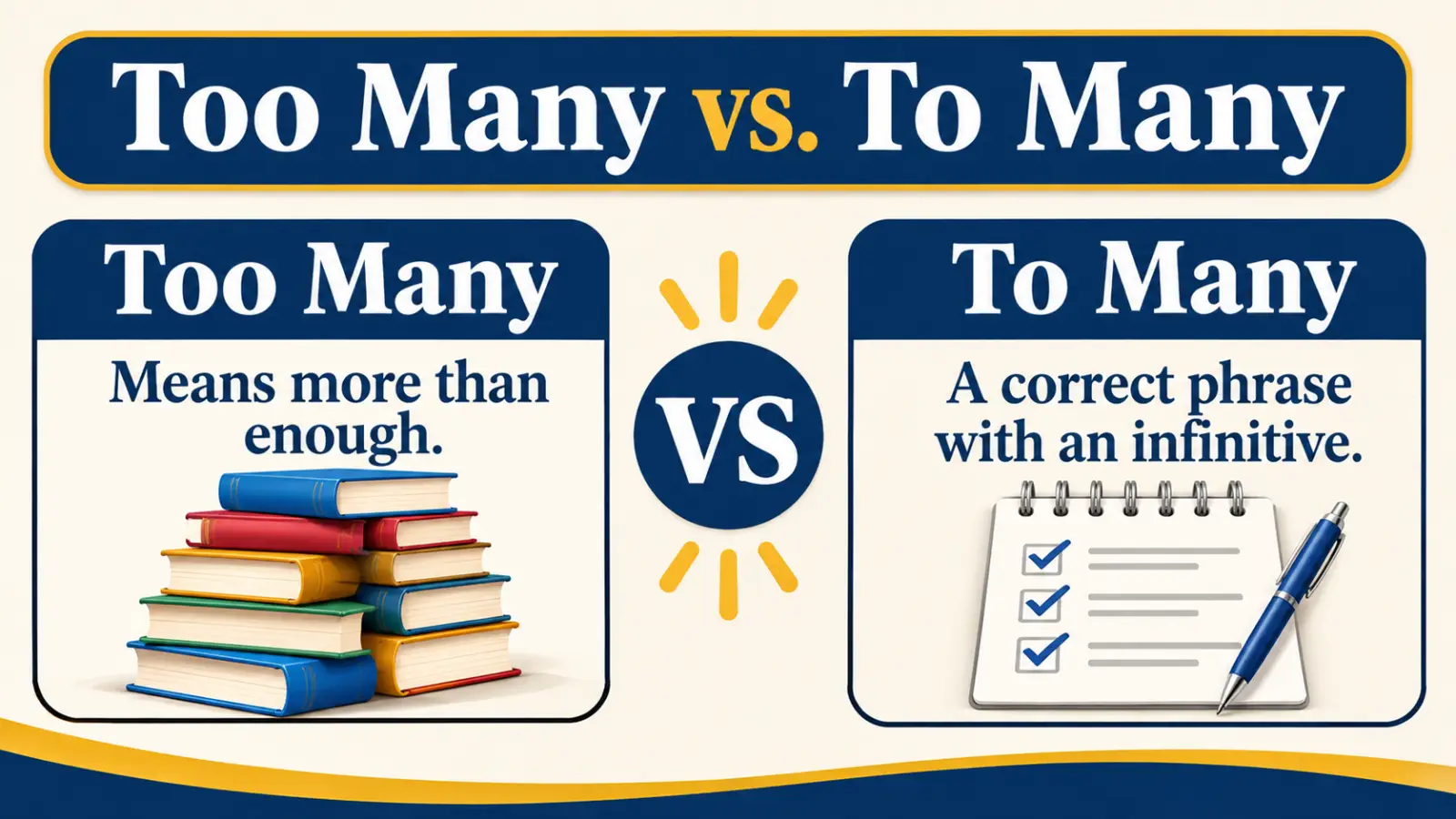
Too Many vs. To Many: Learn the Difference and Correct
Too many is the correct phrase when describing a number that exceeds what is needed, wanted, or acceptable. To many can also be grammatically correct, but only when to serves its own grammatical purpose, such as introducing the recipients of an action. The right choice depends on the meaning of the sentence.
For example, write “There are too many emails to answer” when the number of emails feels excessive. Write “She sent the announcement to many employees” when describing who received the announcement. Although the expressions sound alike, they perform different grammatical functions.
Related Post: Emigrate vs. Immigrate
Too Many vs. To Many: The Key Difference
| Term | Meaning or status | When to use it | Example |
|---|---|---|---|
| Too many | A phrase expressing an excessive number | Before plural countable nouns or without a noun when the meaning is clear | We have too many assignments. |
| To many | The preposition to followed by many, usually referring to a large group of recipients or another relationship | When the sentence requires the preposition to | The notice was sent to many customers. |
Both forms can appear in correct English, but they are not interchangeable. Too many describes an excessive quantity, while to many usually connects an action or relationship to a large number of people or things.
What Does Too Many Mean?
Too many means more than the desired, necessary, or acceptable number. Here, too is an adverb expressing excess, and many refers to a large number of countable items.
The phrase commonly appears before plural nouns, such as books, questions, cars, and people. It can also stand alone when the noun is already understood.
When to Use Too Many
Use too many when you want to say that the number of something is excessive.
Common sentence patterns include:
- Too many + plural noun: There are too many cars on this street.
- Subject + has/have + too many + noun: I have too many errands today.
- Too many without a noun: How many chairs do we need? Five is enough; ten would be too many.
The phrase often suggests a problem or an unwanted result, although the exact meaning depends on the situation.
Too Many in Example Sentences
- The store received too many orders to process before noon. The number of orders exceeded what the staff could handle within the available time.
- There are too many advertisements on this website. The speaker believes the number of advertisements is excessive.
- We invited too many people to fit comfortably in the room. The number of guests exceeds the room’s comfortable capacity.
Each example uses too many to describe a number that goes beyond a practical limit or preference.
Is To Many a Word or a Phrase?
To many is not a fixed expression meaning “an excessive number,” but it can be a correct combination of two separate words. The preposition to may indicate a recipient, destination, or relationship, while many describes a large number of people or things.
For example, “The manager spoke to many applicants” is grammatically correct. The word to connects the verb spoke to the people addressed, and many indicates that the group was large.
When to Use To Many
Use to many when the sentence requires to and the following word many describes a group or quantity.
Examples include:
- Sent to many customers: The company sent a discount code to many customers.
- Spoke to many students: The guest speaker spoke to many students after the presentation.
- Available to many people: The service is available to many people across the country.
In each case, to has a grammatical role separate from many. The sentence is not saying that the number itself is excessive.
To Many in Example Sentences
- The school distributed the schedule to many parents. The parents are the recipients of the schedule.
- This scholarship is available to many qualified applicants. The preposition connects the idea of availability with the people who can apply.
- The coach gave instructions to many players before the game. The sentence identifies the group that received the instructions.
These examples show why to many should not automatically be treated as a spelling mistake.
How to Choose the Right Phrase
The easiest way to choose is to ask what the sentence means.
- Use too many when you mean more than necessary, wanted, or acceptable.
- Use to many when to is required by the sentence and many describes a group of people or things.
A Quick Test You Can Apply
Try replacing too many with more than enough.
- “There are too many boxes in the hallway.”
- “There are more than enough boxes in the hallway.”
The second version conveys the intended idea of excess, so too many fits.
Now consider this sentence:
“The company sent invitations to many guests.”
Replacing to many with “more than enough” would change the sentence’s structure and meaning. The phrase identifies the recipients of the invitations, so to many is appropriate.
When the Quick Test Does Not Work
The substitution test is a useful guide, not a universal rule. Some sentences can express excess and still contain the preposition to elsewhere.
Consider these examples:
- Too many people complained to the manager. The number of people who complained was excessive.
- The manager listened to many people. The manager listened to a large group of people.
The first sentence uses too many to describe the number of people. The second uses to many because the verb phrase listened to requires the preposition to.
Always check the grammatical role of each word rather than choosing based on sound alone.
Common Mistakes and How to Fix Them
| Original sentence | Corrected sentence | Why it changes |
|---|---|---|
| There are to many cars on the road. | There are too many cars on the road. | Too many expresses an excessive number of cars. |
| She sent the message too many customers. | She sent the message to many customers. | The preposition to identifies the recipients. |
| We have to many tasks to finish today. | We have too many tasks to finish today. | The sentence describes an excessive number of tasks. |
| The teacher spoke too many students after class. | The teacher spoke to many students after class. | The verb phrase spoke to requires the preposition to. |
Why These Forms Get Confused
Too and to are homophones in standard American English: they generally sound the same but have different meanings and grammatical functions.
Because pronunciation does not distinguish them, writers may choose the wrong spelling while typing quickly or writing from memory. The best solution is to identify the sentence’s intended meaning and check how each word functions.
Does the Choice Change With Context?
The basic distinction remains the same across American English contexts. However, the surrounding sentence determines whether too many expresses excess or to many forms part of a grammatical construction.
Formal Writing vs. Casual Conversation
In emails, essays, reports, and everyday messages, too many is appropriate for an excessive number:
“The team has too many projects to complete this week.”
Use to many when the sentence needs the preposition:
“The director presented the proposal to many department leaders.”
Neither form is inherently more formal than the other. Correctness depends on meaning and sentence structure.
Can You Use Too Many and To Many Interchangeably?
No. The phrases have different grammatical functions, so switching them can create an error or change the meaning.
When Switching Changes the Meaning
Compare these sentences:
- The company sent too many notices to customers. The company sent an excessive number of notices.
- The company sent notices to many customers. The notices went to a large number of customers; the sentence does not necessarily suggest excess.
The first sentence describes the quantity of notices. The second describes the size of the recipient group. Both can be correct, but they communicate different information.
Common Phrases With Too Many and To Many
| Phrase | When to use it | Original example |
|---|---|---|
| Too many questions | When the number of questions is excessive | We received too many questions during the short meeting. |
| Too many people | When a group is larger than desired or practical | Too many people crowded around the entrance. |
| Too many times | When an action has happened more often than desired | I’ve explained the procedure too many times already. |
| To many customers | When identifying a large group receiving something | The store sent coupons to many customers. |
| To many students | When identifying a group addressed or affected by an action | The program offers free tutoring to many students. |
The key is to look at the full phrase. Too many expresses excess, while to many typically links an action or relationship to a large group.
Apply the Rule to a Real Situation
Imagine that you are writing an email to your manager about a busy week and a company announcement.
Original Version
“We have to many projects this week, so I sent an update too many team members.”
The first phrase is incorrect because the sentence describes an excessive number of projects. The second is incorrect because sent requires to to introduce the recipients.
Improved Version and Explanation
“We have too many projects this week, so I sent an update to many team members.”
The first correction changes to many to too many because the number of projects is excessive. The second changes too many to to many because the team members are the recipients of the update.
This example demonstrates why the two forms must be evaluated separately, even when they appear in the same sentence.
What Is the Difference Between Too, To, and Two?
These three words sound alike in standard American English, but they have different meanings.
- Too: Means “also” or “more than necessary.” Example: “There are too many boxes.”
- To: Commonly introduces a destination, recipient, or infinitive verb. Example: “She walked to the office.”
- Two: Represents the number 2. Example: “She carried two boxes.”
Knowing these differences can help you select the correct phrase when writing about quantities, destinations, and numbers.
An Easy Way to Remember the Difference
Use this memory aid:
- Too many = too much of a countable number.
- To many = to a large group.
For example, “There are too many students for one classroom” describes excess. “The teacher gave the instructions to many students” identifies the recipients.
The second phrase still needs a sentence structure that calls for to. The memory aid helps distinguish the meanings, but it does not replace checking the full sentence.
Frequently Asked Questions
Is to many always incorrect?
No. To many is correct when to serves its normal grammatical function and many describes a group. For example, “The invitation was sent to many families” is correct.
Is too many one word or two words?
Too many is written as two separate words. Too expresses excess, and many refers to a large number of countable items.
Why is too many correct when describing an excessive number?
Too can mean more than is needed, wanted, or acceptable. Combined with many, it describes an excessive number of countable things, as in “There are too many cars.”
How can I remember whether to use too or to?
Ask whether the sentence means “more than enough” or needs the preposition to. If it means an excessive number, use too many. If it identifies a recipient or completes a construction such as speak to, use to many when the sentence calls for that structure.
Is too many grammatically correct with uncountable nouns?
No. Use too much with uncountable nouns such as water, time, and information. Use too many with plural countable nouns such as bottles, hours, and questions.
Which Form Should You Use?
Choose too many when you mean that a countable number exceeds what is needed or acceptable. Use to many when the preposition to connects an action or relationship to a large group.
For a final check, try replacing too many with “more than enough.” If that preserves the intended meaning, too many is likely correct. Otherwise, examine whether the sentence requires the preposition to.
Sources
- Cambridge Dictionary — Too
- Oxford Learner’s Dictionaries — Quantifiers: Too Much, Many and Not Enough


One Comment