Wacky vs. Whacky: Learn Which Spelling to Use
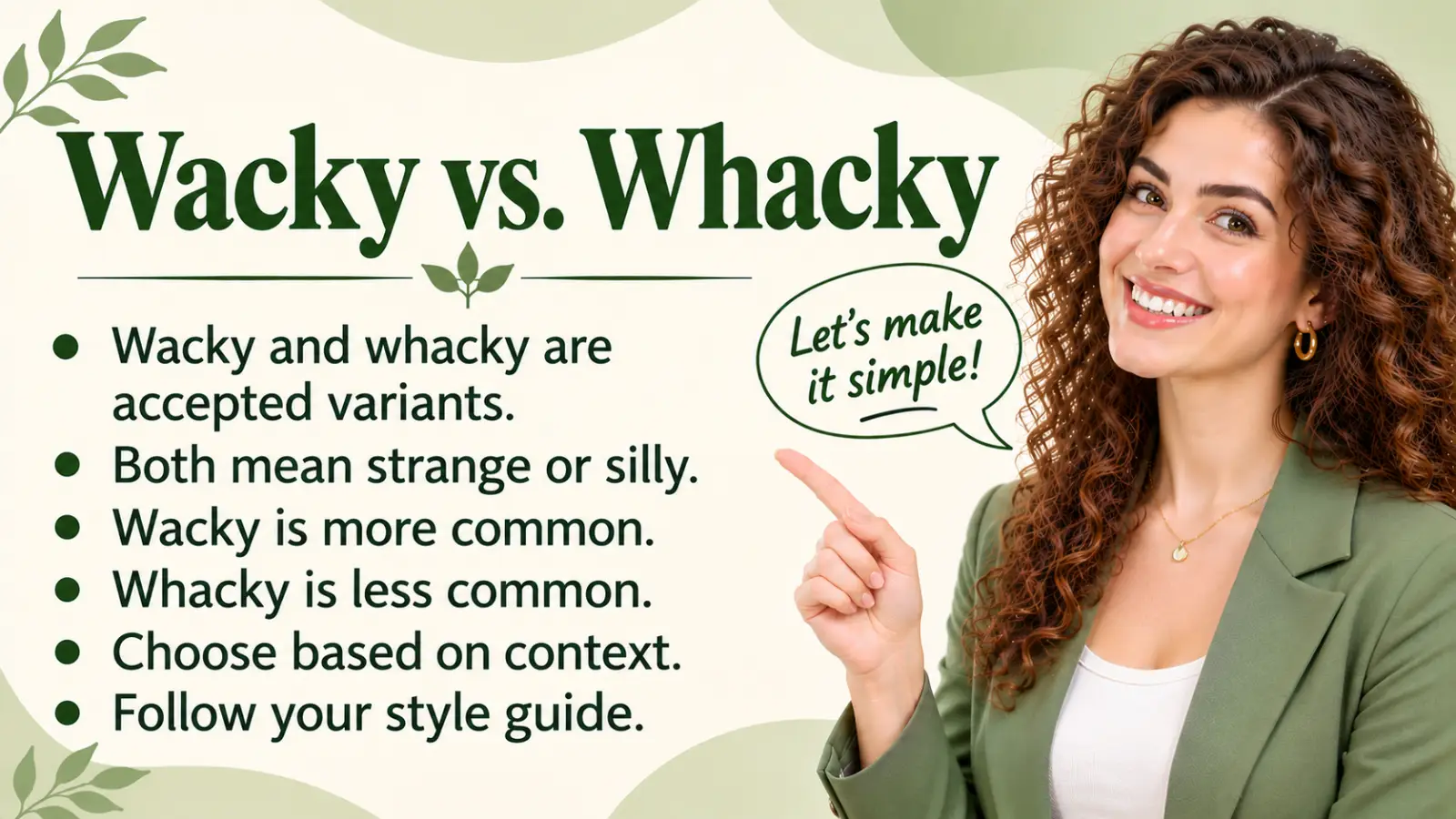
Wacky and whacky are accepted spelling variants of the same informal adjective, meaning strange, silly, eccentric, or amusingly unusual. However, wacky is the preferred spelling for most American English writing, while whacky is a less common alternative.
Choosing the right form matters when writing articles, school assignments, emails, or marketing copy. If you want the spelling most readers expect, use wacky unless you are preserving a specific spelling for a name, quotation, or stylistic purpose.
Related Post: Wracking or Racking
Wacky vs. Whacky: The Key Difference
| Term | Meaning or status | When to use it | Example |
|---|---|---|---|
| Wacky | The preferred spelling of an informal adjective meaning silly, eccentric, or unusual | Everyday American English and professional content | The comedian shared a wacky story. |
| Whacky | An accepted but less common spelling variant with the same meaning | When preserving a particular spelling or using an intentional stylistic choice | The advertisement featured a whacky character. |
The difference is primarily spelling, not meaning. Both words can describe something funny, unconventional, or slightly absurd. For ordinary American English writing, wacky is the safer and more familiar choice.
What Does Wacky Mean?
Wacky is an informal adjective used to describe someone or something that is unusual, silly, eccentric, or amusingly unconventional. Depending on the context, it can express affection, surprise, humor, or mild criticism.
The word often describes playful creativity rather than something genuinely dangerous or harmful.
When to Use Wacky
Use wacky when describing:
- Unusual ideas: Creative suggestions that seem strange but entertaining.
- Funny behavior: Actions that are silly, unpredictable, or eccentric.
- Playful designs: Costumes, decorations, characters, or products that stand out.
- Unconventional entertainment: Comedy, stories, games, or performances with an absurd style.
The word is informal, so it works especially well in conversation, blogs, advertisements, and friendly messages. For highly formal writing, words such as unconventional, eccentric, or unusual may be more suitable.
Wacky in Example Sentences
- The children came up with a wacky plan for their school talent show.
The plan is unusual and playful. - Her wacky sense of humor makes every family gathering entertaining.
The adjective describes a funny, unconventional personality. - The company launched a wacky advertisement featuring dancing vegetables.
The advertisement uses an absurd and amusing concept.
What Does Whacky Mean?
Whacky is an alternative spelling of wacky. It carries the same general meaning and is recognized by major English dictionaries, although it is less common as the default spelling in American English.
It is not a separate word with a distinct definition. Adding the letter h does not create a meaningful difference in how the adjective is used.
When to Use Whacky
Use whacky when the spelling is intentional, such as when:
- Reproducing a person’s exact wording in a quotation.
- Preserving the spelling used by a business, character, publication, or product name.
- Following an established house style that specifically uses the variant.
Otherwise, choose wacky for general American English writing. Using the less common variant is not automatically a spelling error, but some readers may interpret it as a typo.
Whacky in Example Sentences
- The magazine described the inventor’s whacky experiment as entertaining.
The sentence uses an accepted alternative spelling of wacky. - The shop’s sign advertised a whacky collection of handmade toys.
The adjective describes an unusual and playful collection. - He suggested a whacky solution to the problem during the meeting.
The word describes an unconventional idea. In standard American English editing, wacky would usually be preferred.
How to Choose the Right Spelling
The simplest rule is to use wacky for ordinary writing aimed at an American audience. Although whacky is recognized, it is the less common alternative and generally offers no change in meaning.
A Quick Test You Can Apply
Ask yourself whether you are writing a standard sentence or reproducing a specific spelling.
- Writing a regular sentence? Choose wacky.
- Quoting a source that uses whacky? Keep the original spelling if accuracy matters.
- Writing a brand or character name? Follow the official spelling.
- Following a style guide? Use the spelling required by that guide.
For example:
- Preferred: The team developed a wacky promotional campaign.
- Alternative: The team developed a whacky promotional campaign.
Both sentences communicate the same idea, but the first is the recommended choice for general US writing.
When the Quick Test Does Not Work
The preference for wacky does not mean that whacky is always wrong. A direct quotation, proper name, or deliberate creative choice may require the alternative spelling.
Also, do not confuse a less common spelling with a different grammatical form. Both words function as adjectives and can take the comparative and superlative forms wackier and wackiest.
Common Mistakes and How to Fix Them
| Original sentence | Corrected sentence | Why it changes |
|---|---|---|
| The designer created a whacky logo for the American audience. | The designer created a wacky logo for the American audience. | The correction uses the preferred US spelling. |
| We had the wackiest and most whacky costume at the party. | We had the wackiest costume at the party. | The revision removes unnecessary repetition; whacky is not inherently incorrect. |
| Her idea was to wacky for the project. | Her idea was too wacky for the project. | Too is needed to express an excessive degree; this is a grammar and word-choice error, not a spelling-variant issue. |
| The character’s name is Whacky, but the editor changed it to Wacky. | The character’s name is Whacky, so the editor should preserve that spelling. | Proper names should retain their established spelling unless a change is intended. |
Why These Forms Get Confused
The two spellings look and sound very similar, and both communicate the same meaning. The additional h can make whacky look like a different or more emphatic form, but it does not establish a separate meaning.
Because both forms appear in published English, writers may also encounter inconsistent spellings across websites, books, and informal messages. Following a consistent style helps readers focus on the message rather than the spelling variation.
Does the Choice Change With Context?
American vs. British English
For American English, wacky is the recommended default. Whacky is also recognized, but it is less common.
British English sources also recognize both spellings. Cambridge marks whacky as mainly British informal usage and notes that American English usually uses wacky. This is a difference in spelling preference, not a difference in meaning.
Formal Writing vs. Casual Conversation
Both spellings can appear in informal conversation, humor, and creative writing. However, wacky is the more practical choice for articles, reports, educational content, and business communication aimed at a general American audience.
The word itself remains informal regardless of which spelling you choose. In formal academic or business writing, unusual, unconventional, or eccentric may fit better depending on the intended meaning.
Can You Use Wacky and Whacky Interchangeably?
Yes. When both words are used as the adjective meaning silly, eccentric, or unusual, they are interchangeable in meaning. The main difference is that wacky is the preferred spelling for general American English, while whacky is a less common variant.
When Both Forms Work
Both spellings can describe the same thing:
- The children invented a wacky game.
- The children invented a whacky game.
The sentences have the same meaning. The first is the recommended version for most US readers.
When Switching Changes the Meaning
Switching between these two spellings does not normally change the meaning. However, changing a proper name or an exact quotation may change the accuracy of the text.
For example:
- Original name: The performer is known as Whacky Willy.
- Edited name: The performer is known as Wacky Willy.
The change may look minor, but it changes the name itself. Preserve the original spelling when referring to an established person, character, or brand.
Common Phrases With Wacky
| Phrase | When to use it | Original example |
|---|---|---|
| Wacky idea | A strange, imaginative, or playful suggestion | Maya proposed a wacky idea for the science fair. |
| Wacky sense of humor | A person’s unusual or unpredictable style of comedy | His wacky sense of humor kept the group laughing. |
| Wacky costume | An outfit designed to look silly or unusual | Everyone wore a wacky costume to the themed party. |
| Wacky experiment | An unconventional or amusing attempt to test something | The students tried a wacky experiment with paper airplanes. |
| Weird and wacky | A paired expression emphasizing unusual or eccentric things | The festival celebrated the weird and wacky side of local art. |
These combinations work naturally with wacky. The alternative spelling whacky can convey the same meanings, but using wacky keeps the spelling consistent with the recommended US form.
Apply the Rule to a Real Situation
Imagine you are preparing an email to a marketing team about an unusual advertising idea.
Original Version
The campaign should use a whacky character to make the product more memorable.
Improved Version and Explanation
The campaign should use a wacky character to make the product more memorable.
The revision changes whacky to wacky because the message is standard American business writing. The original spelling is recognized, so the change is a style and spelling-preference improvement rather than a correction of a completely invalid word.
If the character already has an official name spelled Whacky, preserve that name instead.
An Easy Way to Remember the Difference
Remember this simple guideline: Wacky is the usual spelling; whacky is the alternative.
When you are writing for a US audience, start with wacky. You only need whacky when there is a specific reason to retain that spelling.
For example, write “a wacky idea” in an ordinary article, but keep “Whacky” if it is the exact name of a fictional character.
Frequently Asked Questions
Is Wacky or Whacky Correct?
Both spellings are recognized, but wacky is the preferred choice for most American English writing. Whacky is a less common variant with the same meaning.
Is Whacky a Real Word?
Yes. Dictionaries recognize whacky as a variant spelling of wacky. It is not a separate word with a different meaning.
Is Wacky More Common in American English?
Yes. Wacky is the usual spelling to choose for a general American audience. The alternative whacky may appear in informal writing, creative work, and some British English contexts.
Do Wacky and Whacky Have Different Pronunciations?
They are commonly pronounced the same way, as WAK-ee. Some dictionaries record a pronunciation with an initial hw sound for whacky, but most readers will understand the two forms as spelling variants.
What Is the Comparative Form of Wacky?
The comparative is wackier, and the superlative is wackiest. The same forms are used with whacky: whackier and whackiest.
Which Form Should You Use?
For most American English writing, use wacky. It is the preferred, familiar spelling for describing something silly, eccentric, or unusually amusing.
Whacky is also an accepted variant, not automatically a spelling mistake. Use it when preserving an exact name, quotation, or deliberate style choice. Otherwise, choosing wacky will keep your writing clear and consistent.
Sources