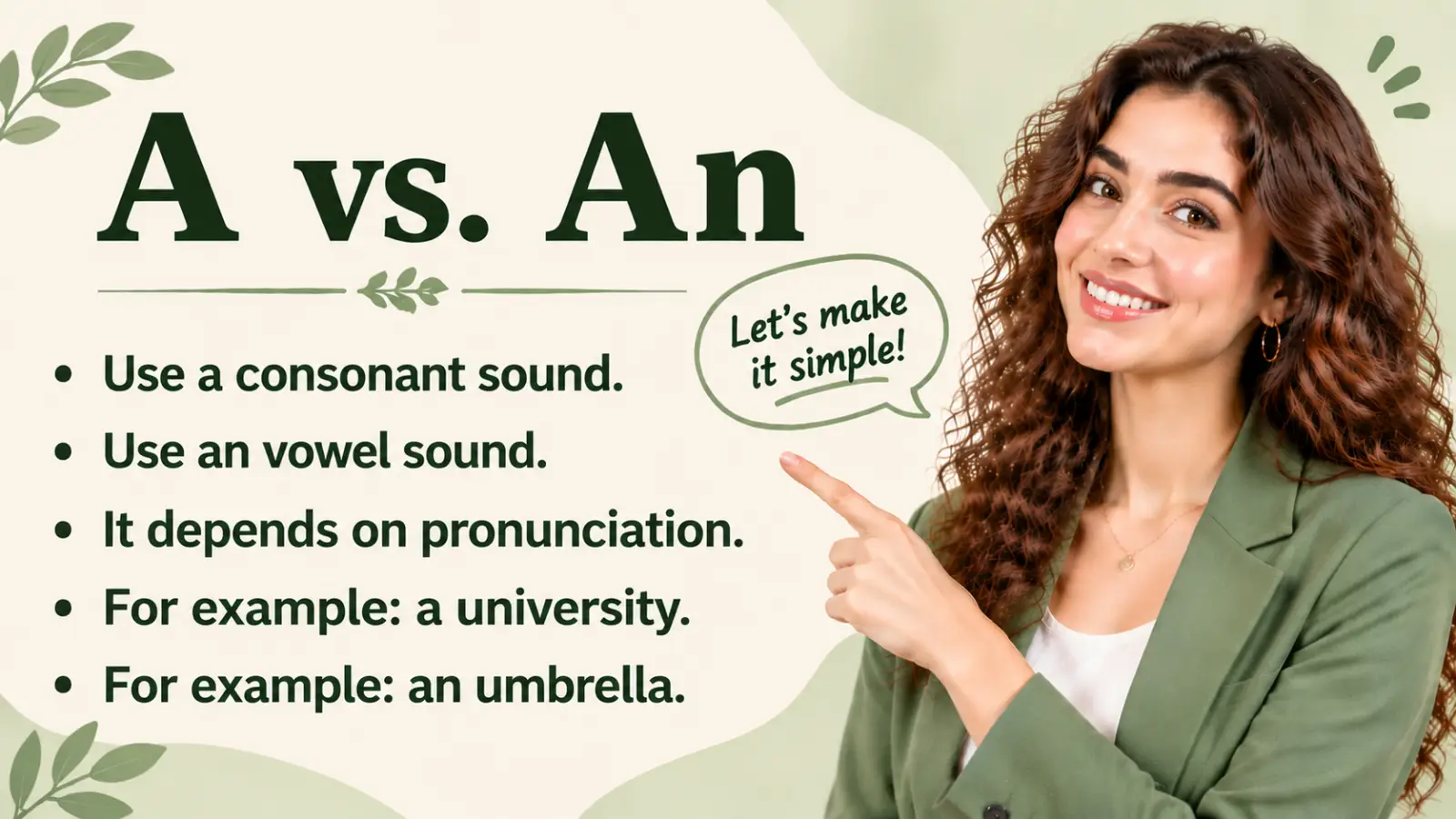
A vs. An: How to Choose the Correct Article
Use a before a consonant sound and an before a vowel sound. The choice depends on how the next word is pronounced, not simply which letter it begins with. For example, write a university but an umbrella.
This distinction matters whenever you introduce a singular, nonspecific count noun. Choosing the wrong article can make a sentence sound awkward or grammatically incorrect, especially when a word begins with a vowel that sounds like a consonant or a silent consonant that produces a vowel sound.
Related Post: Hone In or Home In
A vs. An: The Key Difference
Both a and an are indefinite articles. They introduce a singular count noun when you are referring to something general or mentioning it for the first time.
| Term | Meaning or status | When to use it | Example |
|---|---|---|---|
| A | Indefinite article | Before a consonant sound | She adopted a puppy. |
| An | Indefinite article | Before a vowel sound | He ate an orange. |
The first sound determines the choice. A word can begin with a vowel letter but require a, or begin with a consonant letter but require an.
What Does A Mean?
A is an indefinite article used before a singular count noun that begins with a consonant sound. It can refer to any one person, place, object, or idea rather than a particular one already identified.
For example, “I need a notebook” means that any suitable notebook will do. The sentence does not identify one specific notebook.
When to Use A
Use a before a word that begins with a consonant sound. Common examples include:
- A book — the word begins with the /b/ sound.
- A car — the word begins with the /k/ sound.
- A house — the initial h is pronounced.
- A university — the word begins with a /y/ sound.
- A European country — European begins with a /y/ sound.
- A one-time offer — one begins with a /w/ sound.
The rule also applies when an adjective comes between the article and the noun. Choose the article based on the sound of the adjective immediately following it:
- A small apartment
- An expensive apartment
- A useful tool
- An unusual tool
A in Example Sentences
- Maya bought a new laptop. The article introduces a singular, nonspecific laptop.
- He wants to become a musician. Musician begins with a consonant sound.
- We visited a European museum. European starts with a /y/ sound, so a is correct.
What Does An Mean?
An is an indefinite article used before a singular count noun that begins with a vowel sound. It makes the transition between the article and the next word easier to pronounce.
For example, “She found an answer” uses an because answer begins with a vowel sound.
When to Use An
Use an before a word that begins with a vowel sound, including words that start with a silent h.
Examples include:
- An apple
- An elephant
- An idea
- An office
- An umbrella
- An hour
- An honest person
- An heir
The spelling alone does not determine the article. In hour, the h is silent, so the first spoken sound is a vowel.
An in Example Sentences
- I waited for an hour. Hour begins with a vowel sound because its h is silent.
- She received an invitation. Invitation starts with a vowel sound.
- He made an honest mistake. Honest has a silent initial h, so an is appropriate.
How to Choose the Right Article
The governing rule is straightforward: listen to the first sound of the word immediately after the article.
- Use a before a consonant sound.
- Use an before a vowel sound.
Do not choose based only on whether the first written letter is a vowel or consonant. Words such as university, European, and one begin with vowel letters but have consonant sounds at the beginning. Words such as hour and honest begin with consonant letters but have vowel sounds.
A Quick Test You Can Apply
Read the next word aloud and listen to its opening sound.
| Word or phrase | First sound | Correct choice |
|---|---|---|
| Apple | Vowel sound | An apple |
| University | Consonant /y/ sound | A university |
| Hour | Vowel sound | An hour |
| Useful idea | Consonant /y/ sound | A useful idea |
| Honest answer | Vowel sound | An honest answer |
| One-time event | Consonant /w/ sound | A one-time event |
If you are unsure, say the phrase aloud. The correct article will usually sound more natural.
When the Quick Test Does Not Work
The sound rule still applies, but pronunciation can vary by speaker, accent, or the way an abbreviation is read.
For example, some speakers pronounce the h in herb, while many American speakers leave it silent. In common American pronunciation, an herb is therefore appropriate. A speaker who pronounces the h may naturally use a herb.
The important point is to follow the pronunciation you are actually using rather than relying on the spelling.
Common Mistakes and How to Fix Them
| Original sentence | Corrected sentence | Why it changes |
|---|---|---|
| She attends an university. | She attends a university. | University begins with a consonant /y/ sound. |
| I need a umbrella. | I need an umbrella. | Umbrella begins with a vowel sound. |
| He waited for a hour. | He waited for an hour. | The h in hour is silent. |
| It was an useful suggestion. | It was a useful suggestion. | Useful begins with a consonant /y/ sound. |
Why These Forms Get Confused
The confusion often comes from treating a as the article for consonant letters and an as the article for vowel letters. That shortcut works with many familiar words, such as a dog and an apple, but it does not explain words whose spelling and pronunciation begin differently.
The distinction is based on speech sounds. Once you focus on pronunciation instead of the first written letter, the rule becomes much easier to apply.
Does the Choice Change With Context?
The basic rule stays the same across standard American English. However, pronunciation can affect the article, especially with abbreviations, initialisms, and certain words that have more than one common pronunciation.
Abbreviations, Acronyms, and Initialisms
Choose a or an according to how the abbreviation is spoken.
Use an when the spoken name begins with a vowel sound:
- An FBI agent — F is pronounced “eff.”
- An MBA program — M is pronounced “em.”
- An MRI scan — M is pronounced “em.”
Use a when the spoken name begins with a consonant sound:
- A NASA mission — NASA is pronounced as a word beginning with /n/.
- A URL — when pronounced “you-are-ell,” it begins with a /y/ sound.
- A USB cable — U is pronounced “you.”
This rule applies whether an abbreviation is pronounced as a word or spoken letter by letter.
Formal Writing vs. Casual Conversation
The standard sound-based rule applies in both formal and casual English. In professional emails, school assignments, reports, and everyday messages, choose the article based on the pronunciation of the next word.
Some expressions may have pronunciation differences across speakers or regions. When that happens, use the form that matches your intended pronunciation and keep your writing consistent.
Can You Use A and An Interchangeably?
No. In the same pronunciation and context, a and an are not interchangeable. Replacing one with the other can create an article error or make a phrase sound unnatural.
When Switching Changes the Meaning or Grammar
Compare these sentences:
- She is a university student. Correct: university begins with a /y/ sound.
- She is an university student. Incorrect in standard usage: the article does not match the opening sound.
Now consider another pair:
- He is an honest person. Correct: the h in honest is silent.
- He is a honest person. Incorrect in standard usage: the word begins with a vowel sound.
The noun and intended meaning remain the same. Only the article changes, and the sound determines which form is correct.
Common Phrases With A and An
These familiar combinations show how the rule works with everyday expressions.
| Phrase | When to use it | Original example |
|---|---|---|
| A little | Referring to a small amount | We still have a little time. |
| A lot | Referring to a large amount or number | She has a lot of experience. |
| An example | Introducing one illustration | The teacher gave an example. |
| An opportunity | Referring to a possible chance | This is an opportunity to learn. |
| A unique idea | Describing something distinctive | They developed a unique idea. |
Notice that a unique idea is correct because unique begins with a /y/ sound, even though its first letter is u.
Apply the Rule to a Real Situation
Imagine writing an email to a hiring manager. You want to describe your experience and mention an opportunity you found.
Original Version
“I am interested in applying for an internship at your company. This position would offer a useful opportunity to develop my skills, and I would welcome the chance to discuss it further.”
Improved Version and Explanation
“I am interested in applying for an internship at your company. I believe it would be a useful opportunity to develop my skills, and I would welcome an opportunity to discuss the position.”
Both article choices are correct:
- A useful opportunity uses a because useful begins with a /y/ sound.
- An opportunity uses an because opportunity begins with a vowel sound.
The example also shows why you must evaluate the word immediately after the article, not the noun at the end of the phrase.
Do A and An Always Come Before Singular Nouns?
A and an generally introduce singular count nouns when referring to something nonspecific. They are not normally used directly before plural nouns or uncountable nouns.
- Correct: A chair is beside the desk.
- Correct: An orange is on the table.
- Incorrect: A chairs are beside the desk.
- Incorrect: An information is available.
For plural nouns, use the noun without an indefinite article or choose another expression:
- Chairs are available.
- Some information is available.
You can also use a or an before an adjective that modifies a singular count noun, as in a comfortable chair or an attractive design.
An Easy Way to Remember the Difference
Remember this simple rule: A for a consonant sound; an for a vowel sound.
Think of the spoken beginning, not the written letter:
- A university — sounds like “you-niversity.”
- An umbrella — starts with the vowel sound “uh.”
- A one-time offer — one starts with a “w” sound.
- An hour — the h is silent.
This memory aid works for ordinary words, adjectives, and abbreviations. If pronunciation varies, base your choice on the pronunciation you intend to use.
Practice: Can You Choose the Right Form?
Choose a or an for each sentence.
- She wants to buy ___ umbrella.
- He enrolled at ___ university.
- We have ___ hour before the meeting.
Answers and Explanations
- An umbrella. Umbrella begins with a vowel sound.
- A university. University begins with a consonant /y/ sound.
- An hour. The h in hour is silent, so the word begins with a vowel sound.
Frequently Asked Questions
Is A or An a Grammar Rule?
Yes. Choosing between a and an is a grammar rule involving indefinite articles. The correct form depends on the first sound of the next word, not simply its first letter.
Do You Use A or An Before U?
It depends on how the word beginning with u is pronounced. Use a before a /y/ sound, as in a university or a useful tool. Use an before a vowel sound, as in an umbrella.
Is It A Hour or An Hour?
The correct expression is an hour. The h in hour is silent, so the word begins with a vowel sound.
Is It A Honest Person or An Honest Person?
The correct expression is an honest person. The h in honest is silent, making the first spoken sound a vowel.
Do You Use A or An Before FBI?
Use an FBI agent because the letter F is pronounced “eff,” which begins with a vowel sound. The same principle applies to other initialisms and abbreviations.
Which Form Should You Use?
Use a before a consonant sound and an before a vowel sound. Remember that pronunciation—not the first written letter—controls the choice. This rule applies to ordinary words, adjectives, abbreviations, and initialisms.
When you are uncertain, say the phrase aloud and listen to the first sound after the article. That quick check will help you choose the correct form in everyday conversation and formal writing.
Sources