
To Bad or Too Bad: Which Is Correct?
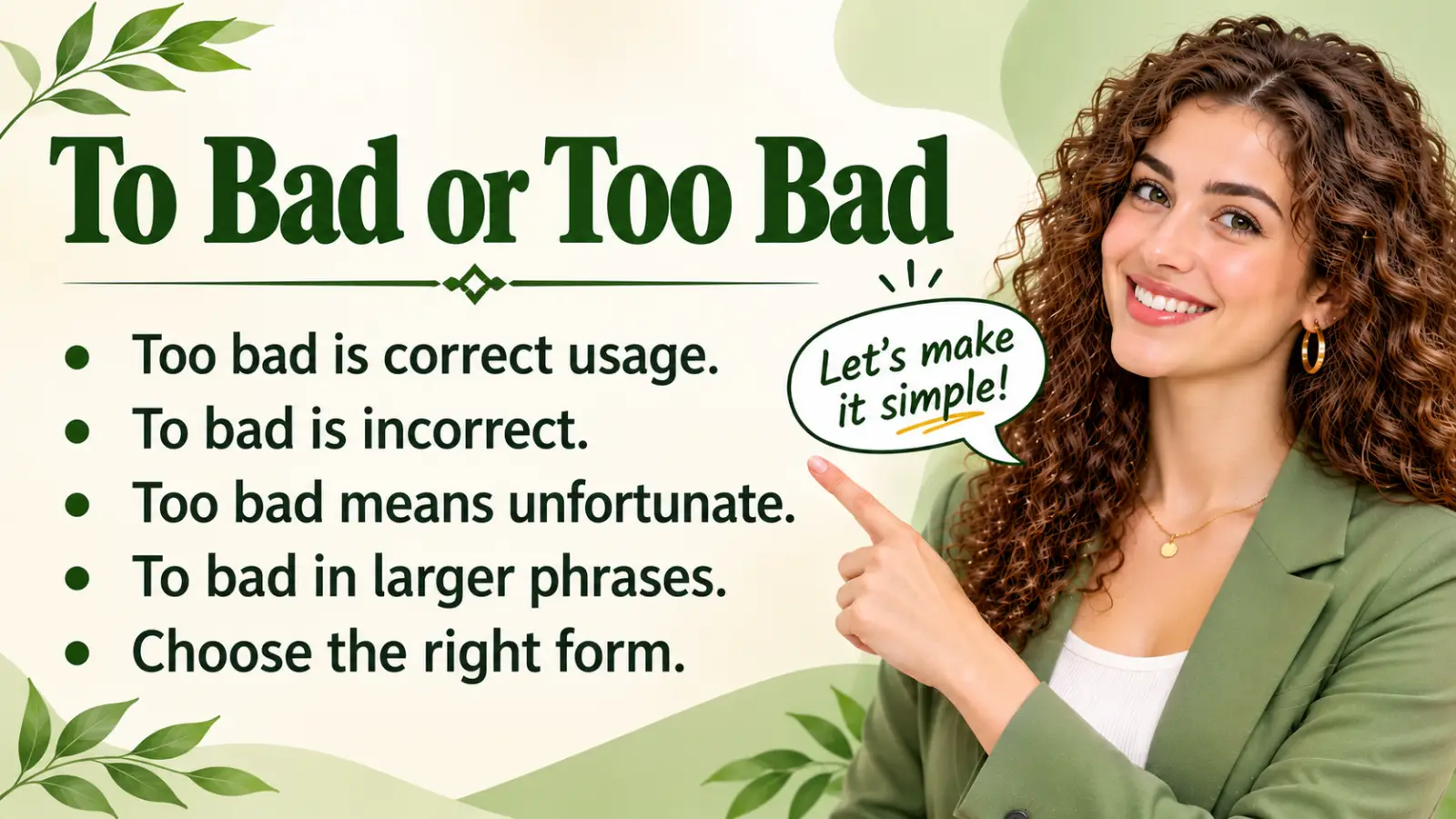
Too bad is the correct expression when you mean “unfortunate,” “disappointing,” or “what a shame.” To bad is incorrect when used with that meaning. However, the words to and bad can appear together correctly in a larger phrase, such as “The situation changed from good to bad.”
Knowing the difference helps you avoid mistakes in texts, emails, school assignments, and everyday writing. Although to and too sound alike, they serve different grammatical purposes.
Related Post: Unfazed vs. Unphased
To Bad vs. Too Bad: The Key Difference
| Term | Meaning or status | When to use it | Example |
|---|---|---|---|
| Too bad | A standard expression meaning unfortunate or regrettable; it can also mean excessively bad | When reacting to disappointing news or describing something beyond an acceptable degree | “That’s too bad.” |
| To bad | Not a correct substitute for too bad, but the two words can appear together in a larger grammatical structure | When to has its own grammatical function | “Things went from good to bad.” |
The main rule is straightforward: write “That’s too bad,” not “That’s to bad,” when expressing disappointment or regret.
What Does “Too Bad” Mean?
Too bad has two main uses. It can express disappointment or sympathy, and it can describe something that is excessively bad or unsuitable.
When to Use “Too Bad”
Use too bad when you want to:
- Express sympathy: “It’s too bad you missed the celebration.”
- Show disappointment: “Too bad the game was canceled.”
- Describe an excessive degree: “The weather was too bad for a picnic.”
In the first two examples, too bad means something like “that’s unfortunate.” In the third, too modifies bad to indicate that the weather was unsuitable for the planned activity.
“Too Bad” in Example Sentences
- “That’s too bad. I know you were looking forward to the concert.”
The phrase expresses sympathy about a disappointment. - “It’s too bad we couldn’t stay longer.”
The speaker regrets leaving earlier than desired. - “The damage was too bad to repair economically.”
Here, too bad means the damage was so severe that repairing it was not worthwhile.
Is “To Bad” a Word?
To bad is not a standard expression meaning “unfortunate” or “what a shame.” If that is your intended meaning, use too bad.
For example:
- Incorrect: “It’s to bad you missed the interview.”
- Correct: “It’s too bad you missed the interview.”
The sequence to bad can still be grammatically correct when the words perform separate functions in a larger sentence. In “The situation went from good to bad,” for example, to connects two conditions and shows a change from one to the other. That is different from the expression too bad.
How to Choose Between “To” and “Too”
The best way to choose is to check what the word is doing in the sentence.
- Too can mean “excessively” or “more than is desirable.” It can also mean “also.”
- To commonly indicates direction or a relationship, or it appears before a verb in its infinitive form.
Compare these examples:
- “The coffee is too hot.” — Too means excessively.
- “I’m walking to work.” — To indicates a destination.
- “I want to leave.” — To introduces the verb leave.
- “I want coffee, too.” — Too means also.
A Quick Test You Can Apply
Try replacing too with “excessively” or “unfortunate” in your sentence.
- “The road is too bad to drive on.”
The road is excessively bad for driving. Too is correct. - “That’s too bad.”
The situation is unfortunate. Too is correct. - “The situation changed from good to bad.”
Neither “excessively” nor “unfortunate” fits in place of to. The sentence describes a change from one condition to another, so to is correct.
This test works well for the common confusion, but remember that too can also mean “also,” as in “I’m coming, too.”
When the Quick Test Does Not Work
Some sentences contain both words, each with a different function. For example:
“The damage was too bad to ignore.”
The first too means “excessively.” The second to introduces the verb ignore. Both spellings are correct in the same sentence.
Common Mistakes and How to Fix Them
| Original sentence | Corrected sentence | Why it changes |
|---|---|---|
| That’s to bad. | That’s too bad. | The expression meaning “that’s unfortunate” uses too. |
| It’s to bad we missed the train. | It’s too bad we missed the train. | Too bad expresses regret. |
| The weather is to bad for outdoor activities. | The weather is too bad for outdoor activities. | Too indicates an excessive degree. |
| Things changed from good too bad. | Things changed from good to bad. | To connects the starting and ending conditions. |
Why These Forms Get Confused
The words to and too are homophones in standard American English: they are pronounced alike but have different spellings and meanings. Because the difference is not usually audible in conversation, writers may select the wrong form when typing quickly.
The solution is to focus on meaning and grammar rather than sound. Ask whether you mean “excessively,” “also,” or a destination or relationship. That check usually reveals which word belongs in the sentence.
Does the Choice Change With Context?
The spelling rule stays the same in American and British English. However, the tone of too bad can change with the situation.
Formal Writing vs. Casual Conversation
Too bad is natural in conversation, texts, and informal emails. In a formal report or professional message, a more specific phrase may sound more appropriate.
For example:
- Casual: “Too bad the meeting was postponed.”
- More formal: “Unfortunately, the meeting was postponed.”
Neither is inherently wrong; the second simply has a more formal tone.
Can You Use “To Bad” and “Too Bad” Interchangeably?
No. They are not interchangeable when you mean “unfortunate” or “excessively bad.” Using to instead of too in that expression creates a spelling and grammar error.
When Switching Changes the Meaning
Compare these sentences:
- “The situation went from good to bad.” The situation changed from a positive condition to a negative one.
- “It’s too bad the situation changed.” The speaker expresses regret about the change.
The first sentence uses to to show a transition. The second uses too bad to express disappointment.
Common Phrases With “Too Bad”
| Phrase | When to use it | Original example |
|---|---|---|
| That’s too bad. | Responding to disappointing or unfortunate news | “Your flight was delayed? That’s too bad.” |
| It’s too bad that… | Expressing regret about a situation | “It’s too bad that the museum closes so early.” |
| Too bad for… | Commenting on an unfavorable outcome; tone can be dismissive | “Too bad for the team that missed the final.” |
| Too bad to… | Describing something too severe or unsuitable for an action | “The scratch was too bad to hide with polish.” |
| Too bad you… | Informally expressing regret about something that happened | “Too bad you couldn’t join us yesterday.” |
Be mindful of tone. A short reply such as “Too bad” can sound sympathetic, indifferent, or sarcastic depending on the situation and how it is delivered.
Apply the Rule to a Real Situation
Imagine you are messaging a friend who could not attend a birthday dinner.
Original Version
“Your train was delayed? That’s to bad. We missed having you there.”
Improved Version and Explanation
“Your train was delayed? That’s too bad. We missed having you there.”
The required correction is to → too because the message expresses sympathy about an unfortunate event. The rest of the message is clear and natural.
Can “Too” and “To” Appear in the Same Sentence?
Yes. The words have different grammatical functions, so they can appear together without any problem.
For example: “The weather was too bad to continue the match.”
- The first too means “excessively.”
- The second to introduces the verb continue.
This is a useful reminder that the correct choice depends on each word’s role, not simply on the words that follow it.
An Easy Way to Remember the Difference
Use this memory aid:
Too = excessively or also. To = direction, connection, or a verb form.
For the expression meaning “what a shame,” remember the extra o in too. If you are writing “That’s too bad,” you need the double-o spelling.
Try this quick comparison:
- “It’s too cold to swim.” — excessively cold
- “I’m going to swim.” — introduces the verb
- “I’m swimming, too.” — also swimming
Practice: Can You Choose the Right Form?
Choose to or too for each blank.
- That’s ___ bad. I know you worked hard for the opportunity.
- The road was ___ dangerous to drive on.
- The situation changed from good ___ bad.
Answers and Explanations
- Too — The phrase expresses sympathy or regret.
- Too — It means the road was excessively dangerous.
- To — It connects the two conditions and describes a change from one to the other.
Frequently Asked Questions
Is “too bad” one word or two?
Too bad is two separate words. For example, “That’s too bad” is correct.
Does “too bad” mean very bad?
Yes. It can mean excessively bad or describe something unfortunate, depending on the context.
Is “too bad” rude?
Not necessarily. However, saying it alone can sound dismissive or sarcastic.
Is “to bad” ever correct?
Yes, in constructions such as “from good to bad.” However, it cannot replace too bad in the expression of regret.
Is “too bad” correct in American English?
Yes. Too bad is the standard spelling in American English and British English.
Sources
- Cambridge Dictionary — Too — Definitions and examples for too, including the expression “too bad.”
- Cambridge Dictionary — Too and Enough — Grammar guidance on too before adjectives and in “too … to” constructions.



One Comment