Fliers or Flyers? Meaning, Spelling, and Usage
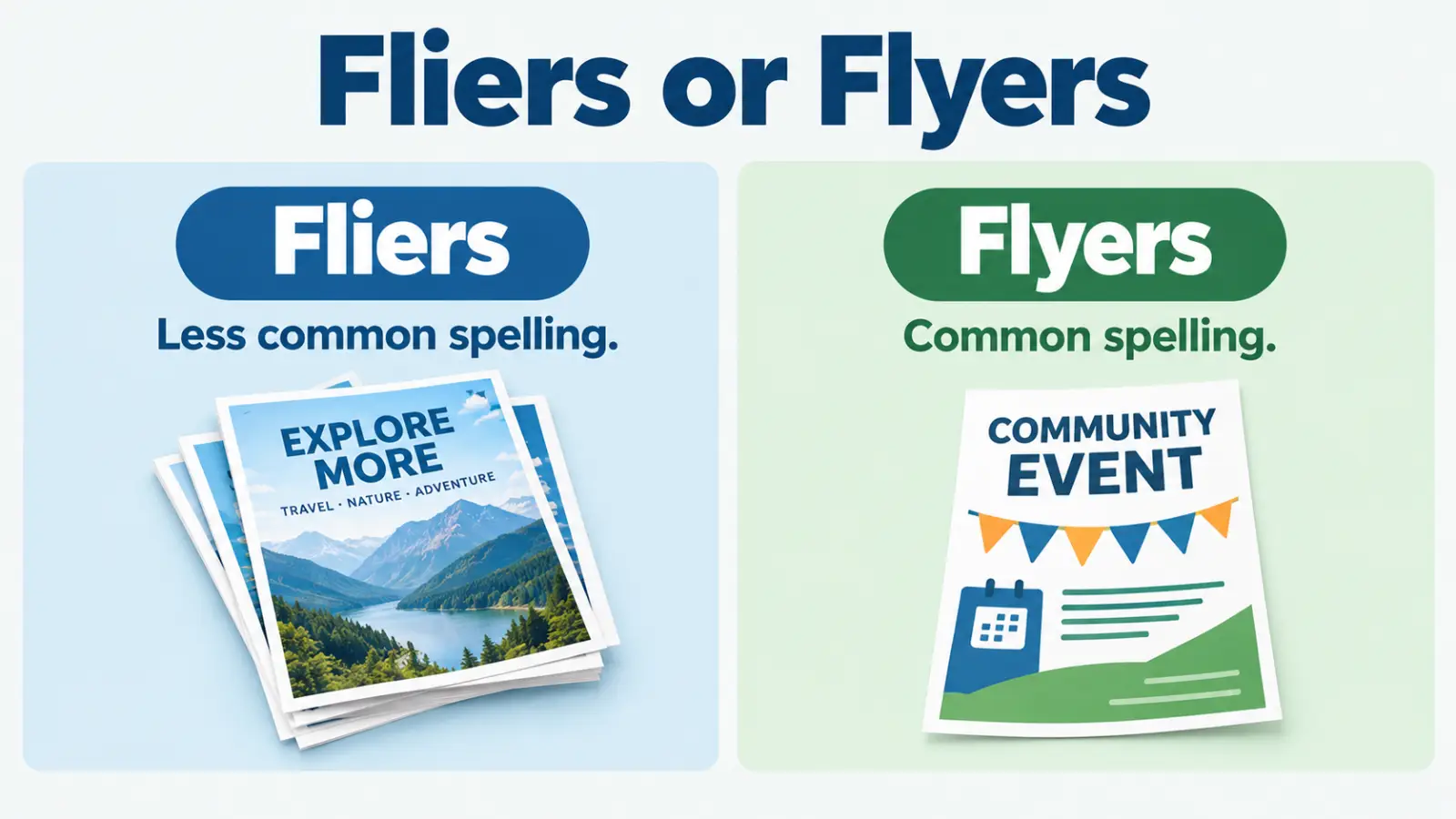
Fliers and flyers are both correct English spellings. They often mean the same thing, including a printed advertisement, a person who flies, or an air traveler. However, flyer is a clear, familiar choice for promotional handouts, while flier is well established in expressions such as take a flier, meaning to take a risk.
Knowing the usual preferences helps you choose the right form for marketing materials, business writing, travel references, and familiar expressions without mistakenly treating an accepted variant as an error.
Related Post: Tomatoes or Tomatos
Fliers vs. Flyers: The Key Difference
| Term | Meaning or status | When to use it | Example |
|---|---|---|---|
| Flyers | Correct plural spelling; commonly used for promotional handouts | Advertising an event, product, or service | We distributed flyers at the fair. |
| Fliers | Correct plural spelling and an accepted variant of flyers | Referring to people or things that fly, printed handouts, or risk-taking expressions | Frequent fliers may qualify for travel rewards. |
| A flier | Singular form, especially familiar in the expression take a flier | Describing a risky or speculative decision | She took a flier on the new business. |
| A flyer | Singular form used for a handout or someone who flies | Referring to promotional material or an air traveler | I picked up a flyer about the concert. |
The distinction is mainly one of usage and preference, not a strict correct-versus-incorrect spelling rule. Both forms appear in established English usage, and their meanings overlap.
What Does “Flyers” Mean?
Flyers is the plural of flyer. It commonly refers to printed or digital promotional material that announces an event, advertises a product, or shares information. The singular form can also refer to a person who flies or travels by air.
When to Use “Flyers”
Choose flyers when you are writing about:
- Promotional handouts for a business or event.
- Notices advertising sales, services, or community activities.
- Printed or digital material designed to attract attention.
- Air travelers, especially when using the familiar phrase frequent flyer.
For marketing and general business writing, flyers is a practical default because readers readily recognize it.
“Flyers” in Example Sentences
- The library printed flyers announcing its summer reading program.
Here, flyers means promotional notices. - The restaurant posted digital flyers advertising its lunch specials.
The word refers to online promotional material rather than paper handouts. - The airline offers extra benefits to frequent flyers.
In this expression, flyers refers to people who travel by air regularly.
What Does “Fliers” Mean?
Fliers is the plural of flier. It can refer to people or things that fly, air travelers, and printed advertisements. It also appears in the established expression take a flier, which means to take a chance on something uncertain.
When to Use “Fliers”
Use fliers when it fits your preferred spelling convention, your organization’s style guide, or a familiar expression.
The phrase take a flier is particularly worth recognizing. It describes a risky or speculative action, such as investing in an uncertain opportunity. In other contexts, fliers can refer to pilots, air travelers, flying creatures, or promotional handouts.
“Fliers” in Example Sentences
- The bird sanctuary cares for injured fliers before releasing them.
Here, fliers refers to birds that fly. - The company distributed fliers describing its new services.
The spelling is an accepted alternative for promotional handouts. - He decided to take a flier on the small startup.
This expression means he chose to take a financial or business risk.
How to Choose the Right Spelling
The easiest approach is to consider your meaning and audience rather than assume that one spelling is always correct.
- For an advertisement: Use flyer or flyers as your default.
- For an air traveler: Both flier and flyer are accepted; frequent flyer is a familiar expression.
- For a risky decision: Take a flier is a well-established expression.
- For formal or professional writing: Follow your organization’s style guide and use the same spelling consistently.
A Quick Test You Can Apply
Ask yourself what you are describing.
Step 1: Is it promotional material?
Write flyer if you want the clearest, familiar choice.
Step 2: Are you describing a person or thing that flies?
Either flier or flyer may work. Check the preferred spelling in your style guide if consistency matters.
Step 3: Are you using the phrase “take a ___”?
Choose flier for the established expression take a flier, meaning to take a risk.
Worked example
Original: The nonprofit printed 500 fliers for its fundraiser.
Edited: The nonprofit printed 500 flyers for its fundraiser.
Why: Fliers is not inherently wrong here. The edit simply uses flyers, a familiar default for promotional handouts.
When the Quick Test Does Not Work
The meanings overlap, so the subject alone will not always determine the spelling. Both forms can describe advertising material and people who fly. In these cases, follow the relevant style guide or choose the spelling most familiar to your intended readers.
Common Mistakes and How to Fix Them
| Original sentence | Corrected sentence | Why it changes |
|---|---|---|
| We handed out flier for the concert. | We handed out flyers for the concert. | The plural noun is needed because multiple handouts were distributed. |
| The airline offers rewards to frequent flier. | The airline offers rewards to frequent fliers. | The plural is needed when referring to travelers generally. |
| She took a flyer on the uncertain investment, and that spelling is always wrong. | She took a flier on the uncertain investment. | Take a flier is an established expression. The original spelling is not impossible, but flier is the traditional choice for this phrase. |
| The event flier is incorrect because it does not say flyer. | The event flyer is a familiar spelling for the handout. | The original makes an overly strict claim. Flier is also an accepted spelling for a handout. |
Why These Forms Get Confused
The words sound the same, and their meanings overlap. Both can describe a person who flies, an air traveler, or a printed handout. Their spelling patterns also resemble other English words formed from fly, such as flying and flies.
Because neither form is universally wrong, the confusion is less about grammar and more about convention, context, and preferred usage.
Does the Choice Change With Context?
American English and British English
There is no simple rule that assigns flier exclusively to American English and flyer exclusively to British English. Both forms are recognized across English varieties, although dictionaries and style guides may differ in their preferences for particular meanings.
For a US audience, flyer is a sensible default for advertising material. For other uses, check the spelling convention followed by your publication or organization.
Formal Writing vs. Casual Conversation
Both spellings can appear in formal and informal writing. The choice is not simply a matter of professional versus casual tone.
For a business announcement, promotional flyer is a clear option. In a sentence about taking a risk, take a flier is a familiar expression. In either case, clarity and consistency matter more than treating the alternative spelling as a mistake.
Can You Use “Fliers” and “Flyers” Interchangeably?
Often, yes. When the words refer to advertising handouts or people who fly, either spelling may be acceptable. However, some expressions have a stronger conventional preference for one form.
When Both Forms Work
These sentences express the same basic idea:
- The school distributed flyers about the fundraiser.
- The school distributed fliers about the fundraiser.
Likewise, frequent flyers and frequent fliers can both refer to people who travel by air regularly.
When Switching Changes the Convention
Compare these examples:
- The business printed flyers for its grand opening.
- The investor decided to take a flier on the business.
The first sentence refers to promotional handouts. The second uses an idiom meaning to take a risk. The spelling difference is not what creates the difference in meaning; the surrounding words and context do that. Still, take a flier is the established form worth remembering.
Common Phrases With “Flier” and “Flyer”
| Phrase | When to use it | Original example |
|---|---|---|
| Promotional flyer | A handout advertising a product, service, or event | The shop designed a promotional flyer for its opening. |
| Event flyer | A notice announcing a gathering or activity | Please email the event flyer to the volunteers. |
| Frequent flyer | A person who travels by air regularly | As a frequent flyer, Dana is familiar with airport routines. |
| Nervous flyer | Someone who feels anxious about flying | The airline offered advice for nervous flyers. |
| Take a flier | To take a chance on an uncertain outcome | They took a flier on an untested idea. |
Flyer or Flier: Is One More Correct in American English?
Neither spelling is automatically incorrect in American English. Both are established forms, but flyer is a useful default for promotional material, while take a flier is a conventional expression for taking a risk.
If you’re writing for a newspaper, company, university, or other organization, consult its style guide. A consistent house style is more useful than trying to enforce a universal rule that English usage does not support.
An Easy Way to Remember the Difference
Remember this practical pairing:
- Flyer for a handout: “We posted flyers around town.”
- Flier for taking a risk: “She took a flier on the investment.”
This is a memory aid, not an absolute rule. Flier can also refer to handouts, and flyer can refer to people who fly.
Frequently Asked Questions
Is “fliers” a real word?
Yes. Fliers is the plural of flier, an accepted spelling used for people or things that fly and for printed handouts. It also appears in the expression take a flier.
Is “flyers” or “fliers” better for advertising?
Flyers is a clear, familiar default for advertisements and promotional handouts. Fliers is also accepted, so it should not automatically be marked as a spelling error.
Is “frequent flyer” or “frequent flier” correct?
Both are accepted. Frequent flyer is a familiar form, while frequent flier is also used. Follow the spelling preferred by the airline or publication when a particular style matters.
What does “take a flier” mean?
To take a flier means to take a risk or chance, often in a business or financial situation. For example, an investor might take a flier on a new company whose future is uncertain.
Are “fliers” and “flyers” pronounced differently?
No. They are normally pronounced the same way. The difference is in spelling and usage preference, not pronunciation.
Which Form Should You Use?
For most US readers, use flyer or flyers when referring to advertising material. Both spellings are correct, and flier remains a valid alternative for handouts and people who fly. When describing a risky decision, remember the established expression take a flier. If you’re writing for an organization, follow its style guide and keep your spelling consistent.
Sources
- Cambridge Dictionary — “Flier”: https://dictionary.cambridge.org/dictionary/english/flier
- Collins Dictionary — “Flier”: https://www.collinsdictionary.com/us/dictionary/english/flier