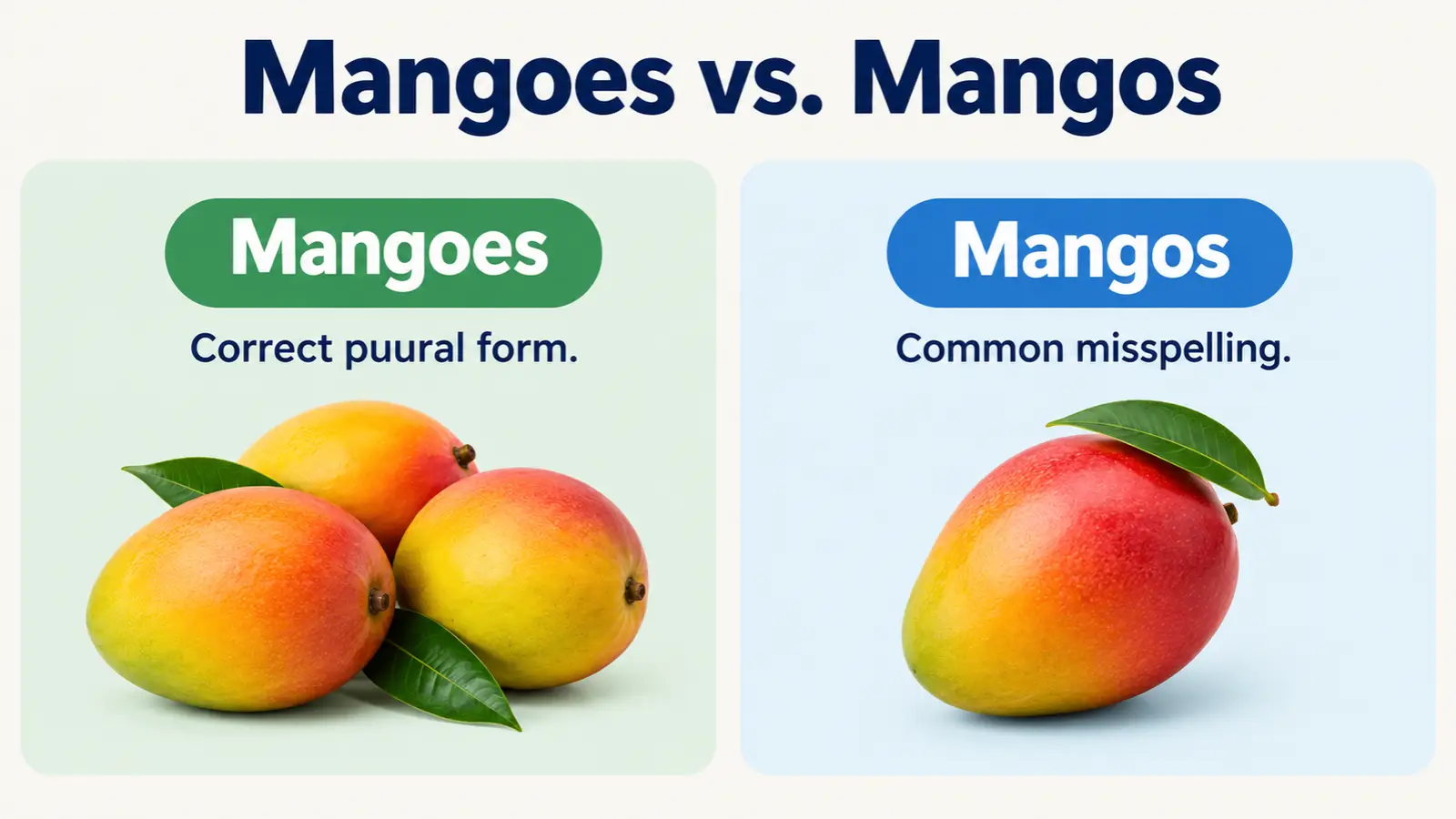
Mangoes vs. Mangos: Which Spelling Should You Use?
Mangoes and mangos are both correct plural forms of mango. They refer to the same tropical fruit, so neither spelling is a mistake. Both Cambridge Dictionary and Oxford Learner’s Dictionaries recognize the two forms.
For American English, you can use either spelling. The important thing is to follow your publication’s style guide, if it has one, and use the same form consistently throughout your writing.
Related Post: Nevermind vs. Never Mind
Mangoes vs. Mangos: The Key Difference
| Term | Meaning or status | When to use it | Example |
|---|---|---|---|
| Mangoes | Accepted plural spelling | General, formal, or everyday writing | We bought four mangoes. |
| Mangos | Accepted plural spelling | General, formal, or everyday writing | We bought four mangos. |
Both forms are grammatically correct and have the same meaning. The difference is spelling, not meaning or pronunciation.
What Does Mangoes Mean?
Mangoes is the plural form of the noun mango. It refers to two or more mango fruits or, depending on context, multiple mango trees.
When to Use Mangoes
Use mangoes when referring to more than one mango. It is a familiar spelling in English and a straightforward choice for articles, school assignments, recipes, and general writing.
Mangoes in Example Sentences
- The mangoes on the counter are ripe. This refers to several fruits.
- She added diced mangoes to the fruit salad. The word describes the fruit used in the recipe.
- The farm exports mangoes every summer. Here, the plural refers to fruit produced for sale.
What Does Mangos Mean?
Mangos is another accepted plural form of mango. It has the same meaning as mangoes and is not a misspelling.
When to Use Mangos
Use mangos when you prefer the shorter spelling or when it matches the style used by your publication, workplace, or organization. The National Mango Board, for example, uses this spelling in its own writing.
Mangos in Example Sentences
- I bought six mangos at the market. The sentence refers to six fruits.
- Fresh mangos make a sweet smoothie. The plural describes the fruit used as an ingredient.
- The store received a shipment of mangos this morning. The sentence refers to multiple fruits delivered to a store.
How to Choose the Right Spelling
The choice is simple: both mangoes and mangos are correct. You do not need to change one form to the other to make a sentence grammatically correct.
Use these steps to make your choice:
- Check your style guide. Follow any spelling preference set by your editor, teacher, or organization.
- Choose one form. If no preference exists, select either spelling.
- Stay consistent. Avoid switching between the two forms without a reason.
A Quick Test You Can Apply
Try replacing the plural with the singular mango. If you are referring to more than one fruit, either plural spelling works.
- Singular: I ate one mango.
- Plural: I ate two mangoes.
- Plural: I ate two mangos.
All three examples use the word correctly.
Common Mistakes and How to Fix Them
| Original sentence | Corrected sentence | Why it changes |
|---|---|---|
| I bought three mango. | I bought three mangoes. | A countable noun needs a plural form after “three.” |
| She picked two mangos and one apple. | No correction needed. | Mangos is an accepted plural spelling. |
| The mangoes was ripe. | The mangoes were ripe. | A plural subject takes the plural verb “were.” |
| We sell mangoes and mangos at the same shop. | No correction needed. | Both forms are correct, though using one consistently may improve style. |
Why These Forms Get Confused
Many English nouns ending in -o form their plurals with -es, as in tomatoes and potatoes. Others take a simple -s, as in photos and pianos. Because English does not apply one universal rule to every noun ending in -o, both mangoes and mangos have become accepted forms.
Does the Spelling Change With Context?
The meaning stays the same, but a publication may prefer one spelling over the other.
American vs. British English
Both spellings are recognized in American and British English. Although usage preferences can vary among publications and dictionaries, neither form is exclusively American or British. Check the relevant style guide rather than treating the choice as a strict regional rule.
Formal Writing vs. Casual Conversation
Both forms are suitable for formal and casual writing. In a school assignment, business report, recipe, or article, follow any stated editorial preference. In everyday messages, choose whichever spelling you prefer.
Can You Use Mangoes and Mangos Interchangeably?
Yes. You can substitute one form for the other without changing the sentence’s meaning.
Example pair:
- We bought fresh mangoes for dessert.
- We bought fresh mangos for dessert.
Both sentences are correct and describe the same purchase. The only difference is the spelling of the plural noun.
Common Phrases With Mangoes and Mangos
| Phrase | When to use it | Original example |
|---|---|---|
| Fresh mangoes | Describing recently harvested or prepared fruit | Fresh mangoes taste delicious in summer. |
| Ripe mangos | Describing fruit ready to eat | The ripe mangos are in the bowl. |
| Sliced mangoes | Describing fruit cut into pieces | Add sliced mangoes to the yogurt. |
| Dried mangos | Describing fruit preserved by drying | Dried mangos make a convenient snack. |
| Mango chutney | Naming a condiment made with mango | The restaurant served mango chutney with the meal. |
These combinations work with either plural spelling when the phrase calls for a plural noun. Mango chutney is different because mango functions as a noun describing the type of chutney.
Apply the Rule to a Real Situation
Imagine you are writing a grocery list for a family gathering.
Original Version
“We need five mangoes for the fruit salad. Please buy three more mangos if the store has them.”
Improved Version and Explanation
“We need five mangoes for the fruit salad. Please buy three more mangoes if the store has them.”
The original is grammatically correct because both plural spellings are accepted. The revised version simply uses mangoes consistently, making the list look more uniform.
Is Mangoes or Mangos More Common in American English?
Both spellings are used in the United States. The shorter form mangos is also accepted by major dictionaries, while mangoes remains a familiar and widely recognized form. For a specific publication, its style guide is the best way to determine which spelling to use.
What Is the Plural of Mango?
The plural of mango is mangoes or mangos. Both are correct. The singular form is mango, as in “I bought one mango,” while either plural works in “I bought four mangoes” or “I bought four mangos.”
An Easy Way to Remember the Difference
Remember this simple rule: one mango, two mangoes, or two mangos.
Both plural forms are acceptable, so you do not need to memorize a rule that makes one spelling correct and the other incorrect. Instead, remember to use a plural after numbers greater than one and keep your spelling consistent.
Practice: Can You Choose the Right Form?
Choose the correct option for each sentence. In these questions, both plural spellings may be acceptable.
1. We bought four ______ at the farmers’ market.
- A. mangoes
- B. mangos
2. The recipe calls for two ripe ______.
- A. mangoes
- B. mangos
3. Which sentence is grammatically correct?
- A. The mangoes are ready.
- B. The mangos are ready.
- C. Both A and B.
Answers and Explanations
- A or B: Both mangoes and mangos are correct plural forms.
- A or B: Either spelling works with the number two.
- C: Both sentences are grammatically correct.
Frequently Asked Questions
Is mangoes or mangos the correct spelling?
Both are correct plural spellings of mango. Neither is a misspelling, and both refer to the same fruit.
Is mangos acceptable in formal writing?
Yes. Mangos is an accepted spelling in formal writing. Follow a relevant style guide if your school, employer, or publisher specifies a preference.
Is mangoes more correct than mangos?
No. Both are accepted forms. One may be preferred by a particular dictionary, editor, or publication, but that preference does not make the other spelling incorrect.
Should I use mangoes or mangos in an SEO article?
Either form is correct. Choose the form that best matches your article’s intended wording and editorial style, and use it consistently. You can mention the alternative naturally when it helps readers understand the spelling variation.
Is mango’s the plural of mango?
No. Mango’s usually indicates possession, as in “the mango’s skin.” The plural is mangoes or mangos, without an apostrophe.
Which Form Should You Use?
Use mangoes or mangos with confidence. Both are correct, and neither changes the meaning. If you have no style guide to follow, choose one spelling and use it consistently throughout your writing.
Sources