Kill or Be Killed: Understand the Meaning and Use It Correctly
“Kill or be killed” is a standard English expression that describes a situation where someone must fight to survive, avoid defeat, or succeed against strong opposition. It can refer to literal danger, but it is also used figuratively for ruthless competition and high-pressure situations. Collins English Dictionary+1
The key is understanding both the meaning and the tone. The phrase is dramatic and forceful, so it can work well in fiction, action scenes, and descriptions of fierce competition. In a professional email or academic paper, a calmer expression may communicate the same idea more appropriately.
Related Post: Quit or Quite
Kill or Be Killed: The Key Difference
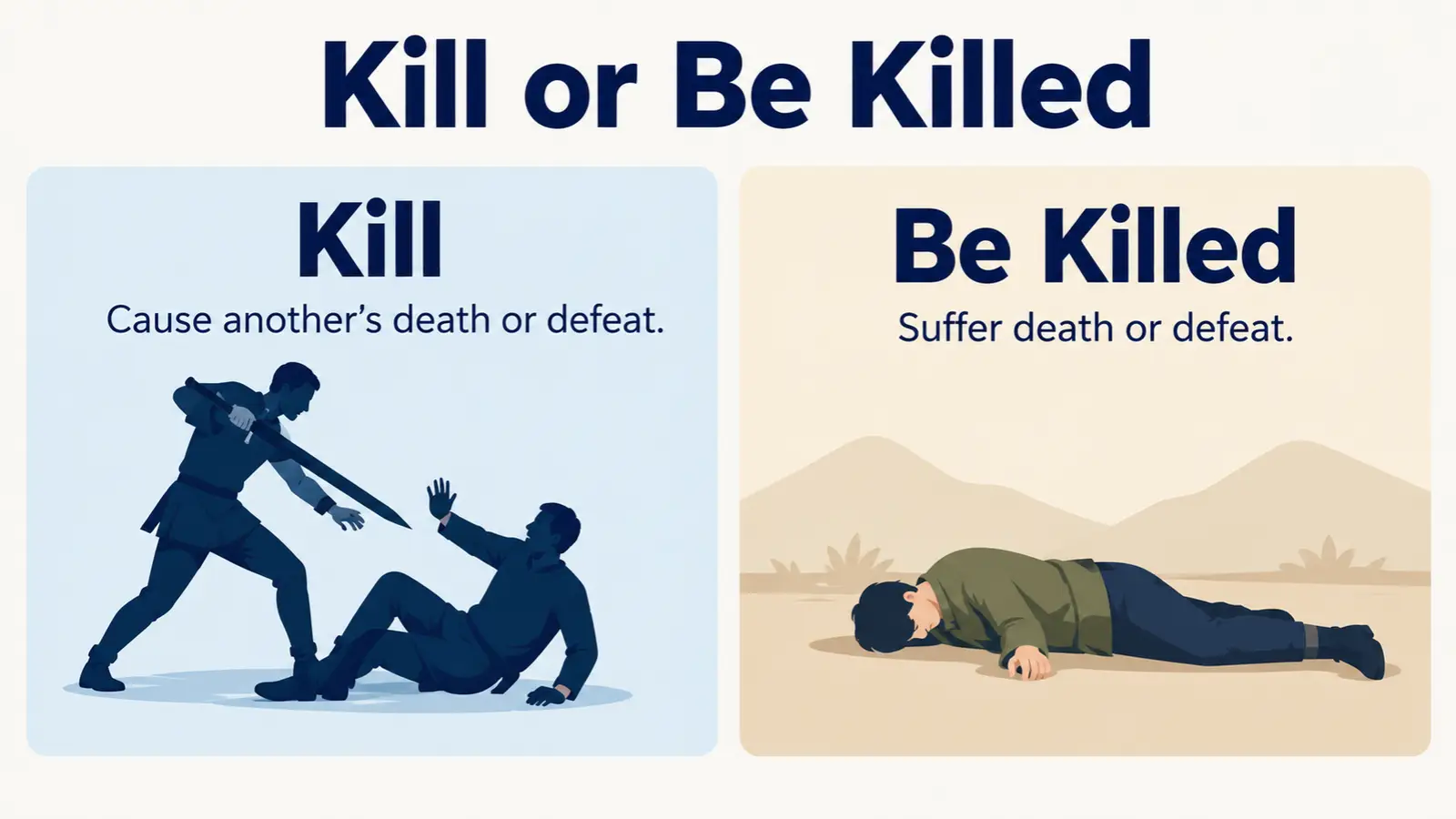
This keyword is not a comparison between two competing spellings. “Kill or be killed” is a complete expression, built from an active verb phrase and a passive verb phrase.
| Term | Meaning or status | When to use it | Example |
|---|---|---|---|
| Kill | To cause death or, figuratively, to end or ruin something | When the subject performs the action | The drought could kill the crops. |
| Be killed | To have death or another harmful outcome caused by an outside force | When the subject receives the action | The crops could be killed by the drought. |
| Kill or be killed | A phrase expressing survival, self-preservation, or ruthless competition | When a situation feels like a struggle to avoid defeat | The story portrays the wilderness as kill or be killed. |
The phrase combines two possible outcomes: taking action against an opponent or suffering the consequences of that opponent’s actions. In figurative use, it often means that only the strongest or most determined competitors will succeed.
What Does “Kill” Mean?
Kill is a verb that primarily means to cause a living thing to die. It also has figurative meanings, such as ending a plan, stopping an activity, ruining an opportunity, or eliminating an idea.
When to Use “Kill”
Use kill when the subject causes an action or result. Depending on the context, the object may be a person, an animal, a plant, a plan, or an opportunity.
Examples include:
- The disease can kill an infected animal.
- The manager decided to kill the proposal before the next meeting.
- Heavy rain could kill our plans for an outdoor event.
The last two examples use the verb figuratively. They refer to ending or spoiling something rather than causing a death.
“Kill” in Example Sentences
- The hero refused to kill his captured opponent. The verb describes a literal action that the hero chooses not to perform.
- One careless comment can kill the mood at a party. Here, kill means to spoil the atmosphere.
- The team worked hard to kill any chance of a comeback. The phrase means to eliminate the opponent’s opportunity to recover.
What Does “Be Killed” Mean?
Be killed is a passive verb phrase. It places the person or thing affected by an action at the center of the sentence rather than the person or thing causing it.
The word killed is the past participle of kill. The verb be combines with that participle to form the passive construction.
When to Use “Be Killed”
Use be killed when the subject receives the action, especially when the cause is more important than the person or force responsible.
For example:
- The animal was killed by a falling tree.
- Several plants may be killed by frost.
- The project could be killed if funding disappears.
The final example is figurative. It means the project may be canceled or brought to an end.
“Be Killed” in Example Sentences
- The character fears that he will be killed during the battle. The character receives the action rather than performing it.
- The young trees were killed by the sudden freeze. The trees are affected by the weather.
- The proposal may be killed before the board votes. The passive construction emphasizes the proposal’s possible fate without naming who will reject it.
How to Choose the Right Form
The expression “kill or be killed” works when you want to emphasize a stark choice between defeating an opponent and suffering defeat yourself. The wording is grammatically balanced: kill describes an action, while be killed describes receiving that action.
A Quick Test You Can Apply
Ask yourself what you want the sentence to emphasize:
- The action: Someone or something causes an outcome. Use kill.
- The outcome: Someone or something experiences the action. Use be killed.
- The struggle: The situation involves survival, self-preservation, or fierce competition. Use kill or be killed.
Compare these sentences:
- The company could kill the project. The company is doing the action.
- The project could be killed. The project receives the action.
- The industry has a kill-or-be-killed mentality. The phrase describes a ruthless competitive attitude.
When the Quick Test Does Not Work
The phrase is sometimes figurative, so the subject does not always face physical danger. For example, a business can face a kill-or-be-killed market without anyone being threatened with literal harm.
Consider the surrounding context before deciding whether the phrase is literal or figurative. Also consider tone: a phrase can be grammatically correct yet too aggressive for the situation.
Common Mistakes and How to Fix Them
| Original sentence | Corrected sentence | Why it changes |
|---|---|---|
| The phrase means you must killed or be killed. | The phrase means you must kill or be killed. | After must, use the base form kill, not killed. |
| The situation was kill or killed. | The situation was kill or be killed. | The established expression uses the passive phrase be killed. |
| The business faced a kill or be killed market. | The business faced a kill-or-be-killed market. | Hyphens help connect the full expression when it modifies a noun. |
| Our workplace is literally kill or be killed because deadlines are stressful. | Our workplace is highly competitive because deadlines are stressful. | Literally is inaccurate if the writer means pressure or competition rather than actual danger. |
Why These Forms Get Confused
The phrase brings together different grammatical structures that express opposite roles. Kill is active, while be killed is passive. Because the expression is usually remembered as a single unit, writers may accidentally alter one part and disrupt its established form.
Another source of confusion is figurative meaning. People often use the phrase to describe competition, pressure, or rivalry, even when physical harm is not involved. That metaphorical use is understandable, but it can make an ordinary challenge sound extreme.
Does the Choice Change With Context?
Yes. The meaning can stay similar while the tone and appropriateness change considerably.
Formal Writing vs. Casual Conversation
In fiction, dialogue, or a forceful opinion piece, “kill or be killed” can communicate urgency and danger. In a formal report, it may sound exaggerated or unnecessarily hostile.
For a neutral alternative, consider:
- Fierce competition
- A high-pressure environment
- A struggle for survival
- A win-or-lose situation
Choose the alternative that best reflects the actual circumstances. A competitive workplace is not necessarily a life-or-death struggle.
Workplace, Academic, or Everyday Usage
The phrase can be useful when discussing a business environment where companies compete aggressively, a sports contest with elimination at stake, or a fictional character who believes survival requires defeating opponents.
For a workplace email, however, this wording may create the impression that colleagues are enemies. Saying “the market is highly competitive” or “the team is under intense pressure” is often clearer and more professional.
Can You Use “Kill” and “Be Killed” Interchangeably?
No. They have related meanings, but they assign different roles in a sentence.
- Active: The hunter could kill the animal.
- Passive: The animal could be killed by the hunter.
The first sentence emphasizes the hunter’s action. The second emphasizes what happens to the animal.
In the fixed expression “kill or be killed,” both parts are necessary to express the contrast between acting and being acted upon. Replacing be killed with killed produces an ungrammatical version of the established phrase: “kill or killed.”
Common Phrases With “Kill”
These expressions can help you understand how the verb works in different contexts.
| Phrase | When to use it | Original example |
|---|---|---|
| Kill time | To do something while waiting | We played cards to kill time before the train arrived. |
| Kill the mood | To spoil a pleasant atmosphere | Bringing up the argument again could kill the mood. |
| Kill a project | To cancel or end a project | The committee voted to kill the project after reviewing the costs. |
| Kill two birds with one stone | To accomplish two goals with one action | By walking to the store, she exercised and picked up groceries, killing two birds with one stone. |
| If looks could kill | A humorous or dramatic way to describe an angry glare | If looks could kill, his glare would have ended the conversation. |
These phrases have meanings that depend on context. Most do not refer to literal death.
Apply the Rule to a Real Situation
Imagine you are writing a report about a competitive business market.
Original Version
“Our industry is kill or be killed, so every company must destroy its rivals to survive.”
Improved Version and Explanation
“Our industry is highly competitive, so every company must work strategically to remain successful.”
The revised version preserves the intended idea of intense competition without suggesting literal violence or unnecessary hostility. If the report is meant to be dramatic or persuasive, the original expression may fit; for a neutral business report, the improved version is more measured.
Is “Kill or Be Killed” Literal or Figurative?
The expression can be either, depending on the situation.
- Literal: A character faces a genuine threat to life and believes that fighting back is necessary to survive.
- Figurative: A competitor believes they must outperform rivals or risk losing their position, business, or opportunity.
For example, “The novel presents the wilderness as kill or be killed” may describe a story about physical survival. “The company entered a kill-or-be-killed market” uses the phrase metaphorically to describe fierce competition.
Should “Kill or Be Killed” Be Hyphenated?
Use the phrase without hyphens when it stands alone:
– The struggle became kill or be killed.
Use hyphens when the complete expression acts as a compound modifier before a noun:
- The company developed a kill-or-be-killed mentality.
- The team faced a kill-or-be-killed contest.
The hyphens help readers recognize that the words work together to describe the noun that follows.
An Easy Way to Remember the Difference
Remember the two roles:
- Kill: Perform the action.
- Be killed: Receive the action.
Think of the sentence, “The storm could kill the plants, or the plants could be killed by the storm.” Both clauses describe the same possible outcome, but they emphasize different parts of the event.
The complete expression “kill or be killed” uses this contrast to communicate an extreme struggle between survival and defeat.
Frequently Asked Questions
Is “kill or be killed” grammatically correct?
Yes. It is an established English expression that combines an active verb with a passive verb phrase. It can describe literal danger or figurative competition.
Is “kill or be killed” an idiom?
It is often used idiomatically when describing ruthless competition, pressure, or a struggle to survive. Its literal meaning is also possible when a situation involves actual physical danger.
Is “kill or get killed” correct?
People may use “kill or get killed” informally, and its meaning is understandable. However, “kill or be killed” is the established expression and is generally the better choice for standard writing.
Is “kill or be killed” too aggressive for professional writing?
It can be. The expression has a forceful, confrontational tone, so phrases such as “highly competitive” or “a struggle for survival” may suit professional writing better.
What is the opposite of “kill or be killed”?
There is no single exact opposite. Depending on the intended meaning, alternatives such as “cooperate to succeed,” “mutual support,” or “win-win situation” can express a more collaborative approach.
Which Form Should You Use?
Use “kill or be killed” when you want to describe a high-stakes struggle involving survival, self-preservation, or ruthless competition. Keep the established wording intact, and use hyphens when it modifies a noun, as in “a kill-or-be-killed mentality.”
For ordinary professional or academic writing, consider a less aggressive alternative if the situation does not involve genuine danger or extreme rivalry.
Sources