Wellbeing vs. Well Being: Learn the Correct Spelling and Usage
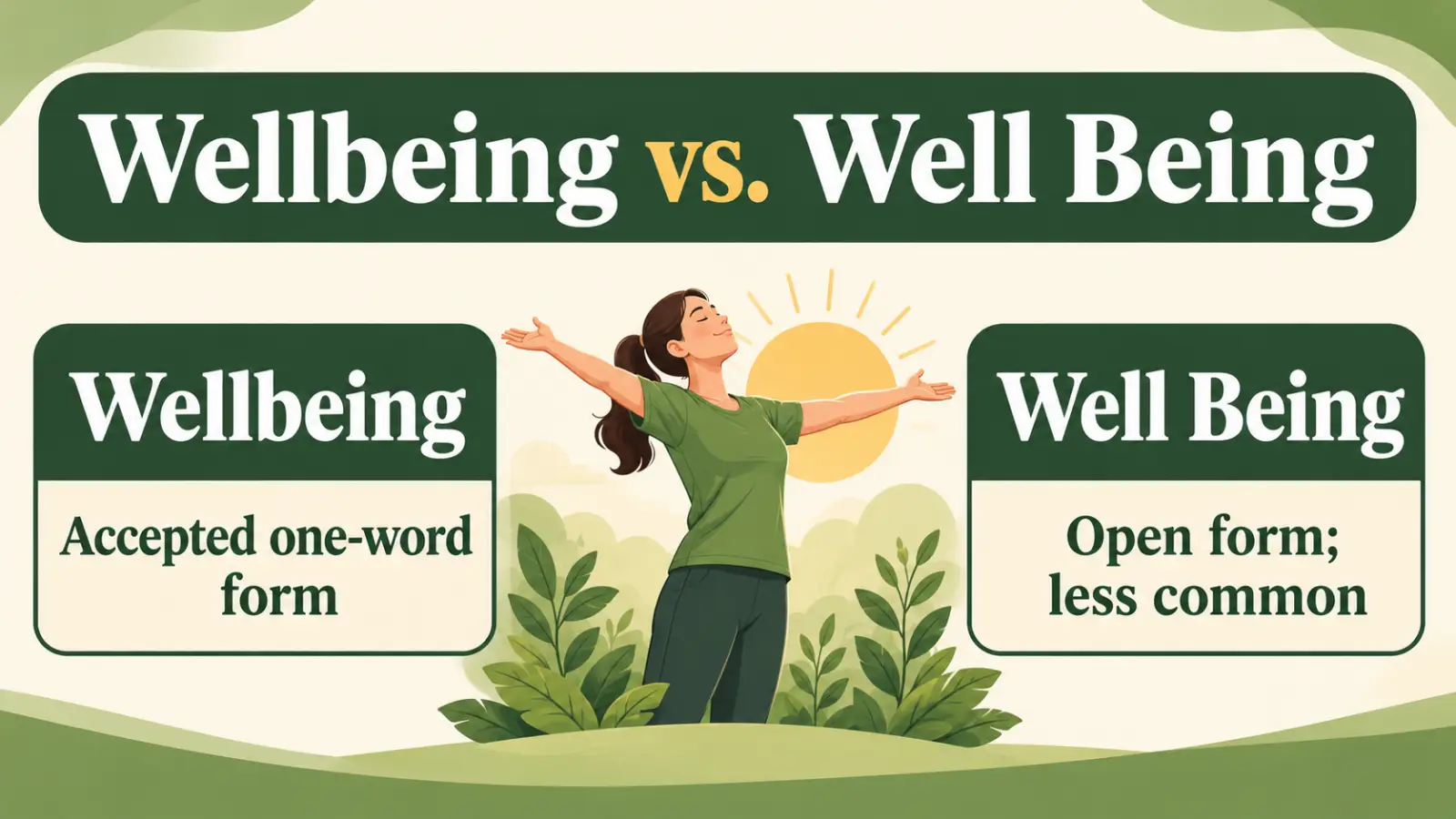
Wellbeing and well-being are both accepted spellings of the noun that describes a person’s health, happiness, and overall welfare. Well being, written as two separate words without a hyphen, is generally not the standard form when referring to that concept.
For American English writing, well-being is a familiar choice, while some organizations and style guides prefer wellbeing. The best option depends on the dictionary or editorial style you follow. The important point is to use one form consistently.
Related Post: Thru vs through
Wellbeing vs. Well Being: The Key Difference
| Term | Meaning or status | When to use it | Example |
|---|---|---|---|
| Wellbeing | Accepted one-word spelling of the noun | When following a style guide that prefers the closed form | The program supports employee wellbeing. |
| Well-being | Accepted hyphenated spelling of the noun | In general and formal writing, especially when following a style guide that uses the hyphen | Exercise can improve mental well-being. |
| Well being | Usually not the standard spelling of the compound noun | Only when well and being have separate grammatical roles | She is well, despite being tired. |
The key distinction is that wellbeing and well-being are spelling variants of the same noun. The open form well being is different: it generally does not work as the compound noun meaning health, happiness, or welfare.
What Does Wellbeing Mean?
Wellbeing is a noun describing a person’s overall state of health, happiness, comfort, and welfare. It can include physical health, mental and emotional health, social relationships, and general quality of life.
The closed spelling is accepted in modern English, although some dictionaries and editorial standards prefer the hyphenated version.
When to Use Wellbeing
Use wellbeing when your preferred dictionary or style guide recommends writing the compound as one word.
It commonly appears in discussions about:
- Employee health and workplace support
- Mental and emotional health
- Physical health and lifestyle
- Community welfare and quality of life
- Education and student support
For example, an organization may use employee wellbeing as a heading for programs that support workers’ health and work-life balance.
Wellbeing in Example Sentences
- The company introduced a program to support employee wellbeing. The program aims to improve workers’ overall health and welfare.
- Regular exercise can contribute to physical and mental wellbeing. The sentence uses the closed form to describe overall health.
- The school considers student wellbeing a priority. Here, the word refers to students’ general welfare and quality of life.
What Does Well-Being Mean?
Well-being has the same meaning as wellbeing. It is the hyphenated form of the noun referring to a person’s health, happiness, comfort, and welfare.
This spelling is widely established and remains a familiar choice in American English. Some dictionaries and style guides use it as their preferred form.
When to Use Well-Being
Use well-being when it matches the spelling preferred by your dictionary, publisher, employer, or academic style guide.
It works in the same contexts as wellbeing, including discussions of:
- Personal health and happiness
- Mental and emotional welfare
- Employee support programs
- Public health and community services
- Quality of life
For general American English writing, well-being is a safe and familiar choice when no specific house style applies.
Well-Being in Example Sentences
- Getting enough sleep can support your physical well-being. The phrase refers to overall health and welfare.
- The organization offers resources to protect employee well-being. The hyphenated form describes workers’ general welfare.
- Strong social connections can contribute to emotional well-being. The sentence uses the term to describe a positive state of emotional health.
Is Well Being Correct?
Usually, well being is not the preferred spelling when you mean the noun referring to health, happiness, or welfare. Use wellbeing or well-being instead.
However, the separate words well and being can appear next to each other in a grammatically correct sentence when they perform separate functions.
For example:
- She is well, despite being tired. Here, well describes her condition, while being begins a separate verb construction.
- He is well, being cared for by his family. The words have separate grammatical roles; they do not form the compound noun.
The distinction is about meaning and grammar, not simply whether two words happen to appear beside each other.
How to Choose the Right Spelling
The choice between wellbeing and well-being is mainly a matter of spelling convention and editorial preference. Both forms can express the same noun meaning.
Use wellbeing if your style guide prefers the closed form. Choose well-being if your reference or publication uses the hyphenated form. Avoid well being when you intend the compound noun.
A Quick Test You Can Apply
Ask whether the phrase refers to someone’s overall health, happiness, or welfare.
- If yes, choose wellbeing or well-being.
- If your style guide specifies one form, follow that preference.
- If the words have separate grammatical roles, write them separately only when the sentence structure requires it.
For example:
The program improves employee well-being.
The phrase refers to employees’ overall welfare, so the hyphenated compound is appropriate.
When the Quick Test Does Not Work
A dictionary and a style guide may recommend different spellings without disagreeing about the word’s meaning.
For example, Microsoft’s Style Guide recommends wellbeing without a hyphen. Other editorial standards prefer well-being. This is why a writer should not assume that one spelling is universally incorrect.
Common Mistakes and How to Fix Them
| Original sentence | Corrected sentence | Why it changes |
|---|---|---|
| The company cares about employee well being. | The company cares about employee well-being. | The compound noun is conventionally written with a hyphen or as one word. |
| Exercise supports your well being. | Exercise supports your wellbeing. | The closed form is an accepted spelling of the noun. |
| Our school focuses on student well-being. | Our school focuses on student well-being. | The original sentence is already correct. |
| The program promotes mental wellbeing. | The program promotes mental well-being. | This is an optional style change if the publication prefers the hyphenated form; the original is also accepted. |
The first two examples correct the open compound when it is intended as the noun. The final example illustrates a style preference rather than a necessary grammatical correction.
Why These Forms Get Confused
The confusion comes from the different ways English compound words are written. Some compounds appear as one word, some use a hyphen, and others remain separate words.
Because both wellbeing and well-being are accepted, writers may also assume that the open form is equally standard. However, the established noun is generally written either closed or hyphenated.
Does the Choice Change With Context?
The meaning does not change between wellbeing and well-being. What changes is the spelling preference of the organization, publication, or style guide.
American English and Editorial Style
Both wellbeing and well-being appear in English-language writing, including American English. The difference should not be treated as a strict British-versus-American spelling rule.
For example, Microsoft’s Style Guide explicitly prefers wellbeing. Other organizations and editorial references use well-being. These choices reflect house style rather than a difference in meaning.
Formal Writing vs. Casual Conversation
Both accepted forms can appear in formal and casual writing, provided they match the chosen style.
For academic papers, workplace documents, reports, and published articles, check the required style guide. For everyday messages, either established form is understandable, but consistency still helps.
Can You Use Wellbeing and Well-Being Interchangeably?
Yes. When both forms are used as the compound noun, wellbeing and well-being have the same meaning. Replacing one with the other does not normally change the sentence’s message.
When Both Forms Work
These sentences communicate the same idea:
- Regular exercise can improve mental wellbeing.
- Regular exercise can improve mental well-being.
Both refer to a person’s mental health and general welfare. The difference is the spelling convention.
When Switching Changes the Meaning
The open form well being should not automatically replace either accepted compound spelling.
Compare:
- The program supports employee well-being. The hyphenated compound noun refers to employee welfare.
- The employee is well, despite being under pressure. Here, well and being have separate grammatical roles.
The second sentence does not use the compound noun. Its structure and meaning are different.
Common Phrases With Wellbeing and Well-Being
| Phrase | When to use it | Original example |
|---|---|---|
| Mental well-being | When discussing emotional and psychological welfare | The workshop focuses on mental well-being. |
| Physical well-being | When discussing physical health and condition | Daily movement can support physical well-being. |
| Employee wellbeing | When discussing workers’ health and welfare | The company expanded its employee wellbeing resources. |
| Overall well-being | When referring to a person’s general quality of life | Strong relationships can contribute to overall well-being. |
| Student wellbeing | When discussing the welfare of students | The school introduced new student wellbeing initiatives. |
These phrases can use either wellbeing or well-being, depending on the style being followed. Keep the spelling consistent throughout the same document.
Apply the Rule to a Real Situation
Imagine that you are preparing a workplace report about a new program designed to help employees manage stress.
Original Version
“Our company is investing in employee well being by offering mental health resources and flexible schedules.”
Improved Version and Explanation
“Our company is investing in employee well-being by offering mental health resources and flexible schedules.”
The revision uses the hyphenated compound noun well-being. You could also write employee wellbeing if your organization’s style guide prefers the one-word form. The important correction is avoiding the open spelling when the compound noun is intended.
What Is the Difference Between Well-Being and Wellness?
Well-being describes an overall state of health, happiness, and welfare. Wellness often refers to the active pursuit or maintenance of good health through habits, choices, and supportive practices.
For example:
- Well-being: The organization wants to improve employees’ overall well-being.
- Wellness: The organization offers a wellness program with fitness and nutrition resources.
The terms overlap, but they are not always interchangeable. Well-being often describes the broader condition, while wellness can emphasize activities or efforts intended to support good health.
An Easy Way to Remember the Difference
Remember that the noun meaning overall health and happiness is normally written as one of two accepted forms:
- Wellbeing: One word.
- Well-being: Two word parts joined by a hyphen.
Avoid well being when you mean that compound noun. If you are unsure which accepted spelling to choose, follow your publication’s style guide.
Frequently Asked Questions
Is wellbeing one word or two?
Wellbeing is one word. It is an accepted spelling of the noun describing health, happiness, and general welfare. Well-being, with a hyphen, is also correct.
Which is correct in American English: wellbeing or well-being?
Both forms are used in American English. Well-being is a familiar standard spelling, while some style guides, including Microsoft’s, prefer wellbeing. Follow the spelling convention required by your publication or organization.
Is well being grammatically correct?
Usually not when you mean the noun describing someone’s overall health or welfare. In that sense, use wellbeing or well-being. The separate words can appear together in other grammatical constructions, but those sentences have a different structure.
Should I hyphenate well-being in formal writing?
Use the spelling required by your style guide. If no guide applies, well-being is a familiar choice for formal American English writing, although wellbeing is also an accepted form.
Does wellbeing mean the same as wellness?
Not exactly. Wellbeing describes a person’s overall state of health, happiness, and welfare. Wellness often emphasizes the practices or efforts that help maintain or improve health.
Which Form Should You Use?
Choose wellbeing or well-being when referring to overall health, happiness, or welfare. Both are accepted spellings, and the choice usually depends on editorial preference rather than meaning.
For general American English writing, well-being is a familiar option. If your employer, school, publisher, or website prefers wellbeing, use that form consistently. Avoid well being when you mean the compound noun.
Sources