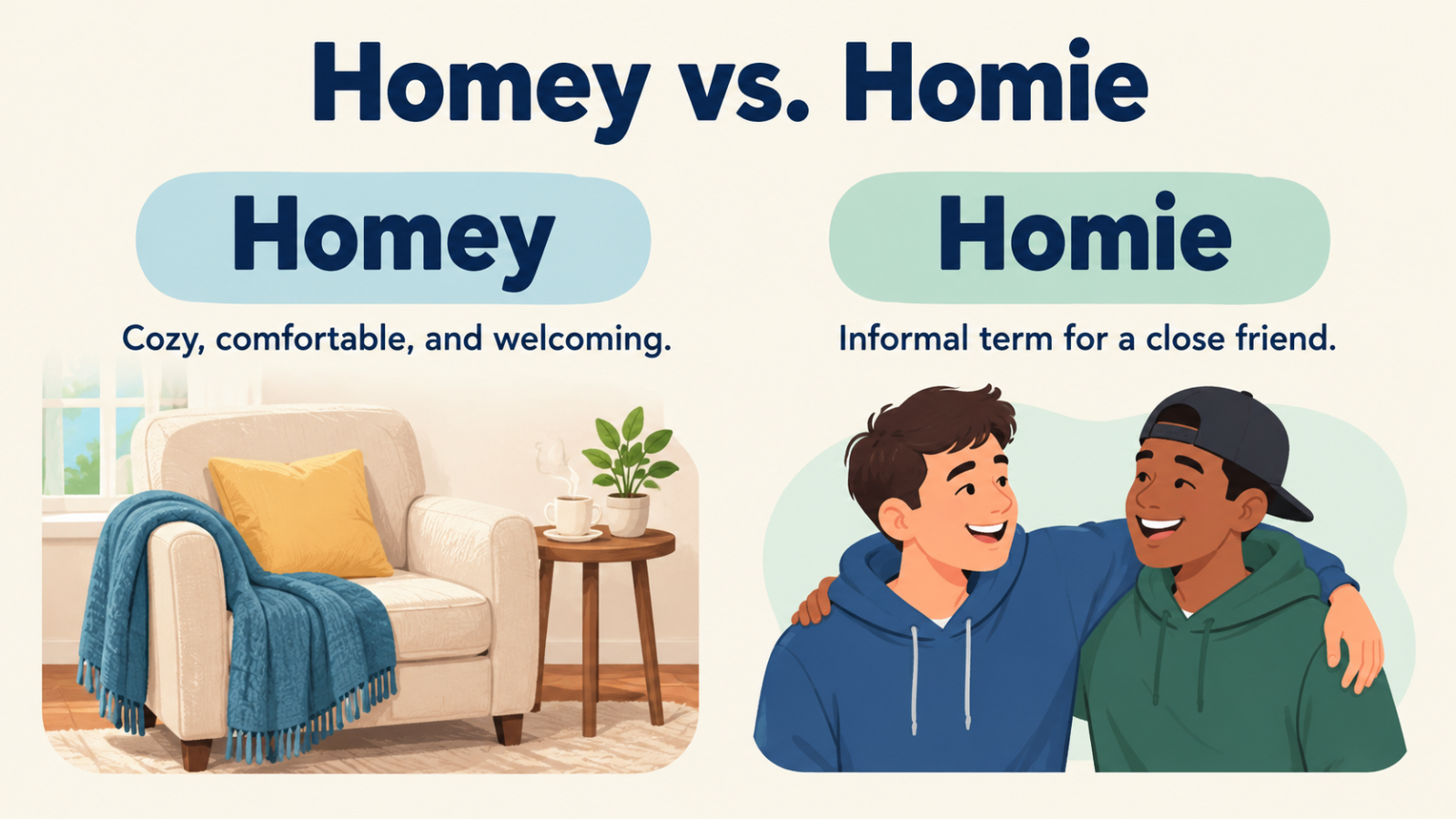
Homey vs. Homie: Understand the Difference
Homey and homie are both accepted spellings, but they can have different meanings. Homey commonly describes a place that feels comfortable and welcoming, while homie is informal American slang for a close friend or someone from your neighborhood. However, homey can also be an alternative spelling of homie when referring to a person.
The right choice depends on what you mean. Use homey to describe a cozy atmosphere, and use homie when addressing or talking about a friend. In casual slang, both spellings can refer to a friend, so context matters.
Related Post: Cosy or Cozy
Homey vs. Homie: The Key Difference
| Term | Meaning or status | When to use it | Example |
|---|---|---|---|
| Homey | Comfortable, familiar, and welcoming; also an accepted slang spelling for a friend | Describing a place or, informally, referring to a friend | The café has a homey atmosphere. |
| Homie | Informal slang for a close friend or someone from one’s neighborhood | Casual conversations, messages, and informal dialogue | My homie is coming over later. |
The main distinction is grammatical and contextual: homey is commonly an adjective, while homie is commonly a noun. As nouns referring to friends, however, the two spellings can overlap.
What Does Homey Mean?
Homey is an adjective that describes something comfortable, familiar, and welcoming, much like a home. It often applies to rooms, restaurants, hotels, and other places with a relaxed atmosphere. In American informal speech, homey can also be a noun meaning a close friend.
When to Use Homey
Use homey when describing:
- A room or house that feels comfortable.
- A restaurant with a warm, relaxed atmosphere.
- A hotel that feels welcoming rather than formal.
- A familiar, informal setting.
You can also use homey as a slang noun when referring to a friend, although homie makes that meaning clearer to many readers.
Homey in Example Sentences
1. The small restaurant has a homey atmosphere.
The adjective describes a comfortable, welcoming environment.
2. We decorated the guest room to make it feel more homey.
Here, homey means pleasant and familiar, like home.
3. My homey stopped by after work.
In this informal sentence, homey means a friend. The spelling homie would also work.
What Does Homie Mean?
Homie is an informal American slang noun for a close friend, someone from your hometown or neighborhood, or a person within your social circle. The word is associated with homeboy and homegirl. It is generally used in casual speech rather than formal writing.
When to Use Homie
Use homie when talking casually about:
- A close friend.
- Someone you grew up with or know from your neighborhood.
- A friend you address in a relaxed, familiar way.
- Friends who share a social circle or background.
Because it is slang, consider your audience before using it in a professional email, academic paper, or formal document.
Homie in Example Sentences
1. I’m meeting my homie for lunch.
The word refers to a close friend.
2. What’s up, homie?
Here, it is a casual way to address a friend.
3. She and her homies went to the concert together.
The plural homies refers to her group of friends.
How to Choose Between Homey and Homie
The easiest way to choose is to check whether you are describing a place or referring to a person.
A Quick Test You Can Apply
Try replacing the word with a simpler expression:
- If you can replace it with comfortable or welcoming, use homey: “The cabin feels homey” becomes “The cabin feels comfortable.”
- If you can replace it with close friend, use homie: “My homie called” becomes “My close friend called.”
If you are using the word as slang for a friend, homie is a clear, familiar choice. Homey is also accepted for that meaning.
When the Quick Test Does Not Work
The substitution test does not settle every case because homey can describe a place or refer to a person. For example, “My homey called” uses the word as a noun, not an adjective. In such cases, examine the sentence’s meaning rather than relying on spelling alone.
Common Mistakes and How to Fix Them
| Original sentence | Corrected sentence | Why it changes |
|---|---|---|
| The living room feels homie and welcoming. | The living room feels homey and welcoming. | Use the adjective homey to describe a comfortable atmosphere. |
| My homey is picking me up later. | My homie is picking me up later. | Homie makes the slang meaning of close friend immediately clear. |
| Hey, homey! What’s going on? | Hey, homie! What’s going on? | Homie is the more familiar spelling for this casual greeting, though homey is also accepted. |
| The hotel had a homie atmosphere. | The hotel had a homey atmosphere. | The intended meaning is comfortable and welcoming, so the adjective homey fits. |
The second and third examples are usage recommendations rather than absolute spelling corrections: homey can also be used as a slang noun for a friend.
Why These Forms Get Confused
Both words are pronounced alike in common American usage, and both can refer to a friend. Their similar spelling and overlapping meanings make them easy to confuse.
The distinction is most useful when homey functions as an adjective describing comfort, while homie functions as a noun for a friend. That is a helpful guideline, not a rule that excludes every other use.
Does the Choice Change With Context?
Formal Writing vs. Casual Conversation
Homey is suitable for descriptions of places in everyday writing, travel copy, and home décor content. For example, “The inn has a homey atmosphere” clearly describes its welcoming feel.
Homie belongs mainly to informal conversation, dialogue, texts, and social media. It can communicate warmth and familiarity, but it may sound too casual for professional or academic writing.
Can You Use Homey and Homie Interchangeably?
Sometimes. When both words refer to a friend, they can have the same meaning. When describing comfort or atmosphere, homey is the appropriate choice, and homie generally does not fit.
When Both Forms Work
Both spellings can refer to a friend:
- “My homie is coming over.”
- “My homey is coming over.”
Both are understandable, but homie is a clearer default for American slang.
When Switching Changes the Meaning
Compare these sentences:
- “The apartment feels homey.” — The apartment feels comfortable and welcoming.
- “The apartment feels homie.” — This is not the usual way to describe a comfortable apartment.
The first sentence uses an adjective. The second uses a form normally associated with slang for a person and does not naturally express the intended meaning.
Common Phrases With Homey and Homie
| Phrase | When to use it | Original example |
|---|---|---|
| Homey atmosphere | Describing a comfortable setting | Warm lighting gives the bookstore a homey atmosphere. |
| Homey feel | Describing a familiar, welcoming quality | Wooden furniture gives the cottage a homey feel. |
| My homie | Referring informally to a close friend | My homie saved me a seat at the game. |
| What’s up, homie? | Greeting a friend casually | “What’s up, homie?” Jordan asked when he arrived. |
| Me and my homies | Informally referring to a group of friends | Me and my homies are watching the game tonight. |
The last example reflects casual speech. In formal writing, use “My friends and I are watching the game tonight.”
Apply the Rule to a Real Situation
Imagine you are writing a social media caption about a comfortable coffee shop.
Original Version
“This little café has such a homie atmosphere.”
Improved Version and Explanation
“This little café has such a homey atmosphere.”
The revised sentence uses homey because it describes the café as comfortable and welcoming. If you were talking about a friend who joined you at the café, homie would fit that meaning instead.
Is Homey or Homie More Common in American English?
Both spellings are recognized, but they are commonly associated with different uses. Homey is an established adjective for a comfortable, familiar atmosphere, while homie is a familiar spelling of the slang noun for a close friend. Dictionaries also recognize homey as an alternative spelling of that noun.
An Easy Way to Remember the Difference
Remember this simple pairing:
- Homey = a home-like feeling
- Homie = a close friend
For example, “My homie loves my homey living room” uses both words correctly: one refers to a friend, and the other describes the room.
This memory aid is most useful for distinguishing their common meanings. It does not eliminate the accepted use of homey as slang for a friend.
Frequently Asked Questions
Is homey a real word?
Yes. Homey is a standard adjective meaning comfortable, familiar, and welcoming. It is also an accepted alternative spelling of the slang noun homie.
Is homie slang?
Yes. Homie is informal American slang for a close friend or someone from one’s neighborhood or social circle. It is most natural in casual conversation and informal writing.
Is homey an insult?
Not usually. As an adjective, it describes a comfortable or welcoming place. As slang for a friend, it is generally familiar or friendly, although tone and context can affect how it is received.
What is the plural of homie?
The usual plural is homies. When homey is used as slang for a friend, its plural can also be written homeys or homies.
Can I use homie in professional writing?
You can use it when quoting someone, writing realistic dialogue, or deliberately adopting an informal voice. For ordinary business communication, friend, colleague, or another context-appropriate term is usually more suitable.
Which Form Should You Use?
Use homey when describing a comfortable, welcoming place or atmosphere. Use homie when referring informally to a close friend. Both spellings can refer to a friend, so the context—not simply the spelling—determines the intended meaning.
Sources