In Effect vs. In Affect: How to Choose the Correct Phrase
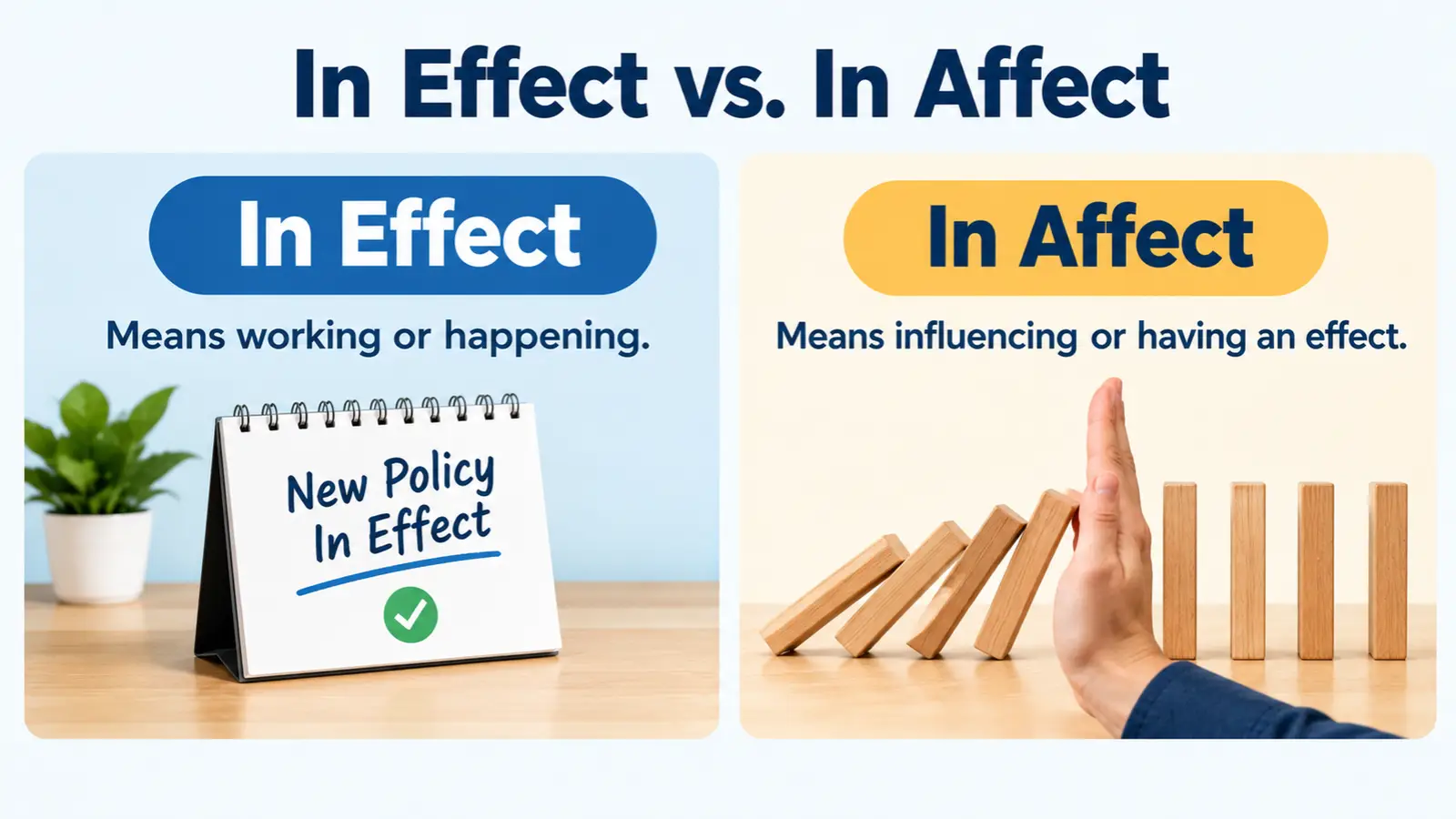
In effect is the standard phrase when you mean “in force,” “operating,” “essentially,” or “in practice.” In affect is not a standard substitute for these meanings, although the words can appear together when affect is used as a noun meaning emotional expression or state, especially in psychology.
Choosing the correct form matters when writing about laws, workplace policies, agreements, practical outcomes, or emotional states. The key is to identify what you want to say rather than relying on the similar spelling of effect and affect.
Related Post: Either-Or Fallacy
In Effect vs. In Affect: The Key Difference
| Phrase | Meaning or status | When to use it | Example |
|---|---|---|---|
| In effect | An established phrase meaning active, in force, essentially, or in practice | Discussing rules, laws, policies, or practical consequences | The new policy is now in effect. |
| In affect | Not a standard phrase for “in force” or “essentially”; grammatically possible when affect is a noun | Specialized discussion of emotional expression or state | The clinician noted changes in affect. |
For everyday American English, choose in effect when describing something that is active or true in practical terms. Use affect as a noun only when its specialized meaning is appropriate.
What Does In Effect Mean?
In effect is an established English phrase with two main uses. It can mean that something is active or operating, or it can mean “essentially” or “in practice.”
When to Use In Effect
Use in effect in these situations:
- A rule or law is active: The regulation is in effect starting Monday.
- A policy is being applied: The company’s updated policy remains in effect.
- A statement describes the practical meaning of something: By rejecting the offer without an explanation, she was, in effect, ending the negotiations.
The phrase can also describe the practical result of an action, even when that result differs from the wording used to describe it.
In Effect in Example Sentences
- The parking restrictions will be in effect during the festival.
- The agreement remains in effect until both parties approve a replacement.
- By removing the department’s funding, the decision was, in effect, a cancellation of the project.
In the first two examples, the phrase means “active” or “in force.” In the third, it means “essentially” or “in practical terms.”
What Does In Affect Mean?
In affect is not the conventional phrase for describing an active law, policy, or agreement. However, the sequence can be grammatically correct when affect is a noun referring to a person’s observable emotional expression or emotional state, a meaning used particularly in psychology and clinical writing.
When to Use In Affect
Use affect as a noun only when the subject calls for this specialized meaning. For example, a clinical report might describe a change in someone’s emotional expression.
Do not use in affect as a replacement for in effect when you mean that a rule is active or that something is true in practice.
In Affect in Example Sentences
- The clinician observed a change in affect during the assessment.
- The report described variations in affect across the interviews.
These examples use affect as a noun, not as part of the fixed expression “in effect.” The distinction matters because the two words have different meanings and grammatical uses.
How to Choose the Right Phrase
The simplest rule is to check whether you mean “active or essentially” or “emotional expression.”
- If you mean a rule is active, use in effect.
- If you mean something is true in practical terms, use in effect.
- If you are discussing a person’s emotional expression in a clinical context, affect may be the correct noun.
A Quick Test You Can Apply
Try replacing the phrase with a synonym.
- “The new rule is in effect.” → “The new rule is in force.” The meaning stays the same.
- “The decision was, in effect, a rejection.” → “The decision was, essentially, a rejection.” The meaning stays the same.
- “The clinician observed a change in affect.” → “The clinician observed a change in emotional expression.” This preserves the specialized meaning.
If “in force” or “essentially” fits your sentence, in effect is the right choice.
When the Quick Test Does Not Work
Some sentences use effect or affect in less common ways. For instance, effect can be a verb meaning “bring about,” as in “The committee hopes to effect change.” Meanwhile, affect can be a noun in psychology.
These exceptions do not change the main rule for the phrase comparison: in effect is the established expression for something active or true in practice.
Common Mistakes and How to Fix Them
| Original sentence | Corrected sentence | Why it changes |
|---|---|---|
| The new law is now in affect. | The new law is now in effect. | The sentence means the law is active. |
| The policy will go in affect next month. | The policy will go into effect next month. | The established expression is “go into effect.” |
| The agreement remains in affect until June. | The agreement remains in effect until June. | “In effect” means the agreement remains active. |
| The clinician observed a change in effect. | The clinician observed a change in affect. | If the intended meaning is emotional expression, “affect” is the relevant noun. |
The first three are errors when the intended meaning concerns a law, policy, or agreement. The last correction depends on context: if the sentence concerns a clinical observation of emotional expression, affect may be correct.
Why These Forms Get Confused
Effect is usually a noun meaning a result, while affect is usually a verb meaning to influence or change something. Both words are pronounced similarly, and their spellings differ by only one letter.
Because in effect is a familiar fixed phrase, writers sometimes replace “effect” with “affect” by mistake. Remember that the standard expression has a specific meaning that cannot be changed simply because the two words look alike.
Does the Choice Change With Context?
Yes. The correct form depends on the meaning of the sentence, not on whether the writing is formal or casual.
Workplace, Academic, or Everyday Usage
In ordinary writing, use in effect for policies, regulations, agreements, and practical consequences.
- Workplace: The updated attendance policy is in effect today.
- Academic: The new assessment rules are in effect for the fall semester.
- Everyday: The road closure is still in effect.
In psychology or clinical writing, affect may refer to observable emotional expression. In that setting, a phrase such as “changes in affect” can be appropriate.
Can You Use In Effect and In Affect Interchangeably?
No. They do not have the same meaning in standard everyday English.
When Switching Changes the Meaning
- The new policy is in effect. The policy is active.
- The clinician noted a change in affect. The clinician observed a change in emotional expression.
The first sentence uses an established phrase. The second uses affect as a specialized noun. Substituting one form for the other would change the meaning or make the sentence incorrect.
Common Phrases With Effect
| Phrase | When to use it | Original example |
|---|---|---|
| In effect | To mean active or essentially true | The revised schedule is in effect. |
| Go into effect | When a rule or policy begins operating | The new policy will go into effect on January 1. |
| Take effect | When a change begins producing a result or becoming active | The changes take effect next week. |
| Remain in effect | When something continues to apply | The agreement will remain in effect through December. |
| Put into effect | When a plan or decision is implemented | The school put its revised safety plan into effect. |
These expressions use effect because they refer to operation, implementation, or a result. In the specialized phrase changes in affect, by contrast, the word refers to emotional expression.
An Easy Way to Remember the Difference
Remember this simple rule: In effect = in force or in practice.
For example:
- The new rules are in effect. They are active.
- The decision was, in effect, a rejection. That is its practical meaning.
- The clinician observed a change in affect. The sentence refers to emotional expression.
When writing about laws, policies, or practical results, remember the E in effect. When discussing emotional expression in a specialized clinical context, affect may be appropriate.
Frequently Asked Questions
Is “in affect” ever correct?
Yes, but not as a substitute for the standard phrase “in effect.” It can occur grammatically when affect is a noun referring to emotional expression or state, as in “a change in affect.”
Is it “in effect” or “into effect”?
Both are correct, but they are used differently. In effect describes something that is already active, while into effect commonly appears in expressions such as “go into effect,” describing when something begins operating.
Does “in effect” mean effective?
Not exactly. In effect can mean active, in force, or essentially true in practice. Effective generally means producing a desired result or being successful at achieving an aim, although the words can overlap in certain contexts.
What is the difference between affect and effect?
Affect is usually a verb meaning to influence or change something. Effect is usually a noun meaning a result or consequence. Both have less common uses, including affect as a noun for emotional expression and effect as a verb meaning to bring something about.
Which Form Should You Use?
For standard American English, use in effect when you mean that a rule, law, policy, or agreement is active, or when you mean “essentially” or “in practice.”
Reserve affect as a noun for contexts where it specifically refers to emotional expression or state. If you remember the difference between in effect and the specialized noun affect, you can avoid the most common usage mistake.
Sources