Premise or Premises: How to Choose the Right Word
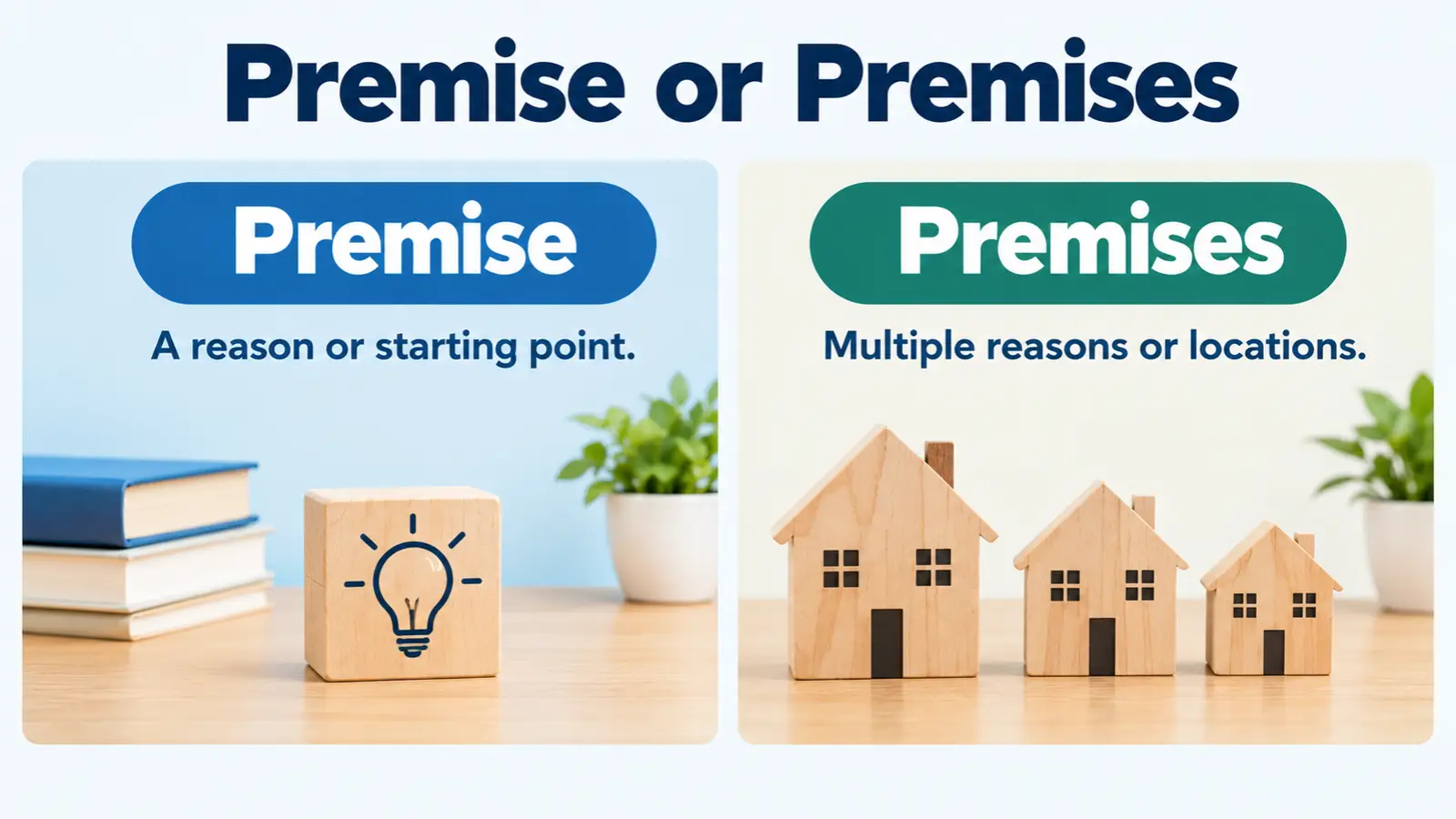
Premise and premises are both correct words, but they have different uses. Premise usually means an idea or statement that supports an argument, while premises can mean multiple supporting statements or the land and buildings occupied by a person or organization.
The correct choice depends on your meaning and sentence structure. Use premise for one assumption or proposition, premises for multiple propositions, and premises when referring to a property or its buildings.
Related Post: In Regard or In Regards
Premise vs. Premises: The Key Difference
| Term | Meaning or status | When to use it | Example |
|---|---|---|---|
| Premise | A statement or assumption supporting an argument or theory | When referring to one foundational idea | The argument rests on a false premise. |
| Premises | The plural of premise; also land and buildings used or occupied by someone | When referring to multiple supporting statements or a property | The premises were inspected yesterday. |
The key distinction is that premise is singular when it refers to an idea, while premises can be plural for ideas or refer to property. In the property sense, premises is conventionally plural even when it describes one building or site.
What Does Premise Mean?
A premise is an idea, assumption, or statement used as the basis for reasoning, an argument, or a theory. It may be accepted as true for the purpose of reaching a conclusion, although it can still be questioned or disproved.
When to Use Premise
Use premise when referring to one underlying assumption or proposition. It commonly appears in academic writing, debates, research, philosophy, and everyday discussions about reasoning.
Examples include:
- The basic premise of the study
- A false premise
- The central premise of an argument
- A premise for further research
Premise in Example Sentences
- The entire argument depends on one premise. The argument relies on a single foundational statement.
- Her proposal is based on the premise that employees need more flexibility. The proposal begins with a particular assumption.
- The detective questioned the premise behind the suspect’s explanation. The detective challenged the assumption supporting the explanation.
What Does Premises Mean?
Premises has two important uses. It is the plural of premise when referring to multiple statements or assumptions. It also refers to land and buildings occupied, owned, or used by a person or organization.
The property meaning is especially common in business, legal, and everyday contexts.
When to Use Premises
Use premises in either of these situations:
- Multiple ideas: A conclusion may depend on several premises.
- Property: A business, school, office, or other organization may occupy premises.
When referring to property, the word normally takes a plural verb, even when the premises consist of one building or location.
Premises in Example Sentences
- The conclusion follows from two premises. Here, the word refers to two supporting statements.
- Visitors must sign in before entering the premises. The word refers to the property occupied or used by an organization.
- The restaurant prepares its meals on the premises. This means the food is prepared at the restaurant’s own location.
How to Choose the Right Word
Start by identifying whether you mean an idea or a physical property. Then check whether you are referring to one idea or more than one.
A Quick Test You Can Apply
Ask these two questions:
- Are you describing an assumption or argument? Use premise for one idea and premises for two or more.
- Are you describing land or buildings? Use premises, even when referring to a single business location.
For example:
- “The theory has one basic premise.” One idea.
- “The theory rests on several premises.” Multiple ideas.
- “The store’s premises are clean.” A physical location.
When the Quick Test Does Not Work
The word premises can refer either to multiple ideas or to a property. If the sentence is unclear, look at the surrounding words. References to arguments, conclusions, and assumptions usually indicate the logical meaning; references to buildings, visitors, security, or locations usually indicate property.
Common Mistakes and How to Fix Them
| Original sentence | Corrected sentence | Why it changes |
|---|---|---|
| The argument is based on three premise. | The argument is based on three premises. | A plural number requires the plural form. |
| The premises of the theory is incorrect. | The premise of the theory is incorrect. | The sentence refers to one assumption, so the singular form is appropriate. |
| The company moved to a new premise. | The company moved to new premises. | The conventional property term is premises, even for one location. |
| The premises were that the plan would succeed. | The premise was that the plan would succeed. | The sentence presents one underlying assumption, not a property or multiple statements. |
Why These Forms Get Confused
The confusion arises because premises serves two grammatical purposes: it is the plural of premise, and it is the standard plural-form noun for land and buildings. The property meaning can describe one site, which may make the word look plural even when the speaker means a single location.
Does the Choice Change With Context?
Yes. Academic and everyday writing often use the words differently depending on the subject.
Academic and Everyday Usage
In academic writing, premise commonly refers to a proposition that supports reasoning. A paper might examine the premise of a theory or evaluate the premises behind a conclusion.
In everyday and business writing, premises often refers to a physical location. Signs such as “No smoking on the premises” use the word to mean the property or buildings where the rule applies.
Can You Use Premise and Premises Interchangeably?
No. The words are related, but replacing one with the other can change the meaning or introduce a grammatical error.
When Switching Changes the Meaning
Compare these examples:
- The premise of the argument was questionable. This refers to one assumption.
- The premises were closed after business hours. This refers to a physical location.
In the first sentence, changing premise to premises would change the grammatical number or suggest multiple assumptions. In the second, replacing premises with premise would be incorrect for the intended property meaning.
Common Phrases With Premise and Premises
| Phrase | When to use it | Original example |
|---|---|---|
| Basic premise | The main assumption behind an idea | The basic premise of the plan is simple. |
| False premise | An incorrect assumption | The debate began with a false premise. |
| Under the premise that | When reasoning from a particular assumption | The team worked under the premise that funding would continue. |
| On the premises | When referring to a location or property | Employees may park on the premises. |
| Off the premises | When referring to a place someone must leave or avoid | Visitors were asked to leave the premises. |
Apply the Rule to a Real Situation
Imagine you are preparing a report about a company’s business plan.
Original Version
“The plan is based on three main premise, and the company’s premises is located downtown.”
Improved Version and Explanation
“The plan is based on three main premises, and the company’s premises are located downtown.”
Why: The first use refers to three assumptions, so premises is the plural of premise. The second use refers to the company’s physical location, so premises is also appropriate there. Because the property term is conventionally plural, it takes are rather than is.
Is Premises Singular or Plural?
Premises is grammatically plural when referring to property, even if it describes one building or site. Use plural verbs and pronouns with this meaning.
For example: “The premises are secure, and they are monitored around the clock.”
When referring to logical statements, premises is also plural, but specifically means more than one premise.
An Easy Way to Remember the Difference
Think of premise as one point of reasoning and premises as either multiple points or a physical place.
- One assumption: “The premise is reasonable.”
- Several assumptions: “The premises are reasonable.”
- One business location: “The premises are open.”
The third example shows why meaning matters: a single location can still be called premises.
Frequently Asked Questions
Is premise or premises correct?
Both are correct. Premise is the singular form for one assumption or proposition, while premises is its plural and also refers to land and buildings.
What is the plural of premise?
The plural is premises. For example, “The argument depends on two premises.”
Can premises refer to one building?
Yes. When premises means a property’s land and buildings, it can refer to one business location or site and is conventionally treated as plural.
Should I write “the premises is” or “the premises are”?
Use the premises are when referring to property. For example, “The premises are open to visitors.” When discussing one logical assumption, use the singular: “The premise is clear.”
What is the difference between a premise and an assumption?
A premise is a statement or proposition used as the basis for reasoning or an argument. An assumption is something accepted as true, often without proof. Their meanings overlap, and an assumption can serve as a premise.
Which Form Should You Use?
Use premise for one underlying idea or assumption. Use premises for multiple supporting statements or for a property’s land and buildings. When describing a physical location, remember that premises normally takes a plural verb, even if the property consists of a single site.
Sources