
Thru vs through: Learn the Difference and When to Use Each
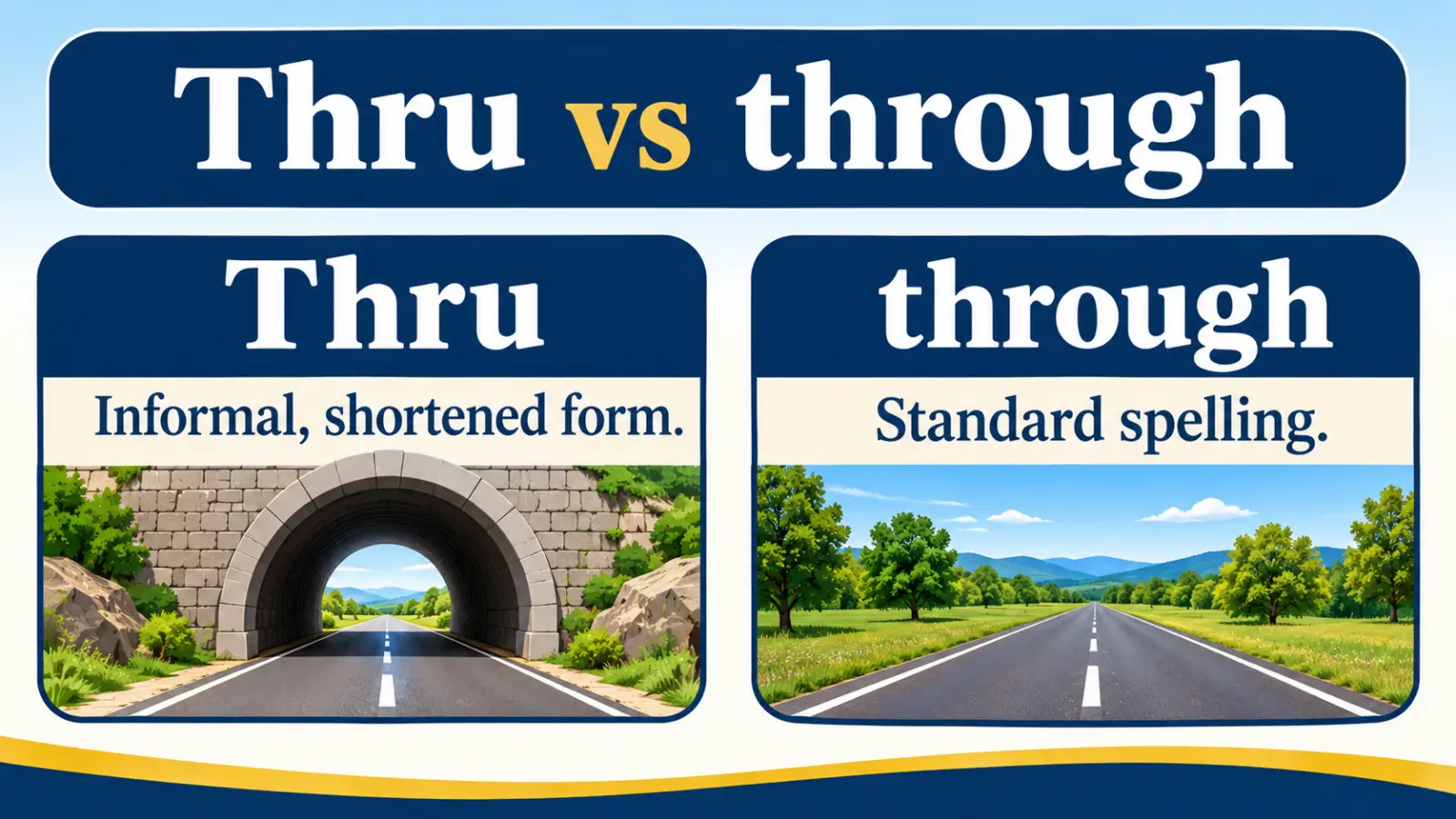
Through is the standard spelling for most American English writing. Thru is an accepted informal variant, commonly seen on signs, in advertisements, and in familiar expressions such as drive-thru. Both forms generally have the same meaning and pronunciation, but they differ in formality and usage.
The distinction matters when writing essays, business documents, emails, signs, or casual messages. Although thru is not simply a random misspelling, through is the safer choice for formal and general-purpose writing.
Related Post: A Lot or Alot
Thru vs. Through: The Key Difference
| Term | Meaning or status | When to use it | Example |
|---|---|---|---|
| Through | Standard spelling with several grammatical uses | Formal writing, professional communication, and everyday writing | We walked through the park. |
| Thru | Informal, simplified spelling variant of through | Informal messages, signs, advertisements, and established compounds | The restaurant has a drive-thru. |
Both spellings are recognized, but through is the conventional choice in standard edited English. Thru is more limited by context and is especially familiar in American commercial language.
What Does Through Mean?
Through is a standard English word that can function as a preposition, adverb, or adjective. It has several related meanings, including moving from one side of something to another, passing within an area, continuing from beginning to end, and reaching completion.
It can also describe a method or means by which something happens. The exact meaning depends on the sentence.
When to Use Through
Use through in standard writing whenever the sentence requires this word.
Common uses include:
- Movement from one side to another: The train passed through the tunnel.
- Movement within an area: We walked through the forest.
- A period from beginning to end: She worked through the night.
- A method or means: He found the job through a friend.
- Completion: I am through with the assignment.
- A range up to and including an endpoint: The office is open Monday through Friday.
These uses make through a flexible word that appears across many types of writing.
Through in Example Sentences
- The sunlight came through the window. The word describes light passing from one side of the window to the other.
- She read the entire report through before the meeting. Here, it describes completing the reading from beginning to end.
- The company improved its service through customer feedback. The word identifies the means by which the improvement happened.
Is Thru a Word?
Yes. Thru is a recognized informal spelling variant of through, not an accidental spelling error in every context. Dictionaries identify it as a simplified or alternative form, particularly in American English.
However, its acceptance does not mean it is suitable for every type of writing. It is most familiar on signs, in advertisements, and in certain established expressions. For general and formal writing, through remains the standard choice.
When to Use Thru
Use thru when the context supports an informal or shortened spelling.
Common examples include:
- Drive-thru: A service that allows customers to order or receive products without leaving their vehicles.
- Walk-thru: An informal label for a guided inspection or demonstration.
- Tuesday thru Friday: An informal way of expressing a period that includes both Tuesday and Friday.
- Informal messages: A shortened spelling used in casual communication.
Some businesses use thru on signs because the shorter form is visually compact and familiar to customers. It may also appear in advertising and headlines.
Thru in Example Sentences
- We ordered lunch at the drive-thru. This is a familiar American compound used for a vehicle-based service.
- The store is open Monday thru Saturday. The shorter spelling communicates the intended inclusive range, but through is preferable in formal writing.
- I’ll send you the details thru email. This is an informal spelling choice; in professional writing, use “through email” or the more natural “by email,” depending on the intended meaning.
How to Choose the Right Spelling
The simplest rule is to use through as your default spelling. Choose thru only when the writing is deliberately informal or when it appears in an established name, sign, or compound.
A Quick Test You Can Apply
Ask yourself whether the sentence belongs in formal or informal writing.
- Formal or general-purpose writing: Choose through. Example: “The application must be submitted through the online portal.”
- Informal sign or familiar compound: Thru may be appropriate. Example: “Drive-thru service available.”
You can also try replacing thru with through. If the meaning stays the same, the shorter form is functioning as a variant. The remaining question is whether the context permits an informal spelling.
When the Quick Test Does Not Work
Some expressions have established spellings that should not be changed simply to follow the general rule.
For example, drive-thru is a widely recognized American compound. Replacing it with drive-through is possible and also correct, but the shorter version is conventional in many business names and signs.
Similarly, a brand or business may intentionally use thru in its official name. Preserve that spelling when referring to the name itself.
Common Mistakes and How to Fix Them
| Original sentence | Corrected sentence | Why it changes |
|---|---|---|
| We walked thru the museum during our visit. | We walked through the museum during our visit. | Through is the standard choice for ordinary writing. |
| The report was completed thru careful research. | The report was completed through careful research. | The standard spelling is preferred in professional and academic writing. |
| The delivery will arrive drive through. | The delivery will arrive at the drive-thru. | Drive-thru is the established compound for this type of service. |
| The store is open Monday through Friday. | The store is open Monday through Friday. | This sentence is already correct; no change is needed. |
The first two examples are style corrections for standard writing, not proof that thru is never a valid spelling. The third corrects an awkward phrase by using the established compound.
Why These Forms Get Confused
Thru and through are pronounced the same way in standard American English. Their meanings are also generally the same when thru is used as a variant of through.
The shorter spelling may look like a natural alternative because English contains other shortened forms used in signs and informal writing. However, visual familiarity does not make both spellings equally suitable for every audience or setting.
Does the Choice Change With Context?
Yes. The main difference is not meaning but writing convention. The shorter spelling is more acceptable in some informal and commercial contexts than in formal documents.
Formal Writing vs. Casual Conversation
For school assignments, business reports, professional emails, and published articles, use through.
For a casual text message, an informal note, or a sign designed for quick reading, thru may be appropriate.
Compare:
- Formal: “Please submit your documents through the online system.”
- Informal: “You can pick up your order at the drive-thru.”
The first uses the standard spelling in a complete sentence. The second uses a familiar compound.
Workplace and Commercial Usage
Businesses often use thru in signs and service labels, especially in the United States. Drive-thru is a common example, and customers generally understand the expression immediately.
In formal workplace documents, however, use through unless you are reproducing an official business name or established label.
Can You Use Thru and Through Interchangeably?
In many sentences, thru can replace through without changing the basic meaning. However, the substitution changes the style and level of formality.
For example:
- Standard: “We drove through the town.”
- Informal: “We drove thru the town.”
Both communicate the same idea, but the first is more appropriate for standard edited writing.
When Both Forms Work
Both forms can work when thru is being used as an informal variant and the intended meaning is clear.
For example:
- “The road runs through the valley.”
- “The road runs thru the valley.”
The first is the standard form. The second is an informal alternative and may suit a casual message or stylized sign.
When Switching Changes the Style
Consider this pair:
- The application is available through the website.
- The application is available thru the website.
The meaning remains essentially the same, but the second sentence looks more informal. In a professional announcement or help document, through is the more suitable choice.
Common Phrases With Thru and Through
| Phrase | When to use it | Original example |
|---|---|---|
| Through the door | Describing movement from one side to another | The guests entered through the front door. |
| Through the night | Describing something that continues during the night | The workers stayed awake through the night. |
| Monday through Friday | Including every day from Monday to Friday | The office is open Monday through Friday. |
| Drive-thru | Describing a vehicle-based service | We picked up dinner at the drive-thru. |
| Walk-through | Describing a guided explanation, inspection, or demonstration | The technician gave us a walk-through of the new system. |
Notice that walk-through is commonly written with a hyphen when used as a noun or adjective. The spelling through remains standard in this compound.
Apply the Rule to a Real Situation
Imagine that you are writing a professional email to explain how employees should submit their weekly reports.
Original Version
“Please send your weekly reports thru the company portal by Friday.”
Improved Version and Explanation
“Please send your weekly reports through the company portal by Friday.”
The correction replaces thru with through because the message is a professional instruction. The meaning stays the same; the change simply makes the spelling appropriate for standard workplace communication.
If the same information appeared on a casual promotional sign, the shorter spelling might be acceptable depending on the design and intended tone.
Is Drive-Thru or Drive-Through Correct?
Both drive-thru and drive-through are used to describe a service where customers can order or receive products without leaving their vehicles.
Drive-thru uses the informal shortened spelling and is especially common in American business signs and commercial language. Drive-through uses the standard spelling of the word and is also correct.
Examples:
- “The restaurant added a new drive-thru lane.”
- “The restaurant added a new drive-through lane.”
For ordinary writing, either compound can be understood. When following a company’s official name or sign, preserve its chosen spelling.
An Easy Way to Remember the Difference
Remember this simple rule:
- Through: The standard spelling for everyday and formal writing.
- Thru: The shorter informal variant, often used on signs and in familiar compounds.
Think of the phrase “drive-thru” as a familiar exception to the usual preference for the full spelling. For nearly every other situation, writing through is a reliable choice.
Frequently Asked Questions
Is thru a misspelling of through?
Not necessarily. Thru is a recognized informal spelling variant, particularly in American English. However, through is the standard spelling for formal and general-purpose writing.
Is thru acceptable in American English?
Yes. It appears in signs, advertisements, informal writing, and established compounds such as drive-thru. Its use is more limited than the standard form.
Should I use thru or through in a formal email?
Use through in a formal email. It is the conventional spelling and is appropriate for professional communication.
Is drive-thru or drive-through more correct?
Both forms are used. Drive-thru is a familiar American commercial spelling, while drive-through retains the standard spelling of through. Follow the official spelling of a business name when referring to a specific company.
Does thru have the same pronunciation as through?
Yes. In standard American English, the two spellings are pronounced the same way. The difference is primarily spelling convention and formality, not pronunciation.
Which Form Should You Use?
Choose through for essays, professional emails, reports, articles, and most everyday writing. Use thru when an informal style is intentional or when it appears in an established expression such as drive-thru.
If you are unsure which spelling fits your sentence, choose through. It is the standard form and works across formal and informal contexts.
Sources



One Comment