
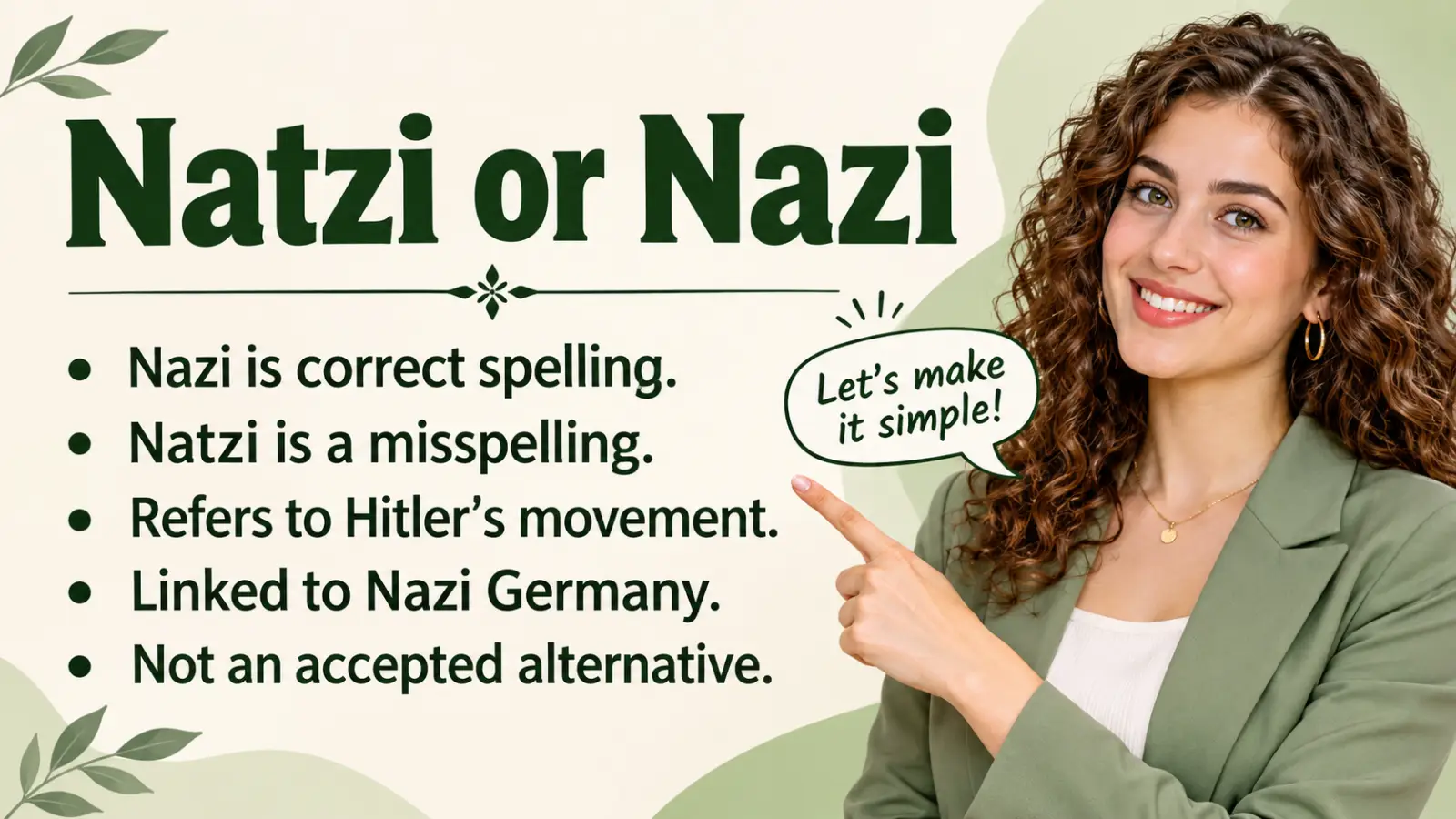
Natzi or Nazi: Which Spelling Is Correct?
Nazi is the correct standard spelling when referring to a member of Adolf Hitler’s political movement, Nazi Germany, or the movement’s ideology. Natzi is a misspelling of this term, not an accepted alternative spelling in standard English.
The distinction matters in history essays, academic papers, news articles, and everyday writing. Although the word can sound as if it contains a “t” when pronounced, its standard spelling has four letters: N-A-Z-I.
Related Post: Nosey or Nosy
Natzi vs. Nazi: The Key Difference
| Term | Meaning or status | When to use it | Example |
|---|---|---|---|
| Nazi | Standard English spelling of the historical and political term | Historical, political, or related descriptive writing | The museum documents Nazi history. |
| Natzi | Misspelling when the intended word is Nazi | Avoid it in standard English writing | Incorrect: Natzi Germany |
| Nazis | Standard plural of Nazi | Referring to multiple members of the movement | The Nazis ruled Germany under Hitler. |
| Nazism | The ideology associated with the Nazi movement | Discussing political beliefs and policies | The course examines Nazism. |
The essential rule is simple: write Nazi, not Natzi, when referring to the historical movement or its members. The two spellings do not represent different American and British English variants.
What Does Nazi Mean?
Nazi is a noun or adjective associated with the National Socialist German Workers’ Party, the political party led by Adolf Hitler that controlled Germany from 1933 to 1945.
The term has two principal grammatical uses.
As a noun, it refers to a member of the Nazi Party or, in some contexts, a person associated with Nazi ideology.
As an adjective, it describes something connected with the Nazi Party, its government, or its ideology.
When to Use Nazi
Use Nazi when writing about the historical movement, its members, its government, or its associated ideology.
Examples include:
- Nazi Germany — Germany under Nazi rule.
- The Nazi Party — The political organization led by Adolf Hitler.
- Nazi propaganda — Propaganda produced or promoted by the Nazi regime.
- Nazi ideology — The political beliefs associated with Nazism.
In historical writing, the word should be used precisely because it refers to a specific political movement, not simply to any person with strict rules or authoritarian behavior.
Nazi in Example Sentences
- The historian examined the effects of Nazi policies on European communities.
This sentence uses Nazi as an adjective describing the policies. - The documentary explains how the Nazis came to power in Germany.
Here, Nazis is the plural noun referring to members of the movement. - The students studied the history of Nazi Germany during World War II.
In this example, Nazi modifies the proper name Germany to identify a specific historical period.
Is Natzi a Word?
Natzi is not a standard English spelling of Nazi. If you intend to refer to Hitler’s political movement or a person associated with it, the correct spelling is Nazi.
The extra letter “t” is not part of the accepted spelling. Although the pronunciation can make the word sound like it contains a “t,” spelling should follow the established written form rather than an attempt to represent every sound with a separate letter.
Consider these corrections:
- Incorrect: The class discussed Natzi Germany.
- Correct: The class discussed Nazi Germany.
- Incorrect: The author studied Natzi propaganda.
- Correct: The author studied Nazi propaganda.
- Incorrect: Several Natzis were discussed in the documentary.
- Correct: Several Nazis were discussed in the documentary.
A particular username, fictional name, or other proper name could independently use the spelling Natzi. That possibility does not make it an accepted alternative spelling of the historical term.
How to Choose the Right Spelling
The easiest way to choose is to identify the meaning you intend to express.
If you are discussing Hitler’s political movement, its members, its government, or its ideology, use Nazi. If you encounter Natzi in a sentence with that meaning, correct it to Nazi.
A Quick Test You Can Apply
Use this three-step check:
- Identify the meaning. Are you referring to Nazi Germany, the Nazi Party, or a person associated with the movement?
- Check the spelling. The correct form is N-A-Z-I, with no T.
- Check related forms. Use Nazis for the plural noun and Nazism for the ideology.
Worked example
Original: The article describes Natzi policies during World War II.
Correction: The article describes Nazi policies during World War II.
Why it works: Nazi is the established spelling of the historical term, and it functions as an adjective modifying policies.
When the Quick Test Does Not Work
The spelling rule is straightforward, but context still matters when identifying the intended word.
For example, Natzi might appear as a username, a fictional character’s name, or a deliberately altered spelling in a quotation. In those cases, do not automatically replace a proper name or reproduce a quotation incorrectly. Determine whether the writer intends the historical term or a separate name.
For ordinary historical, academic, and professional writing, however, Nazi is the appropriate form.
Common Mistakes and How to Fix Them
| Original sentence | Corrected sentence | Why it changes |
|---|---|---|
| The book covers Natzi Germany. | The book covers Nazi Germany. | Nazi is the standard spelling. |
| She researched the Natzi Party. | She researched the Nazi Party. | The political organization’s name uses Nazi. |
| The documentary examines the Natzis. | The documentary examines the Nazis. | The standard plural is Nazis. |
| The lecture focuses on Naziism. | The lecture focuses on Nazism. | Nazism is the established spelling of the ideology. |
These examples involve spelling errors, not differences in grammatical style. Correcting them preserves the intended meaning while making the writing suitable for formal and informal contexts.
Why These Forms Get Confused
One likely explanation is pronunciation. The word Nazi is commonly pronounced with a sound similar to “naht-see” or “not-see,” depending on the speaker’s accent. The audible sequence can lead writers to insert a “t” into the spelling.
Another possible factor is phonetic spelling: people sometimes write unfamiliar words according to how they hear them. However, the standard written form is established independently of that impression.
The best solution is to remember the spelling rather than trying to reconstruct it from pronunciation.
Does the Spelling Change in American and British English?
No. Nazi is the standard spelling in both American and British English. Natzi is not a regional alternative.
This differs from genuine regional spelling pairs such as color and colour, where both forms are accepted in their respective varieties of English.
Capitalization depends on usage. Capitalize Nazi when referring to the historical movement, its members, or the Nazi Party. In broader figurative use, some dictionaries recognize lowercase nazi as a common noun for an excessively controlling or rigid person. In formal writing, consider whether that figurative usage is appropriate and avoid confusing it with the historical meaning.
What Is the Difference Between Nazi and Nazism?
Nazi and Nazism are related but serve different grammatical purposes.
- Nazi: A noun for a member of the Nazi movement, or an adjective describing something connected with that movement.
- Nazism: A noun referring to the ideology associated with the Nazi movement.
Examples:
- The museum displayed documents about the Nazi regime.
- The book analyzes Nazism and its political ideology.
The words are related, but they are not interchangeable. Use Nazi to identify a person or describe something associated with the movement. Use Nazism when discussing the ideology itself.
An Easy Way to Remember the Difference
Remember this simple rule: Nazi has no T.
Spell it as four letters:
N – A – Z – I
Then apply the same pattern to related words:
- Nazi Germany
- Nazi Party
- Nazis
- Nazism
The memory aid works for the standard historical and political meaning. It is not intended to determine the spelling of unrelated proper names or deliberately altered words.
Practice: Can You Choose the Right Form?
Choose the correct spelling for each sentence.
- The students researched (Natzi / Nazi) Germany.
- The historian examined the beliefs associated with (Nazis / Nazism).
- The documentary discussed the actions of several (Natzis / Nazis).
Answers and Explanations
- Nazi — This is the established spelling used in the historical name Nazi Germany.
- Nazism — This noun identifies the ideology, whereas Nazis refers to people.
- Nazis — This is the standard plural of Nazi.
Frequently Asked Questions
Is Natzi ever correct?
No. Natzi is not a standard spelling of Nazi. It may appear as a deliberately chosen name or variation.
Is Nazi spelled differently in American and British English?
No. Nazi is the standard spelling in both American and British English.
Is the plural Nazi or Nazis?
The correct plural is Nazis. For example, “The book examines the history of the Nazis.”
Should Nazi always be capitalized?
Capitalize Nazi when referring to the historical movement, its members, or the Nazi Party. Lowercase use may appear in informal figurative contexts.
What is the difference between Nazi and fascist?
Nazi refers specifically to the German Nazi movement, while fascist is a broader term describing supporters or movements associated with fascism.
Sources
- Merriam-Webster — Nazi
- United States Holocaust Memorial Museum — Frequently Asked Questions About the Holocaust




One Comment