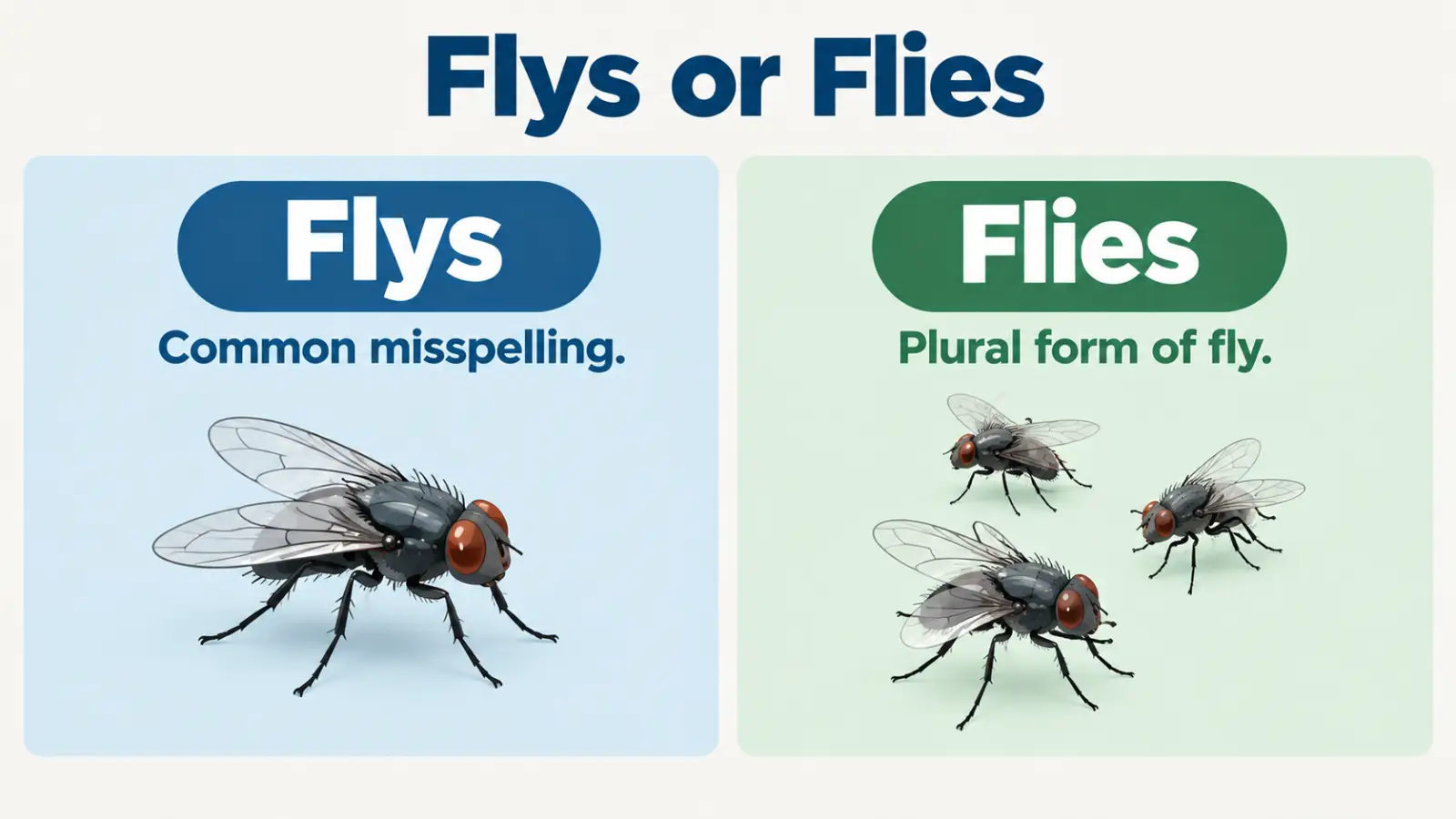
Flys or Flies: Which Spelling Is Correct?
Flies is the correct spelling for the plural of fly and for the verb form used with he, she, or it. Flys is generally incorrect when you mean insects or the action of flying. For example, write “The fly flies around the room,” not “The fly flys around the room.”
The distinction matters because flies can be either a plural noun or a verb, depending on the sentence. Learning how the word functions will help you choose the right spelling in everyday messages, school assignments, and professional writing
Related Post: Traveled vs. Travelled
Flys vs. Flies: The Key Difference
| Term | Meaning or status | When to use it | Example |
|---|---|---|---|
| Flies | Standard plural noun | When referring to more than one fly | Flies gathered near the window. |
| Flies | Standard verb form of fly | With he, she, it, or a singular noun in the present tense | She flies to Chicago every month. |
| Flys | Generally a misspelling for these meanings | Avoid it when referring to insects or the act of flying | Incorrect: He flys a plane. |
What Does Flies Mean?
Flies has two common grammatical uses: it is the plural of the noun fly, and it is the third-person singular present-tense form of the verb fly.
When to Use Flies
Use flies in these situations:
- Plural noun: When talking about two or more insects called flies.
- Present-tense verb: When a person, animal, aircraft, or other subject flies.
- Figurative expressions: When describing time passing, as in “Time flies.”
Flies in Example Sentences
1. Several flies landed on the fruit. Here, flies is a plural noun referring to insects.
2. My brother flies to Dallas for work. Here, flies is the verb describing what my brother does.
3. Time flies when you’re having fun. This familiar expression means that time seems to pass quickly.
Is Flys a Word?
Flys is not the standard spelling for the plural of fly or the usual present-tense verb form. In ordinary writing, use flies for both meanings.
For example:
- Incorrect: Two flys were buzzing near the lamp.
- Correct: Two flies were buzzing near the lamp.
- Incorrect: The pilot flys every weekend.
- Correct: The pilot flies every weekend.
There are specialized contexts in which flys may appear as a technical or industry-specific term, such as certain uses involving theatrical equipment or rigging. These specialized uses do not change the ordinary spelling rule for insects or the verb fly. When writing for a general US audience, flies is the safe choice for the meanings covered here.
How to Choose the Right Spelling
The easiest rule is to remember that fly becomes flies when you make it plural or use it as a third-person singular present-tense verb.
| Base form | Correct form | Example |
|---|---|---|
| One fly | Flies | Three flies are on the screen. |
| I fly | He flies | I fly for work; she flies for work, too. |
| They fly | It flies | They fly south; the bird flies south. |
A Quick Test You Can Apply
Ask yourself what the sentence needs:
- More than one insect? Use flies.
- A present-tense action with he, she, it, or one named subject? Use flies.
- A past-tense action? Use flew, not flied in the ordinary sense of traveling through the air.
For example:
- The bird flies over the lake. (Present tense)
- The bird flew over the lake yesterday. (Past tense)
- The birds fly over the lake every morning. (Plural subject)
When the Quick Test Does Not Work
The word fly has other meanings, so its forms can depend on the context. In baseball, for example, flied is used for hitting a fly ball: “The batter flied out to center field.” That is a specialized use of the verb, not the ordinary past tense for traveling through the air.
Common Mistakes and How to Fix Them
| Original sentence | Corrected sentence | Why it changes |
|---|---|---|
| Two flys landed on the table. | Two flies landed on the table. | The plural of fly is flies. |
| My dad flys to Denver. | My dad flies to Denver. | A singular subject takes flies in the present tense. |
| The plane flys over our house. | The plane flies over our house. | Plane is a singular subject, so the verb is flies. |
| The bird flys away yesterday. | The bird flew away yesterday. | The sentence describes a completed past action, so use flew. |
Why These Forms Get Confused
The confusion comes from a common English spelling pattern. Many nouns ending in a consonant plus y change the y to ies in the plural, as in baby → babies. The same spelling appears in the present-tense verb form flies. Because flys may look like a straightforward way to add an ending, writers sometimes use it by mistake.
Common Phrases With Fly and Flies
| Phrase | When to use it | Original example |
|---|---|---|
| Time flies | When time seems to pass quickly | Time flies when we’re catching up with old friends. |
| House flies | When referring to common flies found around homes | House flies kept gathering near the open door. |
| Fruit flies | When referring to small flies often found around ripe or fermenting fruit | We found fruit flies near the bowl of bananas. |
| As the crow flies | When describing the direct distance between two places | The towns are only five miles apart as the crow flies. |
| Flies around | When something moves or travels through the air in different directions | Dust flies around when the old rug is shaken. |
How Do You Use Flys or Flies in an Email?
Imagine you’re writing a message to a coworker about a problem in the office kitchen.
Original Version
“Hi, there are a few flys around the fruit bowl, and one flys near the window.”
Improved Version and Explanation
“Hi, there are a few flies around the fruit bowl, and one flies near the window.”
Both corrections use flies: the first is a plural noun, and the second is a present-tense verb with the singular subject one.
What Is the Plural of Fly?
The plural of fly is flies, not flys. This follows the common English pattern of changing a final consonant plus y to ies when forming the plural.
- One fly → two flies
- One baby → two babies
- One city → two cities
This pattern applies to many words, but not every word ending in y. For example, toy becomes toys because the y follows a vowel.
An Easy Way to Remember the Difference
Think of the phrase “one fly, many flies.” When you change fly into its plural form, the y changes to ies.
The same spelling helps with the verb: “The bird flies.” Just remember that the past tense of the ordinary flying action is flew: “The bird flew away.”
Frequently Asked Questions
Is “flys” ever correct?
For ordinary American English, use flies for the insect plural and the present-tense verb. Some specialized or branded uses may follow their own conventions, but flys is not the standard form for these common meanings.
Is it “the fly flies” or “the fly flys”?
The correct sentence is “The fly flies.” Fly is the singular noun, and flies is the verb agreeing with that singular subject.
What is the past tense of “flies”?
The past tense of the ordinary verb fly is flew. For example, “The bird flies every day” becomes “The bird flew yesterday.”
Why does “toy” become “toys,” but “fly” becomes “flies”?
When a word ends in a vowel plus y, the plural usually adds s: toy → toys. When it ends in a consonant plus y, the plural commonly changes y to ies: fly → flies.
Which Form Should You Use?
For standard American English, choose flies when you mean more than one insect or when a singular subject performs the action of flying in the present tense. Use flew for the ordinary past-tense action.
Avoid flys in these contexts. The simple reminder “one fly, many flies” will help you spell the word correctly.
Sources
- Cambridge Dictionary: Flies — confirms flies as the plural of fly.
- Cambridge Dictionary: Fly — explains the verb fly, including its forms flew and flown.