Putting or Puting: Which Spelling Is Correct?
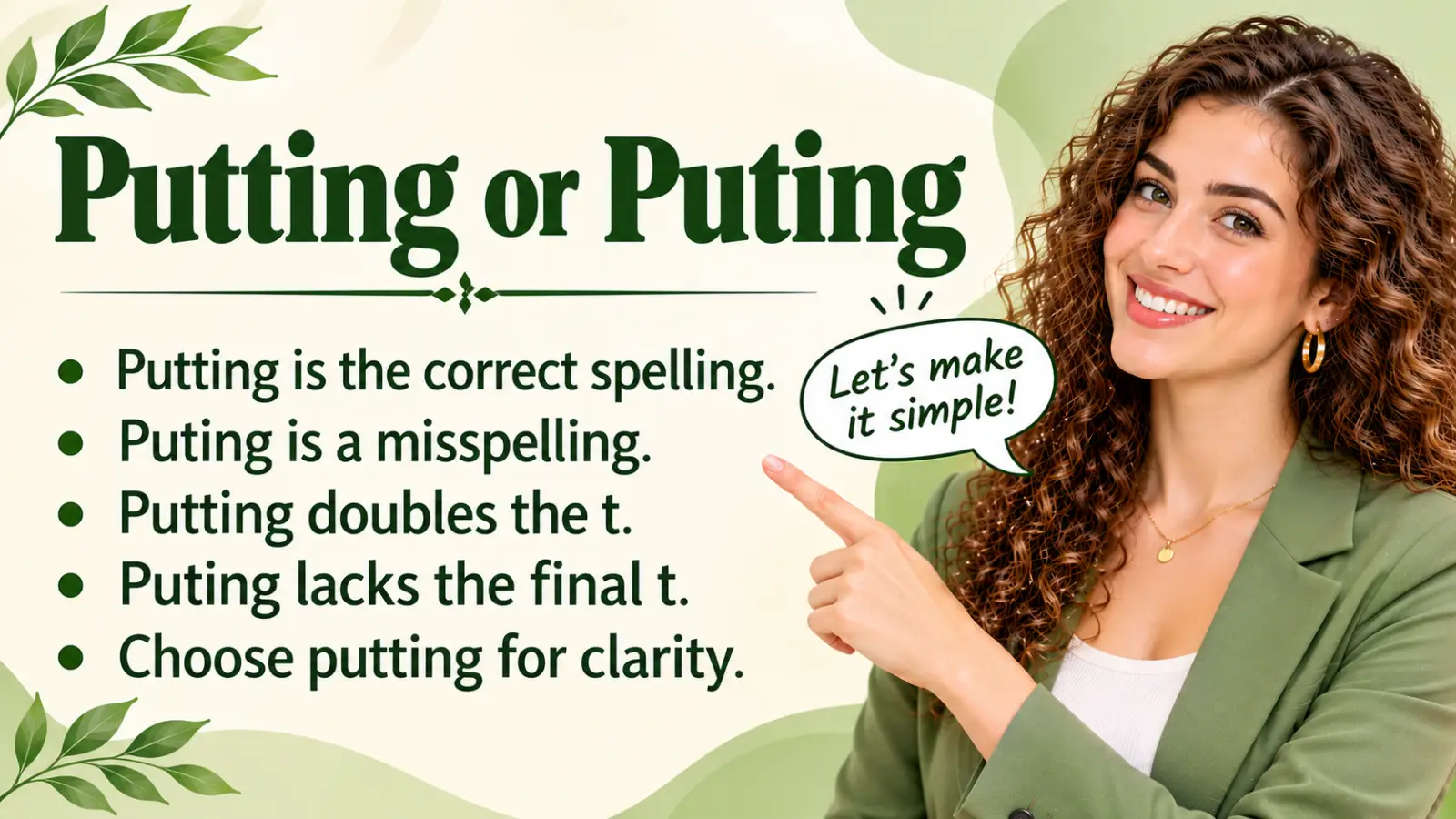
Putting is the correct spelling, while puting is a misspelling when you mean the -ing form of the verb put. The correct form doubles the final t: put → putting.
This spelling matters in everyday messages, school assignments, professional emails, and other writing. Remembering the double-t pattern can help you avoid a common typo and apply the same rule to similar verbs.
Related Post: To Bad or Too Bad
Putting vs. Puting: The Key Difference
| Term | Meaning or status | When to use it | Example |
|---|---|---|---|
| Putting | Correct spelling; the -ing form of put | When describing an ongoing action or an activity | She is putting the books away. |
| Puting | Misspelling of putting in standard English | Do not use it for the intended meaning | Incorrect: She is puting the books away. |
The key distinction is simple: putting has two t’s; puting has only one and is incorrect for this meaning.
What Does Putting Mean?
Putting is the present participle of the verb put. It commonly describes placing something somewhere, positioning an object, or expressing an idea. It can also function as a gerund, which is an -ing verb form used as a noun.
When to Use Putting
Use putting in these common situations:
- Ongoing actions: “He is putting his shoes by the door.”
- Activities described as nouns: “Putting things in order takes time.”
- Common expressions: “She is putting effort into her studies.”
- Golf: “His putting has improved this season.”
The exact meaning depends on the sentence, but the spelling remains the same.
Putting in Example Sentences
- “I am putting the groceries in the refrigerator.”
Putting describes the action happening now. - “Putting your ideas into words can be difficult.”
Putting functions as a noun-like form referring to the act of expressing ideas. - “He practiced putting before the golf tournament.”
Here, putting refers to hitting a golf ball gently toward the hole.
Is Puting a Word?
Puting is not the standard spelling of the intended word in these examples. If you mean placing something, describing an ongoing action, or referring to the golf activity, write putting.
For example:
- Incorrect: “She is puting her phone on the desk.”
- Correct: “She is putting her phone on the desk.”
The correction requires adding the second t. There is no need to change the sentence’s meaning or structure.
How to Choose the Right Spelling
The easiest way to choose is to start with the base verb put and add -ing using the standard consonant-doubling rule.
Because put has one syllable and ends in a single vowel followed by a single consonant, its final consonant doubles before the -ing ending:
- put → putting
- sit → sitting
- run → running
- get → getting
The correct spelling is not puting. The final t doubles to form putting.
A Quick Test You Can Apply
Use this three-step check:
- Find the base verb: Are you starting with put?
- Add -ing correctly: Double the final t before adding the ending.
- Check the result: The finished word should be putting.
For example:
- put + ing → putting
- sit + ing → sitting
- run + ing → running
This pattern helps you remember the spelling without relying only on how the word looks or sounds.
When the Quick Test Does Not Work
The consonant-doubling rule is not universal for every verb. The spelling depends on the word’s structure and, in some cases, its stress pattern.
For instance, read becomes reading, not readding. You should not double a final consonant automatically whenever you add -ing. For the specific verb put, however, the correct form is always putting.
Common Mistakes and How to Fix Them
| Original sentence | Corrected sentence | Why it changes |
|---|---|---|
| She is puting the dishes away. | She is putting the dishes away. | The final t must be doubled. |
| I am puting my thoughts in writing. | I am putting my thoughts in writing. | The correct -ing form is putting. |
| He is puting too much pressure on himself. | He is putting too much pressure on himself. | The verb follows the same spelling rule. |
| Puting your name on the form is necessary. | Putting your name on the form is necessary. | The gerund also requires the double t. |
Why These Forms Get Confused
The mistake may happen because writers treat put like verbs that simply take -ing without changing their spelling, such as read → reading or help → helping.
However, English spelling rules treat certain short verbs differently. With put, the final consonant doubles before -ing. Remembering the pattern in putting, sitting, and running can help prevent the error.
Does the Choice Change With Context?
No. In standard American English, the spelling putting remains correct whether you are describing an everyday action, writing formally, or discussing golf.
The context can change the meaning of putting, but it does not make puting an accepted alternative.
Can You Use Putting and Puting Interchangeably?
No. For the intended meaning, putting is correct and puting is a misspelling. Replacing the correct spelling with the single-t version introduces an error rather than a difference in meaning or tone.
Compare these sentences:
- Correct: “We are putting the chairs outside.”
- Incorrect: “We are puting the chairs outside.”
Both sentences aim to express the same action, but only the first uses standard spelling.
Common Phrases With Putting
| Phrase | When to use it | Original example |
|---|---|---|
| Putting effort into | Describing the work devoted to a goal | Maya is putting effort into her presentation. |
| Putting pressure on | Describing demands or stress placed on someone | The deadline is putting pressure on the team. |
| Putting together | Describing the act of assembling or organizing something | We are putting together a welcome package. |
| Putting into practice | Describing the application of knowledge or advice | He is putting the lessons into practice. |
| Putting it simply | Introducing an easy-to-understand explanation | Putting it simply, the plan needs more time. |
Each phrase uses the same correct spelling: putting.
Apply the Rule to a Real Situation
Imagine you are writing an email to a coworker about preparing a presentation.
Original Version
“I’m puting the slides together now, and I’ll send you the final version this afternoon.”
Improved Version and Explanation
“I’m putting the slides together now, and I’ll send you the final version this afternoon.”
The only necessary correction is changing puting to putting by doubling the final t. The rest of the sentence is clear and grammatically appropriate.
How Do You Spell Putting in Golf?
The golf term is also spelled putting, with two t’s. It refers to hitting a golf ball gently across the green toward the hole.
For example: “Her putting helped her finish the round strongly.”
The spelling is the same as the everyday verb form. The context determines the meaning.
An Easy Way to Remember the Difference
Remember this simple pattern:
Put + ing = putting
Think of the familiar pair sit → sitting. Just as sitting doubles the final t, putting does too.
A quick reminder is to picture the two words side by side:
- Correct: PUTTING
- Incorrect: PUTING
Whenever you add -ing to put, keep the double t.
Practice: Can You Choose the Right Form?
Choose the correct spelling for each sentence.
- She is ___ the keys on the kitchen counter.
a) puting
b) putting - ___ your ideas into a clear paragraph takes practice.
a) Putting
b) Puting - He spent an hour practicing his ___ before the golf match.
a) puting
b) putting
Answers and Explanations
- b) putting — The present participle of put doubles the final t.
- a) Putting — The word is a gerund, but it keeps the same correct spelling.
- b) putting — The golf term also uses two t’s.
Frequently Asked Questions
Is it putting or puting?
Putting is correct. Puting is a misspelling when you mean the -ing form of put.
Why does putting have two t’s?
The final consonant in put doubles before the -ing ending under the standard spelling rule for this word. The correct formation is put + ing → putting.
Is putting a verb or a noun?
It can function as both. In “She is putting the bag away,” it forms part of a verb phrase. In “Putting things away is helpful,” it functions as a gerund.
Is putting spelled the same way in American and British English?
Yes. Putting is the standard spelling in both American and British English for these meanings.
What is the past tense of put?
The past tense is put, not putted, when you mean the ordinary verb put. For example: “Yesterday, I put the package by the door.” Golf has its own verb putt, whose past tense is putted.
Which Form Should You Use?
Use putting whenever you mean the -ing form of put or the golf activity. Puting is a misspelling for these meanings and should be corrected in schoolwork, emails, reports, and everyday writing.
The easiest rule to remember is that put doubles its final t before -ing: put → putting.
Sources