
Naive vs. Nieve: Learn the Correct Spelling and Meaning
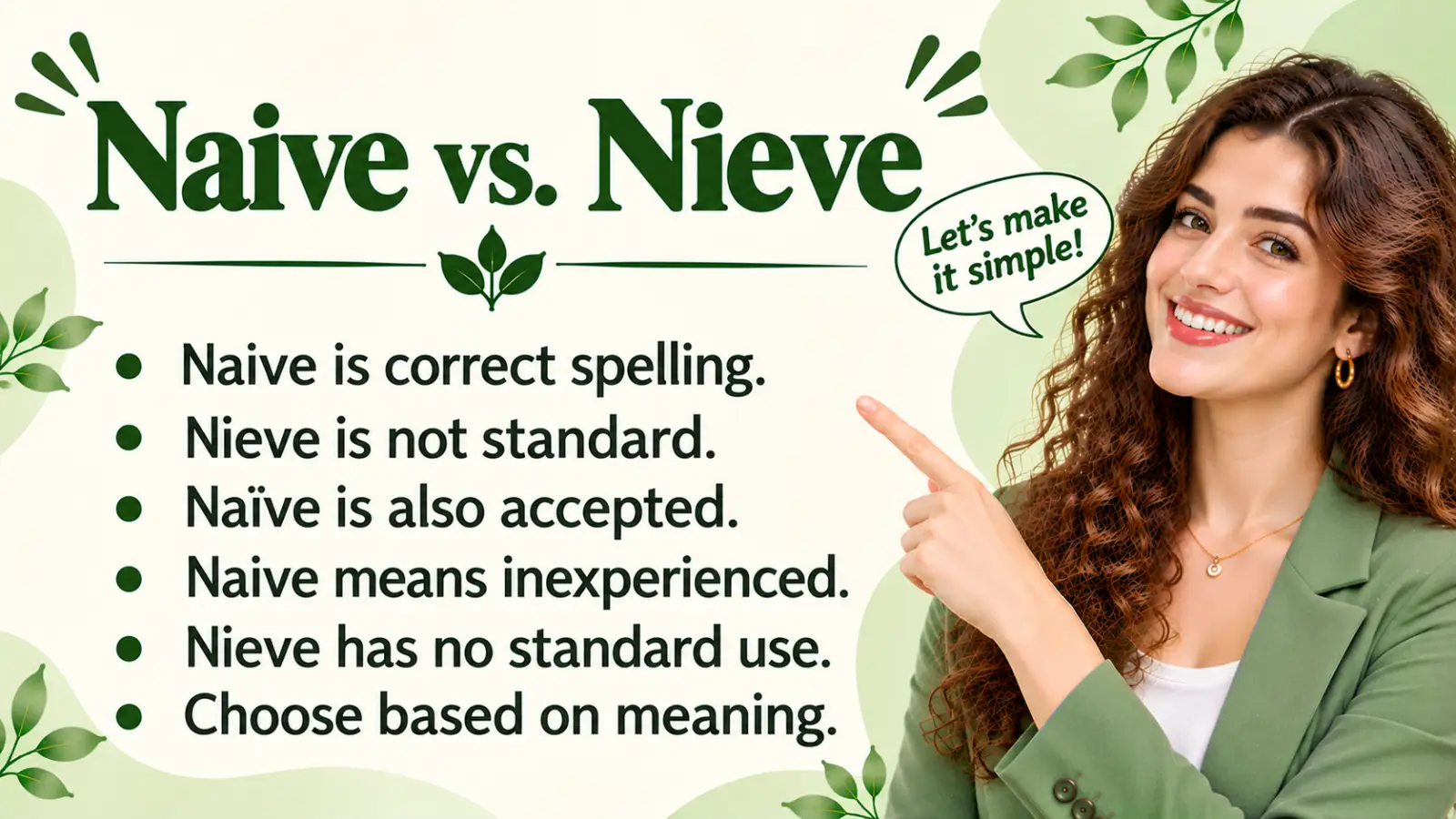
Naive is the correct spelling when you mean inexperienced, innocent, or too trusting. Nieve is not a standard English spelling of that adjective. You may also see naïve, which is an accepted spelling with the same meaning.
Choosing the right form matters in school assignments, work emails, articles, and everyday writing. Although the two spellings look similar, only naive and naïve express the intended English meaning.
Related Post: Affect vs. Effect
Naive vs. Nieve: The Key Difference
| Term | Meaning or status | When to use it | Example |
|---|---|---|---|
| Naive | Standard English adjective meaning inexperienced or overly trusting | Describing a person, belief, plan, or assumption | It was naive to trust the offer without checking it. |
| Naïve | Accepted spelling variant of naive | The same situations as naive | Her naïve optimism made her overlook the risks. |
| Nieve | Not the standard English spelling of the adjective naive | Do not use it to mean inexperienced or too trusting | Incorrect: He was nieve about the risks. |
The main rule is simple: write naive or naïve when describing inexperience or excessive trust. For most American English writing, naive is a straightforward choice.
What Does Naive Mean?
Naive is an adjective that describes someone who lacks experience, practical knowledge, or good judgment in a particular situation. It can also describe an idea, expectation, or plan that overlooks important realities.
Depending on context, the word may suggest innocence and simplicity or criticize someone for being too trusting or unrealistic. Being naive does not necessarily mean being unintelligent; someone can be highly capable in one area but inexperienced in another.
When to Use Naive
Use naive when describing:
- A person who trusts others too easily.
- An assumption that ignores practical difficulties.
- A plan based on unrealistic expectations.
- An inexperienced approach to a complicated situation.
The word can also describe a simple, childlike style in art. In that context, it refers to an artistic style rather than a person’s lack of experience.
Naive in Example Sentences
- She was naive about the costs of starting a business.
She did not fully understand the expenses involved. - It was naive to assume the project would finish in one day.
The assumption overlooked the work required. - His naive trust in strangers made him vulnerable to scams.
He trusted people without adequately considering the risks.
Is Nieve a Word?
Nieve is not the correct spelling when you mean naive in standard English. If you write, “She was nieve about the risks,” the sentence contains a spelling error for the intended meaning.
However, the same letter sequence exists in Spanish: nieve means “snow.” That separate Spanish word does not make nieve an alternative English spelling of naive.
Correcting Nieve to Naive
| Incorrect sentence | Correct sentence | Explanation |
|---|---|---|
| He was nieve about the contract. | He was naive about the contract. | Naive describes his lack of experience or understanding. |
| That is a nieve assumption. | That is a naive assumption. | Naive is the standard adjective for an overly simple or unrealistic assumption. |
| The proposal was nieve about the costs. | The proposal was naive about the costs. | The intended meaning concerns a lack of practical judgment. |
Naive vs. Naïve: Are Both Correct?
Yes. Naive and naïve are both accepted English spellings of the same adjective. The two dots over the i in naïve are called a diaeresis. You do not need to use the mark to spell the word correctly in ordinary American English.
For example, both sentences are correct:
- The proposal was naive about the potential costs.
- The proposal was naïve about the potential costs.
Choose one spelling and use it consistently throughout a document. If you are writing for a general US audience, naive is a practical default.
How to Choose the Right Spelling
Use this quick decision guide:
- Do you mean inexperienced, innocent, or overly trusting? Write naive or naïve.
- Are you writing in standard American English and want the simplest spelling? Choose naive.
- Do you mean the Spanish word for snow? Use nieve in the appropriate Spanish context.
A Quick Test You Can Apply
Replace the word with inexperienced or too trusting. If the sentence keeps its intended meaning, use naive or naïve.
Example:
- Original: It was a nieve decision to spend the entire budget immediately.
- Replacement: It was an inexperienced decision to spend the entire budget immediately.
- Correction: It was a naive decision to spend the entire budget immediately.
The replacement test helps identify the intended adjective. It is not a universal rule for every use of the letters nieve, since that spelling has a separate meaning in Spanish.
Common Mistakes and How to Fix Them
| Original sentence | Corrected sentence | Why it changes |
|---|---|---|
| She was nieve enough to believe the claim. | She was naive enough to believe the claim. | Naive is the correct English adjective for this meaning. |
| His plan was nieve about the time required. | His plan was naive about the time required. | The sentence describes an unrealistic plan. |
| It was naive to check the facts first. | It was wise to check the facts first. | This is a meaning error, not a spelling error: checking facts is sensible, not naive. |
Why These Forms Get Confused
The spellings differ by the order of two vowels: naive has ai, while nieve has ie. Because spelling does not always make pronunciation obvious, a writer may guess the wrong letter order. That is a plausible explanation for the mix-up, but the important point is to remember the standard spelling rather than rely on sound alone.
Common Phrases With Naive
| Phrase | When to use it | Original example |
|---|---|---|
| Naive assumption | When an idea overlooks important facts or complications | The budget relied on the naive assumption that prices would never rise. |
| Naive optimism | When confidence overlooks realistic obstacles | Her naive optimism faded when the first problems appeared. |
| Naive belief | When someone accepts an idea without enough experience or evidence | The naive belief that every online offer is genuine can lead to trouble. |
| Politically naive | When someone lacks practical understanding of political realities | The article described the proposal as politically naive. |
Apply the Rule to a Real Situation
Original Version
Imagine you are writing feedback on a business proposal:
“The timeline is nieve because it does not allow time for testing.”
Improved Version and Explanation
“The timeline is naive because it does not allow time for testing.”
The correction changes nieve to naive, the standard English spelling for an unrealistic or inexperienced approach. The rest of the sentence is grammatically sound, although “unrealistic” might be a more precise and less judgmental choice in professional feedback:
“The timeline is unrealistic because it does not allow time for testing.”
An Easy Way to Remember the Difference
Remember the letter order in N-A-I-V-E. The A comes before the I.
- Naive: inexperienced or too trusting.
- Naïve: the same word, with a diaeresis.
- Nieve: not the standard English spelling for this meaning.
For example, “It was naive to trust an unverified offer” uses the correct spelling because the sentence describes a lack of caution or experience.
Frequently Asked Questions
Is naive or nieve correct?
Use naive when you mean inexperienced, innocent, or overly trusting. Naïve is also correct. Nieve is not a standard English alternative spelling for this meaning.
Is naïve more correct than naive?
No. Both spellings are accepted. The version without the diaeresis is a convenient choice for everyday American English writing.
Does nieve mean anything?
Yes. Nieve means “snow” in Spanish. It is not the standard English spelling of naive, so do not substitute it when describing a person or idea as inexperienced or overly trusting.
Is naive an insult?
Not necessarily. The word can describe a lack of experience neutrally, but it can also sound critical when applied to someone’s judgment. In professional communication, words such as inexperienced, overly optimistic, or unrealistic may communicate the specific issue more tactfully.
Which Form Should You Use?
For standard English, choose naive when describing inexperience, innocence, or excessive trust. Naïve is equally correct if you prefer the accented spelling. Avoid nieve for this meaning, and remember that its separate use as a Spanish word does not change the English spelling rule.
Sources



One Comment