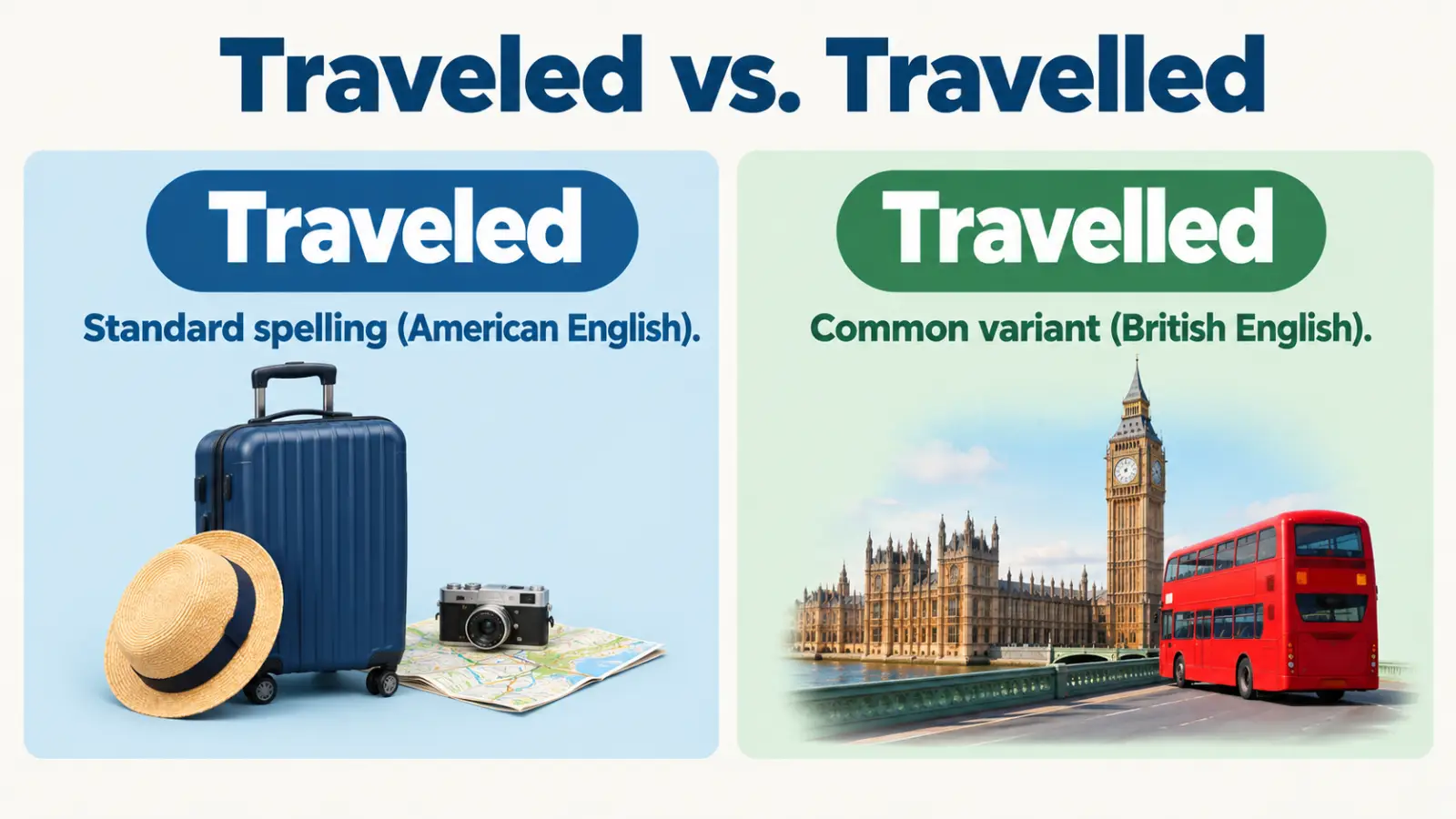
Traveled vs. Travelled: Which Spelling Should You Use?
Traveled and travelled are both correct spellings of the past tense and past participle of travel. The difference is regional: traveled is the standard American English spelling, while travelled is the standard British English spelling.
For US readers, use traveled in articles, emails, school assignments, and professional documents. If you’re writing for a British audience, use travelled and follow that spelling convention consistently.
Related Post: Moreso or More So
Traveled vs. Travelled: The Key Difference
| Term | Meaning or status | When to use it | Example |
|---|---|---|---|
| Traveled | Standard American English spelling | Writing for a US audience | She traveled across the country. |
| Travelled | Standard British English spelling | Writing in British English | She travelled across the country. |
| Traveling | Standard American spelling of the -ing form | Describing an ongoing journey | He is traveling to Chicago. |
| Travelling | Standard British spelling of the -ing form | Describing an ongoing journey | He is travelling to London. |
| Traveler | Standard American spelling of the noun | Referring to someone who travels | The traveler asked for directions. |
| Traveller | Standard British spelling of the noun | Referring to someone who travels | The traveller asked for directions. |
The key difference is spelling, not meaning or grammar. Both traveled and travelled describe the same action, and both are accepted forms in their respective English conventions.
What Does “Traveled” Mean?
Traveled is the past tense and past participle of the verb travel in American English. It means to have gone from one place to another, whether for work, vacation, education, or another reason.
When to Use “Traveled”
Use traveled when writing in American English about a completed journey or an experience involving travel.
It works in several common sentence patterns:
- Simple past: She traveled to Florida last summer.
- Present perfect: They have traveled to several countries.
- Past perfect: He had traveled extensively before starting his new job.
The word can also describe a route or object associated with movement, as in “a well-traveled road.”
“Traveled” in Example Sentences
- We traveled to Colorado during our spring break.
The sentence describes a completed trip. - My aunt has traveled throughout Europe for work.
Here, traveled follows has to form the present perfect tense. - The author is well-traveled and has visited dozens of cities.
The word describes someone with extensive travel experience.
What Does “Travelled” Mean?
Travelled has the same meaning as traveled, but it is the conventional spelling in British English. It is also used in other English varieties that follow British spelling conventions.
When to Use “Travelled”
Use travelled when writing for a British English audience or following a publication’s British-style spelling guide.
The form works in the same grammatical situations as traveled. You can use it for a completed journey, a past experience, or an adjective describing someone or something associated with travel.
“Travelled” in Example Sentences
- She travelled to Edinburgh to visit her cousins.
This is the British English spelling of the past-tense verb. - They have travelled extensively for their research.
The word is the past participle after have. - The museum stands along a well-travelled route.
Here, the adjective describes a route used by many travelers.
How to Choose the Right Spelling
The easiest rule is to match the spelling to your audience.
- American English: traveled
- British English: travelled
- American English: traveling, traveler
- British English: travelling, traveller
If you’re writing for a US publication, school, employer, or website, traveled is the appropriate default. If you’re writing for a British publication, use travelled.
A Quick Test You Can Apply
Ask yourself one question: Which English spelling convention am I following?
Then use the matching form throughout the document.
Worked example
Original: Our team travelled to New York for the annual conference.
US English edit: Our team traveled to New York for the annual conference.
Why: The sentence is intended for an American audience, so the single-l spelling fits US conventions. The original spelling is not universally wrong; it simply follows a different regional convention.
When the Quick Test Does Not Work
Some international organizations, publishers, and academic institutions use their own style guides. If a guide specifies a particular spelling, follow it even if it differs from the usual regional preference.
For Canadian English, usage can vary by publication and context. Check the relevant Canadian style guide instead of assuming that every Canadian source follows the same convention.
Common Mistakes and How to Fix Them
| Original sentence | Corrected sentence | Why it changes |
|---|---|---|
| I travelled to Boston last weekend. | I traveled to Boston last weekend. | For a document following US English, use the American spelling. |
| She is traveling to London next week. | She is travelling to London next week. | In British English, the -ing form usually has two ls. |
| The traveler has travelled widely. | The traveler has traveled widely. | A US-style document should use the American forms consistently. |
| He has travel to three countries this year. | He has traveled to three countries this year. | The present perfect requires the past participle, traveled in American English. |
The first three examples illustrate spelling or consistency choices, not universal grammatical errors. The fourth is a grammatical correction: has needs a past participle in this sentence.
Why These Forms Get Confused
Both spellings sound the same and carry the same meaning. The difference comes from regional spelling conventions for words ending in an unstressed -el.
American English generally uses one l in traveled, traveling, and traveler. British English generally doubles the l in travelled, travelling, and traveller.
Because both forms are established, spellcheckers may flag one when their language setting is configured for the other variety of English.
Does the Choice Change With Context?
American vs. British English
This is the main distinction.
| American English | British English |
|---|---|
| traveled | travelled |
| traveling | travelling |
| traveler | traveller |
| traveled extensively | travelled extensively |
The meaning remains the same across both varieties. The spelling changes to match the convention used by the intended audience.
Formal Writing vs. Casual Conversation
Both spellings are acceptable in their respective regional conventions, whether you’re writing formally or casually.
For a US résumé, academic paper, business report, or personal email, use traveled. In British English writing, use travelled. The extra l does not make a word more formal or more correct on its own.
Can You Use “Traveled” and “Travelled” Interchangeably?
They are interchangeable in meaning, but not always in style. Either spelling communicates the same action, and neither is inherently incorrect. However, switching between them within one document can make the writing inconsistent.
When Both Forms Work
Both sentences are correct:
- American English: We traveled by train through the mountains.
- British English: We travelled by train through the mountains.
The sentences describe the same journey. The spelling simply reflects a different English convention.
When Switching Creates a Style Problem
Consider this paragraph:
“Our team traveled to Boston in May. In June, we travelled to Denver.”
If the document follows American English, revise it to:
“Our team traveled to Boston in May. In June, we traveled to Denver.”
The original paragraph mixes two regional spellings of the same verb. That is a consistency issue, not a change in meaning.
Common Phrases With “Traveled” and “Travelled”
| Phrase | When to use it | Original example |
|---|---|---|
| Traveled abroad | When someone went to another country | She traveled abroad to study marine biology. |
| Traveled by train | When describing a mode of transportation | We traveled by train to avoid driving. |
| Traveled extensively | When someone has made many trips | The consultant traveled extensively for her job. |
| Well-traveled person | When describing someone who has visited many places | The well-traveled guide shared stories from Asia and Europe. |
| Traveled a long distance | When emphasizing the distance covered | The volunteers traveled a long distance to attend the event. |
For British English, use the corresponding forms travelled, well-travelled, and so on. Keep the spelling consistent with the rest of the text.
What Is the Difference Between “Traveled,” “Traveling,” and “Traveler”?
These forms have different grammatical roles, but the regional spelling pattern is similar.
- Traveled / travelled: Past tense and past participle.
- Traveling / travelling: The -ing form, used in continuous verb tenses and other constructions.
- Traveler / traveller: A noun for someone who travels.
For example, an American writer might say, “The traveler is traveling after having traveled abroad.” A British writer would generally write, “The traveller is travelling after having travelled abroad.”
The grammar is the same. Only the regional spelling convention changes.
An Easy Way to Remember the Difference
Use this simple memory aid:
US = one L; UK = two Ls.
- US: traveled, traveling, traveler
- UK: travelled, travelling, traveller
Think of the spelling as a set. Once you choose the regional style, apply it to all three forms.
This is a practical guide rather than a rule for every English word. Other words follow different spelling patterns, so do not automatically remove or add an l in unrelated words.
Frequently Asked Questions
Is “traveled” or “travelled” correct?
Both are correct. Traveled is the standard American English spelling, while travelled is the standard British English spelling.
Does “traveled” have one L or two?
In American English, traveled has one l. British English usually spells it travelled, with two.
Is “travelled” wrong in American English?
It is understandable and an established spelling variant, but traveled is the normal choice for standard US English writing. If you’re writing for an American audience, use the single-l form unless a style guide says otherwise.
Is it “traveling” or “travelling”?
Both spellings are correct. American English uses traveling, while British English usually uses travelling.
Are “traveled” and “travelled” pronounced differently?
No meaningful pronunciation difference is indicated by the extra l. The difference is primarily written spelling, not meaning or tense.
Which Form Should You Use?
For a US audience, choose traveled. For British English, choose travelled. Both are correct, and neither changes the meaning of the sentence.
To keep your writing polished, apply the same convention to related forms: traveling/travelling and traveler/traveller. Consistency is the key.
Sources
- Cambridge Dictionary — “Traveled”
https://dictionary.cambridge.org/us/dictionary/english/traveled - Cambridge Dictionary — “Travelled”
https://dictionary.cambridge.org/us/dictionary/english/travelled