Perfect vs Prefect: How to Choose the Right Word
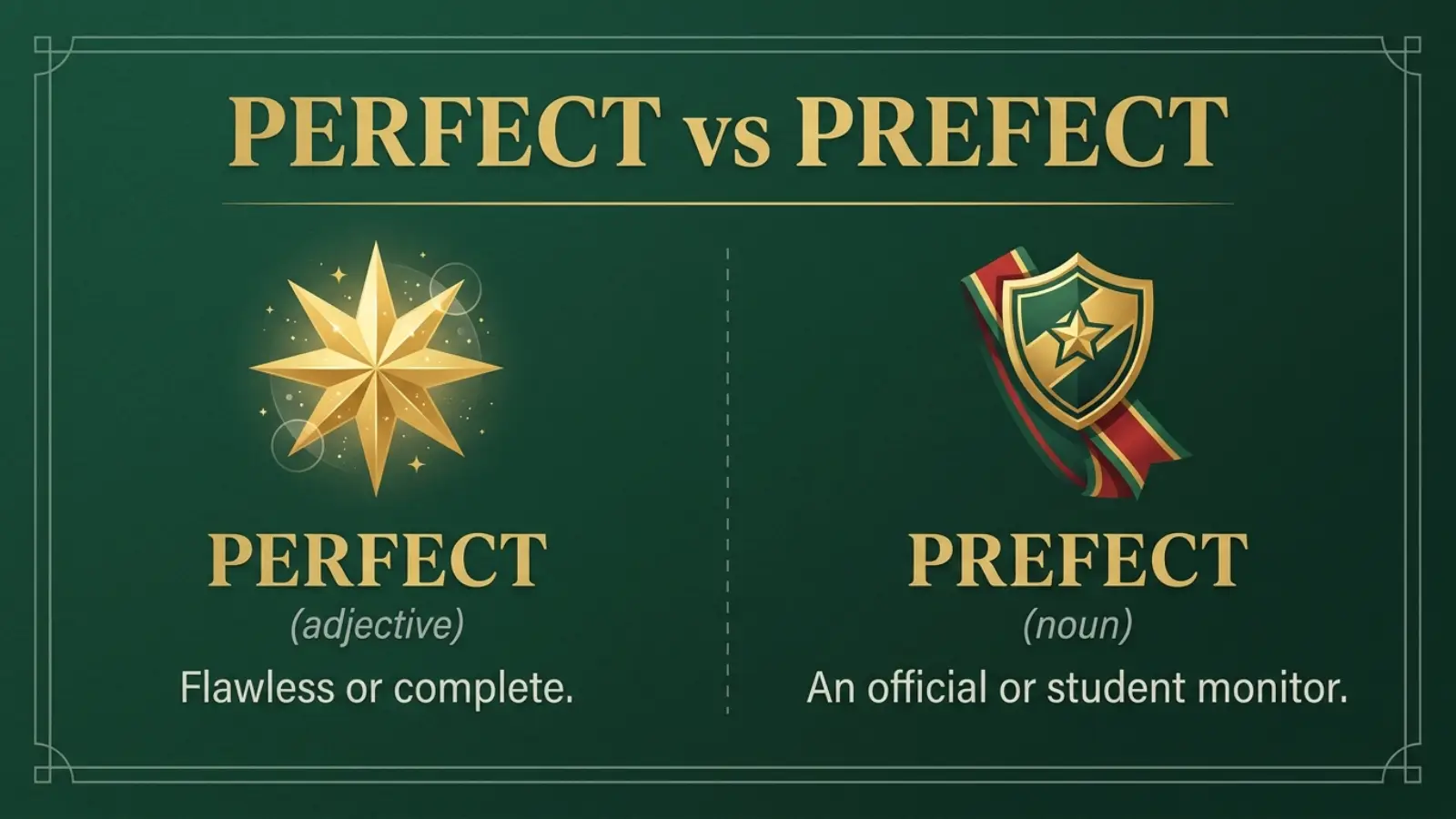
Perfect and prefect are both real English words, but they have different meanings. Perfect usually describes something excellent, complete, or without flaws. Prefect is a noun for an official or, in some school systems, a student given certain responsibilities.
The words differ by just one letter, and their pronunciation is similar, so they can be confused in writing. Choosing correctly depends on whether you’re describing something or naming a person with a particular role.
Related Post: Loose vs. Lose
Perfect vs Prefect: The Key Difference
| Term | Meaning or status | When to use it | Example |
|---|---|---|---|
| Perfect | Usually an adjective meaning flawless, complete, or ideal; also a verb | When describing quality or the act of improving something | This is the perfect solution. |
| Prefect | A noun meaning an official or a student with assigned authority | When referring to someone who holds that role | The prefect helped organize the students. |
What Does Perfect Mean?
Perfect most often works as an adjective. It describes something that has no faults, meets all requirements, or is especially suitable for a purpose. It can also be a verb meaning to improve or refine something.
When to Use Perfect
Use perfect when you want to describe:
- Something without flaws: a perfect score
- Something ideal for a purpose: the perfect gift
- Something accurate or complete: a perfect copy
- The act of improving a skill or process: perfect your technique
Perfect in Example Sentences
1. The weather was perfect for a picnic. Here, perfect describes weather that was ideal for the activity.
2. She earned a perfect score on the quiz. The word means she answered everything correctly.
3. He practiced daily to perfect his presentation. In this sentence, perfect is a verb meaning to refine or improve something.
What Does Prefect Mean?
A prefect is a person appointed to a position of authority or responsibility. In some British and Australian schools, a prefect is an older student who helps supervise or support other students. In some countries, the word also refers to a government or administrative official.
When to Use Prefect
Use prefect when discussing a person who holds an official role, such as:
- A student leader in a school that uses the prefect system
- A government or administrative official in certain countries
- An official with a designated supervisory role
The word is less common in everyday American school terminology, where titles such as student council president or hall monitor may be more familiar, depending on the role.
Prefect in Example Sentences
1. The school appointed Maya as a prefect for the new term. She was given specific responsibilities within the school.
2. The prefect helped younger students find their classrooms. Here, prefect refers to a student leader.
3. The regional prefect attended the public meeting. In this context, the word refers to an administrative official.
How to Choose Between Perfect and Prefect
The simplest rule is to check what you are trying to say:
- If you mean excellent, ideal, or without flaws, use perfect.
- If you mean a person with an official or student leadership role, use prefect.
A Quick Test You Can Apply
Try replacing the word with a definition.
- “This is the ___ answer.” → “This is the ideal answer.” Choose perfect.
- “The ___ checked the students’ attendance.” → “The student leader checked the students’ attendance.” Choose prefect, if that matches the role.
When the Quick Test Does Not Work
Perfect can be a verb as well as an adjective, so don’t assume it always describes a noun. For example, “She wants to perfect her writing” means she wants to improve it. Prefect, by contrast, is normally a noun naming a person or official role.
Common Mistakes and How to Fix Them
| Original sentence | Corrected sentence | Why it changes |
|---|---|---|
| That was a prefect answer. | That was a perfect answer. | The sentence describes quality, so perfect is correct. |
| The perfect helped younger students. | The prefect helped younger students. | The sentence names a student leader. |
| I want to prefect my interview skills. | I want to perfect my interview skills. | Perfect is the verb meaning to improve or refine. |
| She was chosen as the perfect of her school. | She was chosen as a prefect at her school. | Prefect names the role; perfect does not. |
Why These Forms Get Confused
Perfect and prefect look and sound similar. Both begin with per- and end with -fect, and the middle vowel is the main spelling difference. That similarity may explain why writers occasionally substitute one for the other, even though their meanings and grammatical roles differ.
Does the Choice Change With Context?
Formal Writing vs. Casual Conversation
The meanings remain distinct in both formal and casual English. Use perfect to praise a result or describe something suitable, as in “That plan is perfect.” Use prefect when the person’s official role is relevant, as in “The prefect will lead the assembly.”
In American writing, consider whether readers will recognize the term prefect. If the role belongs to a school system outside the United States, a short explanation may make the sentence clearer.
Can You Use Perfect and Prefect Interchangeably?
No. Perfect and prefect are not interchangeable because they refer to different things.
When Switching Changes the Meaning
Compare these sentences:
- “The student is perfect for the role.” This means the student is an ideal choice.
- “The student is a prefect.” This means the student holds a particular position of responsibility.
The first describes suitability; the second identifies a role. Replacing one word with the other changes the meaning or makes the sentence incorrect.
Common Phrases With Perfect and Prefect
| Phrase | When to use it | Original example |
|---|---|---|
| Perfect condition | When something is in excellent shape | The used bicycle was in perfect condition. |
| Perfect timing | When something happens at exactly the right moment | Your call came at perfect timing for our discussion. |
| Perfect fit | When something suits a person or purpose very well | This schedule is a perfect fit for our team. |
| School prefect | When referring to a student appointed to a leadership or supervisory role | The school prefect welcomed the new students. |
| Chief prefect | When referring to a senior student leader in a school that uses this title | The chief prefect spoke at the assembly. |
What Is the Difference Between Perfect and Prefect in Pronunciation?
The words have different standard pronunciations:
- Perfect as an adjective is pronounced roughly PUR-fikt.
- Prefect is pronounced roughly PREE-fekt.
In American English, perfect can also be pronounced with stress on the second syllable when it is a verb: “per-FECT the design.” The noun prefect generally has stress on the first syllable. Hearing the stress can help, but spelling and context are more reliable than pronunciation alone.
Apply the Rule to a Real Situation
Original Version
“Congratulations on becoming the perfect of your school. You are the prefect person for the job.”
Improved Version and Explanation
“Congratulations on becoming a prefect at your school. You are the perfect person for the job.”
The first sentence needs prefect because it names a student leadership role. The second needs perfect because it describes someone as ideal for a position.
An Easy Way to Remember the Difference
Use this memory aid:
- Perfect = praise. It describes something excellent or ideal.
- Prefect = position. It names a person who holds a designated role.
For example, “The prefect gave a perfect speech.” The prefect is the person; perfect describes the speech.
Frequently Asked Questions
Is “prefect” a misspelling of “perfect”?
No. Prefect is a real word with its own meaning. It refers to an official or, in some school systems, a student who has assigned responsibilities.
Can “perfect” be used as a verb?
Yes. Perfect can mean to improve or refine something until it reaches a desired standard. For example, “She practiced to perfect her technique.”
Is “prefect” commonly used in American schools?
It is less familiar in many US school settings than in some British and Australian schools. The exact terminology depends on the institution and the role being described.
Are “perfect” and “prefect” pronounced the same way?
No. In American English, perfect as an adjective is generally pronounced “PUR-fikt,” while prefect is pronounced “PREE-fekt.” When perfect is a verb, its stress shifts to the second syllable.
Which Word Should You Use?
Use perfect when you mean excellent, ideal, complete, or to improve something. Use prefect when you mean a person with an official role, such as a student leader or certain government officials.
Remember perfect = praise and prefect = position to choose the right word in your writing.
Sources
- Oxford Learner’s Dictionaries: Perfect — definitions and examples of perfect as an adjective and verb.
- Cambridge Dictionary: Prefect — definitions of prefect as an official and a student with assigned authority.