
Complaint vs Complain: How to Use Each Word Correctly
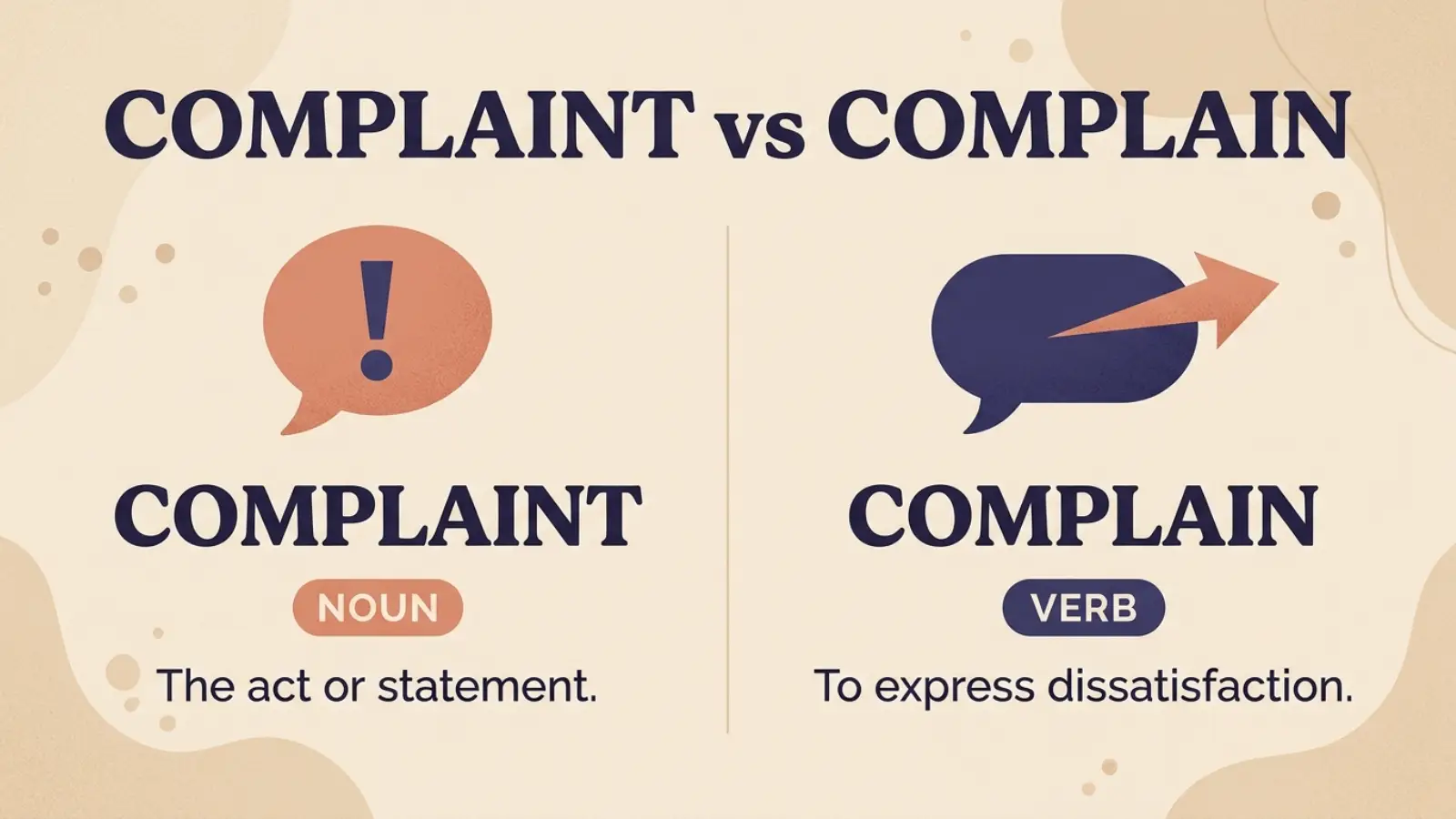
Complaint is a noun, while complain is a verb. You make or file a complaint, but you complain when you express dissatisfaction about something. Both words are correct; the right choice depends on how the word functions in your sentence.
This distinction matters in everyday conversations, customer service messages, workplace emails, and formal requests. Knowing which word is a noun and which is a verb helps you explain a problem clearly and professionally.
Related Post: Perfect vs Prefect
Complaint vs Complain: The Key Difference
| Term | Meaning or status | When to use it | Example |
|---|---|---|---|
| Complaint | Noun: an expression of dissatisfaction or a formal statement about a problem | When naming the concern, report, or grievance | I submitted a complaint about the delay. |
| Complain | Verb: to express dissatisfaction or report that something is wrong | When describing the act of expressing a concern | I plan to complain about the delay. |
What Does Complaint Mean?
Complaint is a noun that refers to an expression of dissatisfaction, a concern about a problem, or a formal statement alleging that something is wrong. Depending on the context, it may be an informal comment, a customer service report, or a formal legal document.
When to Use Complaint
Use complaint when you are talking about the concern itself or the document or statement used to report it.
Common patterns include:
- Make a complaint: She made a complaint about the service.
- File a complaint: He filed a formal complaint.
- Submit a complaint: Customers can submit a complaint online.
- A complaint about something: We received a complaint about the noise.
Complaint in Example Sentences
1. The customer filed a complaint about the damaged package. Here, complaint refers to the report of a problem.
2. The manager reviewed her complaint before responding. The word names the concern being reviewed.
3. The tenant submitted a written complaint about the broken heater. In this example, it refers to a formal statement describing a problem.
What Does Complain Mean?
Complain is a verb meaning to express dissatisfaction, annoyance, or concern about something. It describes what a person does, rather than naming the concern itself.
When to Use Complain
Use complain when describing the act of expressing dissatisfaction.
Common patterns include:
- Complain about something: He complained about the noise.
- Complain to someone: She complained to the supervisor.
- Complain that something happened: They complained that the order arrived late.
- Complain of a problem: The patient complained of a headache.
The past-tense form is complained, and the present participle is complaining.
Complain in Example Sentences
1. Several customers complain about the long wait. Complain describes the action of expressing dissatisfaction.
2. I will complain to customer service if the issue continues. The verb describes what the speaker intends to do.
3. He complained that the instructions were unclear. Complained is the past tense of complain.
How to Choose Between Complaint and Complain
The easiest way to choose is to identify whether you need a noun or a verb.
- Use complaint to name the problem or report: “I submitted a complaint.”
- Use complain to describe the action: “I want to complain.”
A Quick Test You Can Apply
Try placing a or the before the word.
- “I filed a complaint.” Correct: complaint is a noun.
- “I filed a complain.” Incorrect for this meaning.
- “I want to complain.” Correct: complain is a verb.
- “I want to complaint.” Incorrect because the sentence needs a verb.
When the Quick Test Does Not Work
A noun can appear without a or the, and a verb can take different forms. For example, “Customers complain regularly” and “Customer complaints increased” are both correct. Focus on the word’s grammatical role, not just the words immediately before it.
Common Mistakes and How to Fix Them
| Original sentence | Corrected sentence | Why it changes |
|---|---|---|
| I want to complaint about my bill. | I want to complain about my bill. | After to expressing an action, use the verb complain. |
| She made a complain to the manager. | She made a complaint to the manager. | After a, use the noun complaint. |
| He complaint about the service yesterday. | He complained about the service yesterday. | The sentence needs the past-tense verb complained. |
| We received several complain from customers. | We received several complaints from customers. | The noun needs its plural form, complaints. |
Why These Forms Get Confused
The words share the same root and have similar meanings, so it is easy to mix them up. The ending provides a useful clue: complaint names the concern, while complain names the action. This noun–verb pattern also appears in pairs such as advice/advise and practice/practise in British English, though the spelling rules for those pairs differ.
Common Phrases With Complaint and Complain
| Phrase | When to use it | Original example |
|---|---|---|
| File a complaint | To formally report a problem | She decided to file a complaint about the billing error. |
| Make a complaint | To express dissatisfaction, formally or informally | You can make a complaint if the product arrives damaged. |
| Complain about something | To say what is wrong or unsatisfactory | The residents complain about the late-night noise. |
| Complain to someone | To tell a person or organization about a problem | He complained to the store manager. |
| Complain that… | To introduce the problem being reported | Employees complained that the office was too cold. |
Apply the Rule to a Real Situation
Original Version
“Hello, I want to complaint about my recent order. I already made a complain last week, but nobody has responded.”
Improved Version and Explanation
“Hello, I want to complain about my recent order. I already made a complaint last week, but nobody has responded.”
The first sentence needs complain because it describes an action. The second needs complaint because it names the report the customer submitted.
What Are the Plural and Past-Tense Forms?
The words change differently because one is a noun and the other is a verb.
| Form | Correct usage | Example |
|---|---|---|
| Complaint | Singular noun | I have one complaint. |
| Complaints | Plural noun | We received three complaints. |
| Complain | Base verb | Customers can complain directly. |
| Complains | Present tense with he, she, it, or a singular subject | She complains about the noise. |
| Complained | Past tense and past participle | He complained yesterday. |
| Complaining | Present participle or gerund | They are complaining about the delay. |
An Easy Way to Remember the Difference
Remember this simple pairing:
- Complaint = concern.
- Complain = action.
You make a complaint, but you complain about a problem.
For example: “I made a complaint because I wanted to complain about the poor service.” The noun names the report; the verb describes the action.
Frequently Asked Questions
Is “complaint” a noun or a verb?
Complaint is a noun. It names an expression of dissatisfaction, a reported problem, or a formal grievance.
Is “complain” a noun or a verb?
Complain is a verb. It means to express dissatisfaction or tell someone that something is wrong.
Should I say “make a complaint” or “make a complain”?
Say make a complaint. The phrase needs a noun after make a, so complaint is the correct choice.
Is it “complained” or “complaint” about the service?
Use complained when describing a past action: “She complained about the service.” Use complaint when naming the concern: “She submitted a complaint about the service.”
Which Form Should You Use?
Use complaint when naming a concern, report, or grievance. Use complain when describing the act of expressing dissatisfaction. If you can say “make a complaint,” use the noun; if you can say “to complain,” use the verb.
Sources
- Cambridge Dictionary: Complaint — defines complaint as a noun and provides examples of its use.
- Cambridge Dictionary: Complain — defines complain as a verb and explains common sentence patterns.






One Comment