All Right or Alright? Choose the Right Spelling Guide!
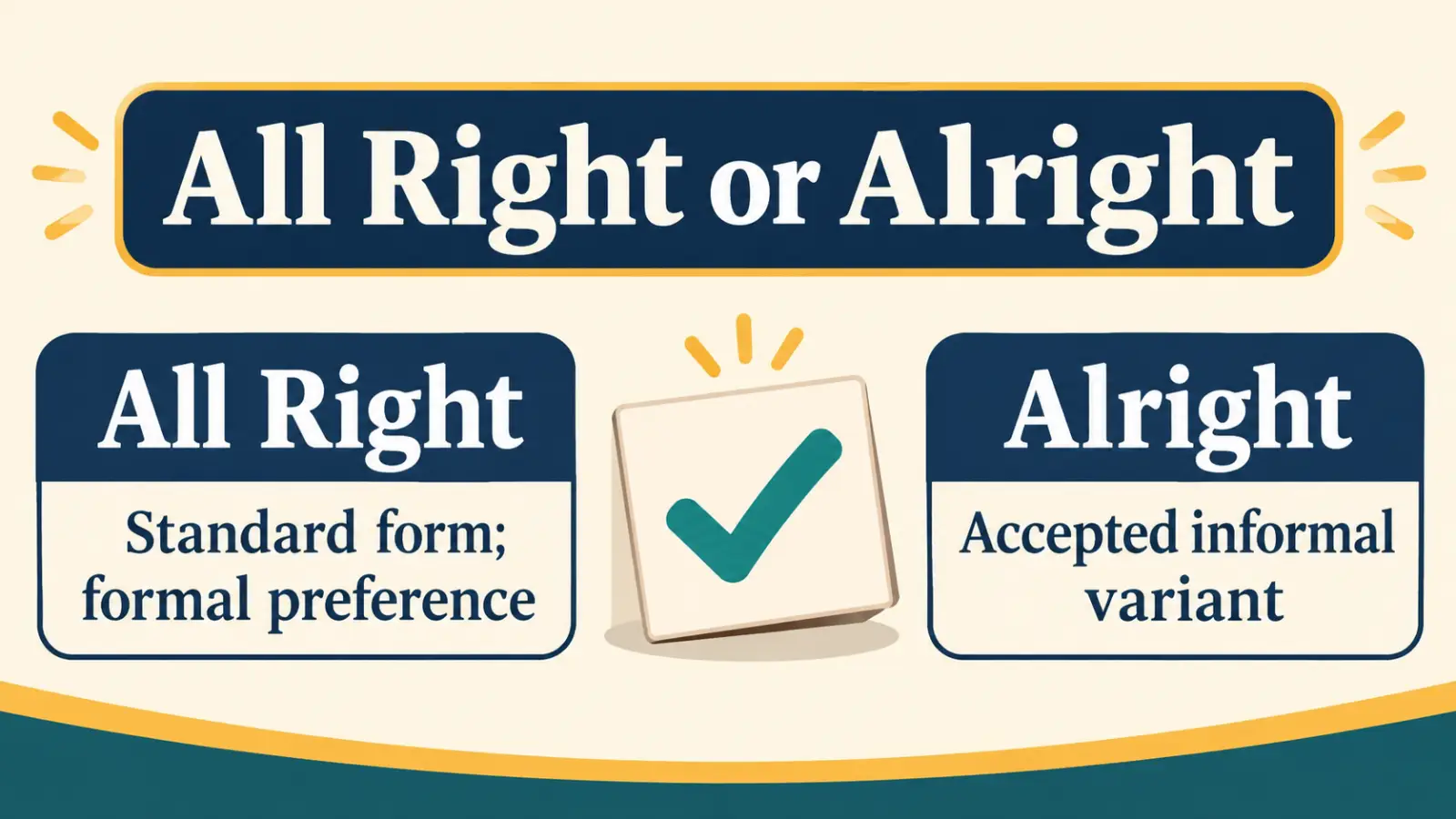
All right and alright are both used to mean acceptable, satisfactory, well, or okay. However, all right is the more widely accepted spelling in standard and formal American English, while alright is a recognized alternative that is more common in informal writing.
The distinction matters when writing for a professional, academic, or general audience. If you want the safest choice across different settings, use all right. You can use alright in casual messages or dialogue when the tone suits it.
Related Post: A vs An
All Right vs. Alright: The Key Difference
| Term | Meaning or status | When to use it | Example |
|---|---|---|---|
| All right | Traditional, widely preferred spelling | Formal writing, professional communication, and general use | “Everything will be all right.” |
| Alright | Accepted one-word variant, often considered informal | Casual messages, dialogue, and informal writing | “The movie was alright.” |
Both forms can express agreement, well-being, or an acceptable result. Nevertheless, all right remains the safer editorial choice because some readers and style guides still consider alright nonstandard.
What Does All Right Mean?
All right is a two-word expression that can function as an adjective, adverb, or interjection. Depending on the sentence, it can mean okay, safe, healthy, satisfactory, or agreed.
For example, someone might use it to describe how they feel, approve a suggestion, or indicate that something went well.
When to Use All Right
Use all right in several common situations:
- To describe someone’s condition: “Are you all right after the fall?”
- To express agreement: “All right, I’ll meet you at six.”
- To describe something acceptable: “The presentation was all right.”
- To indicate that something went satisfactorily: “Everything worked out all right.”
It is also a practical choice when writing for an audience that expects traditional spelling conventions.
All Right in Example Sentences
- “Are you all right after your long journey?” The speaker is asking whether someone feels well or is safe.
- “All right, let’s begin the meeting.” Here, the expression signals agreement and introduces an action.
- “The restaurant was all right, but the service was slow.” In this example, it means the restaurant was acceptable, although not especially impressive.
What Does Alright Mean?
Alright is a one-word spelling variant of all right. It carries similar meanings, including okay, satisfactory, well, or agreed.
Although some traditional style guides discourage it, reputable dictionaries recognize its use. It appears frequently in informal communication, conversational writing, and fictional dialogue.
When to Use Alright
Use alright when the writing is casual and the audience is comfortable with informal spelling.
For instance, it can work in:
- Text messages between friends.
- Informal emails.
- Casual online conversations.
- Fictional dialogue that reflects everyday speech.
However, when writing an academic paper, business report, or formal letter, all right is the more dependable choice.
Alright in Example Sentences
- “I’m feeling alright after getting some rest.” The speaker means they feel okay.
- “The new schedule looks alright to me.” Here, the word describes something acceptable.
- “Alright, I’ll call you when I arrive.” In this sentence, it expresses agreement before the speaker explains what they will do.
How to Choose the Right Form
The main difference is not the meaning but the spelling convention and level of formality. Both forms are used with similar meanings, but all right has broader acceptance in edited writing.
A simple approach is to use all right by default. Choose alright only when the informal tone is appropriate and your publication or organization allows it.
A Quick Test You Can Apply
Try replacing the expression with okay, fine, or satisfactory.
- “Are you all right?” → “Are you okay?”
- “The results were alright.” → “The results were satisfactory.”
- “All right, let’s go.” → “Okay, let’s go.”
If one of these substitutions preserves the intended meaning, you are probably using the expression correctly. Then choose the spelling based on your audience and writing style.
When the Quick Test Does Not Work
The substitution test helps identify the intended meaning, but it cannot decide which spelling a particular editor or style guide prefers.
For example, both of these sentences are understandable:
- “Everything will be all right.”
- “Everything will be alright.”
The difference is editorial preference rather than a change in meaning. When consistency is important, follow the style guide for your assignment, workplace, or publication.
Common Mistakes and How to Fix Them
| Original sentence | Corrected sentence | Why it changes |
|---|---|---|
| “I hope your feeling alright.” | “I hope you’re feeling all right.” | The sentence needs the verb contraction you’re; all right is the safer standard spelling. |
| “Allright, I’ll handle it.” | “All right, I’ll handle it.” | Allright is not the standard spelling of either form. |
| “Are you alright after the accident?” | “Are you all right after the accident?” | The correction follows the preferred spelling for standard writing. |
| “The report looks allright.” | “The report looks all right.” | Write the traditional form as two words in edited prose. |
Why These Forms Get Confused
The two spellings sound identical and usually communicate the same idea. As a result, writers may treat them as interchangeable in every setting.
The confusion also comes from a familiar English spelling pattern: some expressions that began as separate words eventually developed accepted one-word forms. However, not every combined spelling receives the same acceptance from dictionaries and style guides.
Does the Choice Change With Context?
Formal Writing vs. Casual Conversation
The audience and purpose of your writing matter when choosing between these forms.
All right is the preferred option for:
- Academic assignments and research papers.
- Business reports and professional emails.
- Formal letters and applications.
- Published articles that follow traditional editorial standards.
By contrast, alright is more at home in:
- Text messages and casual chats.
- Informal social media posts.
- Conversational dialogue in fiction.
- Personal notes where a relaxed tone is appropriate.
This distinction is a matter of style and editorial preference. It does not mean that every use of alright is automatically a grammatical error.
Can You Use All Right and Alright Interchangeably?
In many sentences, yes. Both forms can express agreement, well-being, or something that is acceptable or satisfactory.
For example:
- “Are you all right?”
- “Are you alright?”
Both ask whether someone is okay. Likewise, “The food was all right” and “The food was alright” communicate a similar judgment.
However, the spellings are not equally suitable for every audience. All right is the more widely accepted choice in formal and edited writing, while alright may be considered too informal by some readers.
When Both Forms Work
Both forms can appear naturally in casual sentences:
- “Everything will be all right.”
- “Everything will be alright.”
- “All right, let’s get started.”
- “Alright, let’s get started.”
The meaning stays essentially the same. Still, using all right consistently avoids potential objections from editors who prefer traditional spelling.
When Switching Changes the Meaning
Replacing all right with alright usually does not change the intended meaning. However, context can create a different interpretation when all emphasizes that every item is correct.
Compare:
- “The answers are all right.” — Every answer is correct.
- “The answers are alright.” — The answers are acceptable or satisfactory.
The first sentence clearly emphasizes that every answer is correct. The second is more naturally understood as a general judgment of adequacy. When accuracy matters, use wording that makes your intended meaning unmistakable.
Common Phrases With All Right
| Phrase | When to use it | Original example |
|---|---|---|
| Are you all right? | Asking whether someone is safe or feeling well | “You look tired. Are you all right?” |
| All right, then | Accepting a suggestion or decision | “All right, then, I’ll see you tomorrow.” |
| That’s all right | Reassuring someone or accepting an apology | “That’s all right; mistakes happen.” |
| All right with me | Expressing approval or agreement | “Moving the appointment is all right with me.” |
| Everything will be all right | Offering reassurance about a situation | “Take a breath. Everything will be all right.” |
Apply the Rule to a Real Situation
Imagine you are replying to a coworker who asks whether a revised meeting schedule works for you.
Original Version
“Alright, the new meeting time is allright with me.”
Improved Version and Explanation
“All right, the new meeting time is all right with me.”
The revised sentence uses the traditional two-word spelling consistently. The original used alright, which is an accepted informal variant, but allright is not the standard spelling. For a professional email, choosing all right throughout is the safer editorial decision.
Is All Right One Word or Two?
All right is written as two words. Alright is the accepted one-word variant, although it is less widely preferred in formal and edited writing.
Avoid writing allright as one word. It is not the standard form.
Here is the distinction:
- All right: Traditional two-word spelling.
- Alright: Recognized one-word variant, often informal.
- Allright: Nonstandard spelling.
An Easy Way to Remember the Difference
Remember this simple rule: All right is the safest choice for all types of writing.
The two-word form is widely accepted in both formal and informal contexts. The one-word variant is more likely to attract criticism in professional or academic work.
For example, write “Everything will be all right” in an assignment, report, or formal email. In a casual text, “Everything will be alright” may also be suitable.
Frequently Asked Questions
Is alright a real word?
Yes. Alright is recognized by major dictionaries as a variant of all right. However, some style guides and editors still prefer the traditional two-word spelling.
Is all right more correct than alright?
All right is the more widely accepted form in standard and formal writing. Although alright is recognized and commonly used informally, the two-word spelling is the safer choice when you are unsure.
Is alright acceptable in American English?
Yes. Alright appears in American English, especially in informal writing and dialogue. Nevertheless, some readers and publications consider it nonstandard, so check the relevant style guide when writing professionally.
Does alright mean the same thing as all right?
In most everyday sentences, yes. Both can mean okay, satisfactory, well, or agreed. The main difference is their spelling and level of acceptance in edited writing.
Should I use alright in a professional email?
It is better to use all right in a professional email. This spelling is widely accepted and avoids possible objections from readers who prefer traditional usage.
Which Form Should You Use?
Choose all right when writing for a general, academic, or professional audience. It is the traditional spelling and the safest option when consistency and editorial acceptance matter.
Alright is also a recognized variant, particularly in informal writing and dialogue. However, if you are unsure which form your readers expect, use all right.
Sources
- The Chicago Manual of Style: Which One Is Correct, “Alright” or “All Right”?
- Cambridge Dictionary: All Right and Alright