Vendor vs Vender: Which Spelling Should You Use?
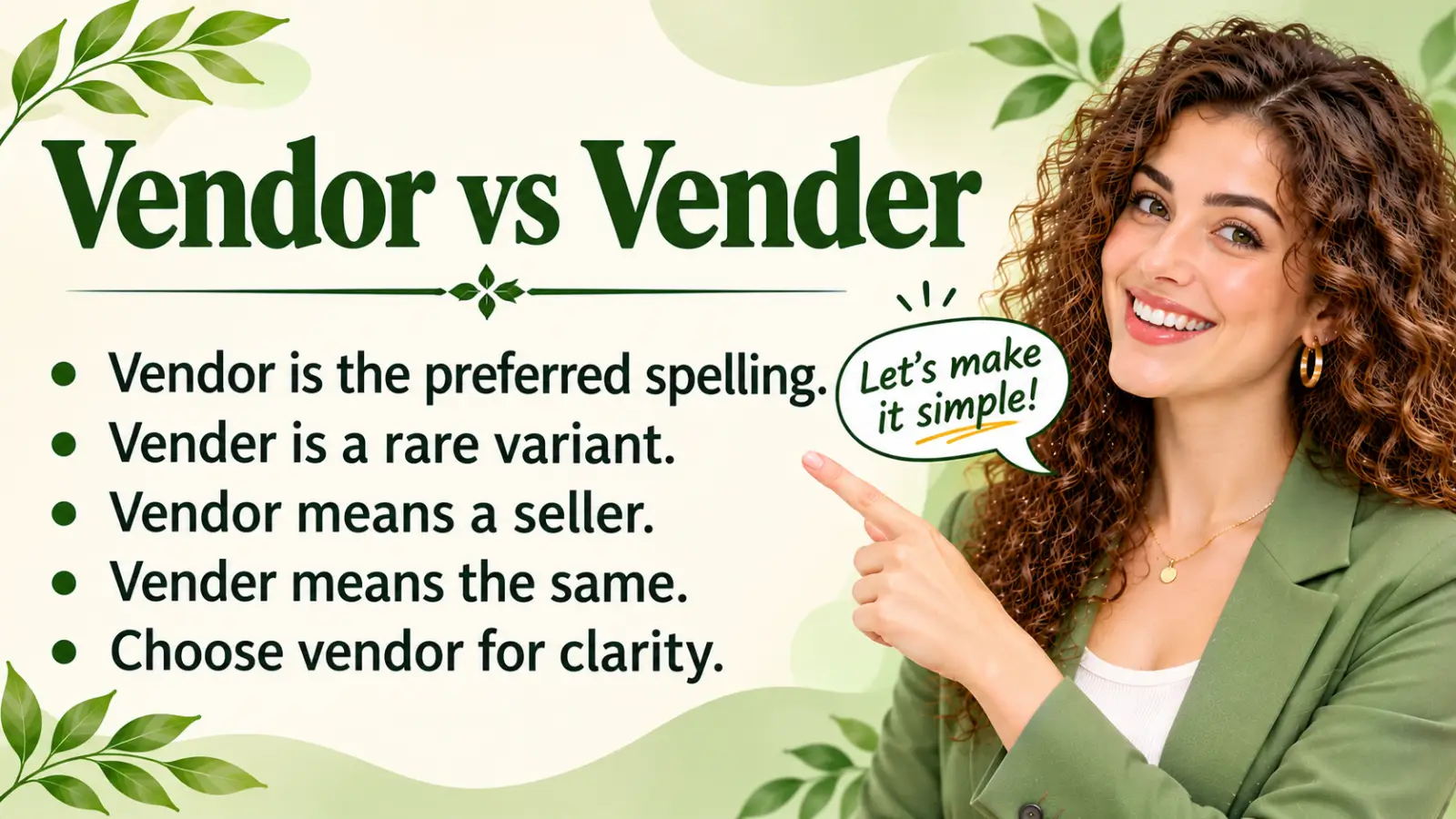
Vendor is the preferred spelling in modern American English for a person or business that sells goods or services. Vender is also a recognized spelling variant with the same basic meaning, but it is much less common. For most everyday, academic, and professional writing, choose vendor.
The distinction matters in business emails, contracts, invoices, procurement documents, and website content. Although neither spelling should automatically be labeled incorrect, vendor is the familiar choice that most US readers expect.
Related Post: Goodmorning or Good Morning
Vendor vs Vender: The Key Difference
| Term | Meaning or status | When to use it | Example |
|---|---|---|---|
| Vendor | Standard, widely used spelling | General, business, and professional writing | We selected a new software vendor. |
| Vender | Recognized but less common spelling variant | When preserving a source’s spelling or following a specific established usage | The historical text describes a street vender. |
| Vendors | Standard plural of vendor | Referring to multiple sellers or businesses | Three vendors submitted proposals. |
| Vendor’s | Singular possessive | Showing something belongs to one vendor | The vendor’s invoice arrived. |
| Vendors’ | Plural possessive | Showing something belongs to multiple vendors | The vendors’ contracts were reviewed. |
The key difference is conventional usage, not meaning. Both vendor and vender can refer to someone who sells something, but vendor is the better default for contemporary US writing.
What Does Vendor Mean?
A vendor is a person, company, or organization that sells goods or services. The word appears in retail, technology, events, construction, and corporate purchasing.
For example, a food vendor might sell meals at a festival, while a software vendor supplies applications to a business.
When to Use Vendor
Use vendor when referring to:
- Businesses and suppliers: A company that sells products or services to another company.
- Retail and markets: Someone who sells food, merchandise, or other goods.
- Technology: A company that develops or supplies software and hardware.
- Events: A business selling products at a conference, fair, or festival.
- Procurement: An organization being evaluated, approved, or paid by a purchasing department.
Vendor in Example Sentences
1. The company hired a new vendor to maintain its computer systems. Here, vendor refers to a business providing a service.
2. Several food vendors set up booths at the summer festival. The plural vendors refers to multiple sellers.
3. Our purchasing department approved the vendor’s proposal. The apostrophe in vendor’s indicates that the proposal belongs to one vendor.
What Does Vender Mean?
Vender is a recognized variant spelling of vendor. It can describe a person or business that sells goods or services, but it is considerably less common in contemporary writing.
The spelling is recorded in established dictionaries, so it is misleading to claim that vender is never a word. However, its existence does not make the two forms equally suitable for every audience.
When to Use Vender
Use vender only when there is a specific reason to retain that spelling, such as:
- Quoting a source that uses vender.
- Preserving the original wording of an older document.
- Following an established spelling in a particular publication or record.
For new business documents, choose vendor instead.
Vender in Example Sentences
1. The old newspaper described a street vender selling fruit. The sentence uses the recognized variant spelling. In contemporary US writing, street vendor would be the more familiar choice.
2. The historical document referred to the seller as a vender. Here, vender is retained to reflect the document’s wording.
These examples illustrate the variant’s use without suggesting that it is the preferred spelling today.
How to Choose the Right Spelling
For most modern writing, choose vendor. The two spellings have the same basic meaning, but vendor is much more established in everyday and professional usage.
A Quick Test You Can Apply
Ask yourself whether you are writing a new sentence about a person or business that sells something.
- If yes, use vendor.
- If you are referring to several sellers, use vendors.
- If you are preserving an original quotation or historical spelling, retain vender when appropriate.
- If you are preparing a business document, use vendor consistently.
Example: “We need a reliable software vender” should normally become “We need a reliable software vendor.”
When the Quick Test Does Not Work
Both spellings can be valid as nouns, so meaning alone cannot always determine which spelling appears in a source. Context and editorial preference matter.
If you are quoting a document, do not silently alter its spelling when exact wording matters. If you are writing original material, there is rarely a practical reason to choose the less common variant.
Common Mistakes and How to Fix Them
| Original sentence | Corrected sentence | Why it changes |
|---|---|---|
| We hired a new software vender. | We hired a new software vendor. | The correction uses the preferred modern spelling. |
| Three vender submitted their bids. | Three vendors submitted their bids. | The plural noun needs the plural ending, and vendor is the preferred spelling. |
| The vendors proposal arrived yesterday. | The vendor’s proposal arrived yesterday. | The sentence refers to one vendor, so the singular possessive needs an apostrophe. |
| We reviewed all of the vendor’s contracts. | We reviewed all of the vendors’ contracts. | If the contracts belong to multiple vendors, the plural possessive is appropriate. |
The first correction is a style and usage improvement, not proof that vender is universally invalid. The remaining examples illustrate plural and possessive grammar.
Why These Forms Get Confused
The words look nearly identical and are generally pronounced the same in American English. Both also refer to someone who sells something, so their meanings do not provide an obvious clue.
The ending -er may look natural because English often forms nouns for people who perform actions with that suffix, as in seller and buyer. However, spelling patterns are not always predictable. The established form vendor is the better choice to remember.
Does the Choice Change With Context?
American vs. British English
This is not a straightforward American-versus-British spelling difference. Vendor is the normal choice in both varieties of English, while vender is a less common variant.
US writers should use vendor for business correspondence, reports, contracts, and online content. The same recommendation works for a general British English audience.
Workplace, Academic, or Everyday Usage
In professional settings, vendor appears in familiar expressions such as vendor agreement, vendor management, and vendor registration. Using the standard spelling makes documents easier to scan and keeps terminology consistent.
In historical writing, preserve vender when it appears in a source and the exact wording matters. Otherwise, use vendor in your own prose.
Can You Use Vendor and Vender Interchangeably?
Generally, yes, in meaning—but not equally in style. Both can refer to a seller, so replacing one with the other usually preserves the basic meaning of a sentence. However, vender may look unusual to contemporary readers.
When Both Forms Work
Both forms can be understood in a sentence such as:
- The vendor sold handmade jewelry.
- The vender sold handmade jewelry.
The meaning is essentially the same, but the first sentence uses the more familiar spelling for modern American readers.
When Switching Changes the Meaning
The spelling change itself usually does not change the meaning. However, changes to number or possession can affect a sentence.
- The vendor’s contract was approved. One vendor’s contract was approved.
- The vendors’ contracts were approved. Contracts belonging to multiple vendors were approved.
This distinction is grammatical, not a difference between vendor and vender.
Common Phrases With Vendor
| Phrase | When to use it | Original example |
|---|---|---|
| Vendor agreement | A contract between a buyer and a seller | Both companies signed the vendor agreement. |
| Vendor management | Coordinating and overseeing seller relationships | The department improved its vendor management process. |
| Approved vendor | A seller authorized to work with an organization | Only an approved vendor can supply the equipment. |
| Vendor registration | The process of enrolling a seller in an organization’s system | Complete vendor registration before submitting an invoice. |
| Vendor payment | Money paid to a seller for goods or services | The finance team scheduled the vendor payment for Friday. |
These expressions are common in procurement and business communication. In new documents, use vendor consistently throughout.
Apply the Rule to a Real Situation
Original Version
Hi Jordan,
We reviewed the proposals from three software venders. Please confirm which vender meets our security requirements so we can finalize the agreement.
Improved Version and Explanation
Hi Jordan,
We reviewed the proposals from three software vendors. Please confirm which vendor meets our security requirements so we can finalize the agreement.
The correction replaces venders and vender with vendors and vendor. It also preserves the intended meaning and the professional tone of the email. No other grammatical changes are necessary.
What Is the Difference Between Vendor, Supplier, and Seller?
These terms overlap, but they are not always interchangeable.
| Word | Typical meaning | Example |
|---|---|---|
| Vendor | A person or business selling goods or services | We approved a new software vendor. |
| Supplier | A business or person providing goods or materials, often to another business | The supplier delivered the raw materials. |
| Seller | A general term for a person or business that sells something | The seller accepted the offer. |
A company can be both a vendor and a supplier. Supplier often emphasizes providing goods or materials, while seller is the broadest everyday term.
An Easy Way to Remember the Difference
Remember this simple rule:
Vendor is the default; vender is the variant.
For a new business email, write:
- Preferred: “Please contact the vendor.”
- Less common: “Please contact the vender.”
The memory aid is a practical writing recommendation, not a claim that the alternative spelling is never accepted.
Practice: Can You Choose the Right Form?
Choose the best answer for each sentence.
1. We need to contact the software _____ about the update.vendorvender
2. Four _____ submitted bids for the project.vendorvendorsvendor’s
3. The _____ invoice is overdue.vendorsvendor’svendors’Try again
Frequently Asked Questions
Is vendor or vender correct in American English?
Both spellings are recognized, but vendor is the standard and much more common choice in contemporary American English. Use it for business writing, school assignments, and everyday communication.
Is vender a misspelling?
Not necessarily. Established dictionaries recognize vender as a variant of vendor. However, it is less common, so vendor is usually the safer choice.
Do vendor and vender mean the same thing?
Yes, when used as nouns referring to a seller. The difference is primarily spelling preference and conventional usage rather than meaning.
What is the plural of vendor?
The plural is vendors. For possession, write vendor’s when something belongs to one vendor and vendors’ when it belongs to multiple vendors.
Is vendor a noun or a verb?
Vendor is a noun. The related verb is vend, meaning to sell. For example, “The machine vends snacks” uses vends as a verb.
Which Form Should You Use?
For modern American English, choose vendor whenever you mean a person or business that sells goods or services. Although vender is a legitimate spelling variant, it is much less common. Use vendor in new writing and reserve vender for cases where preserving the original spelling or following a specific convention matters.
Sources