Time Flies or Time Flys: Which Spelling Is Correct?
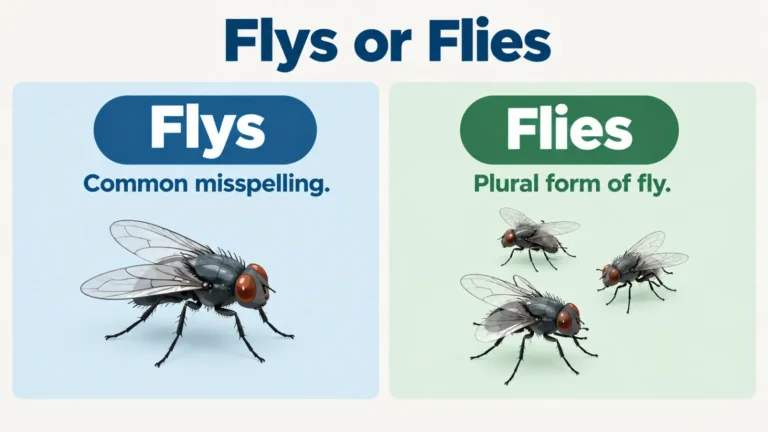
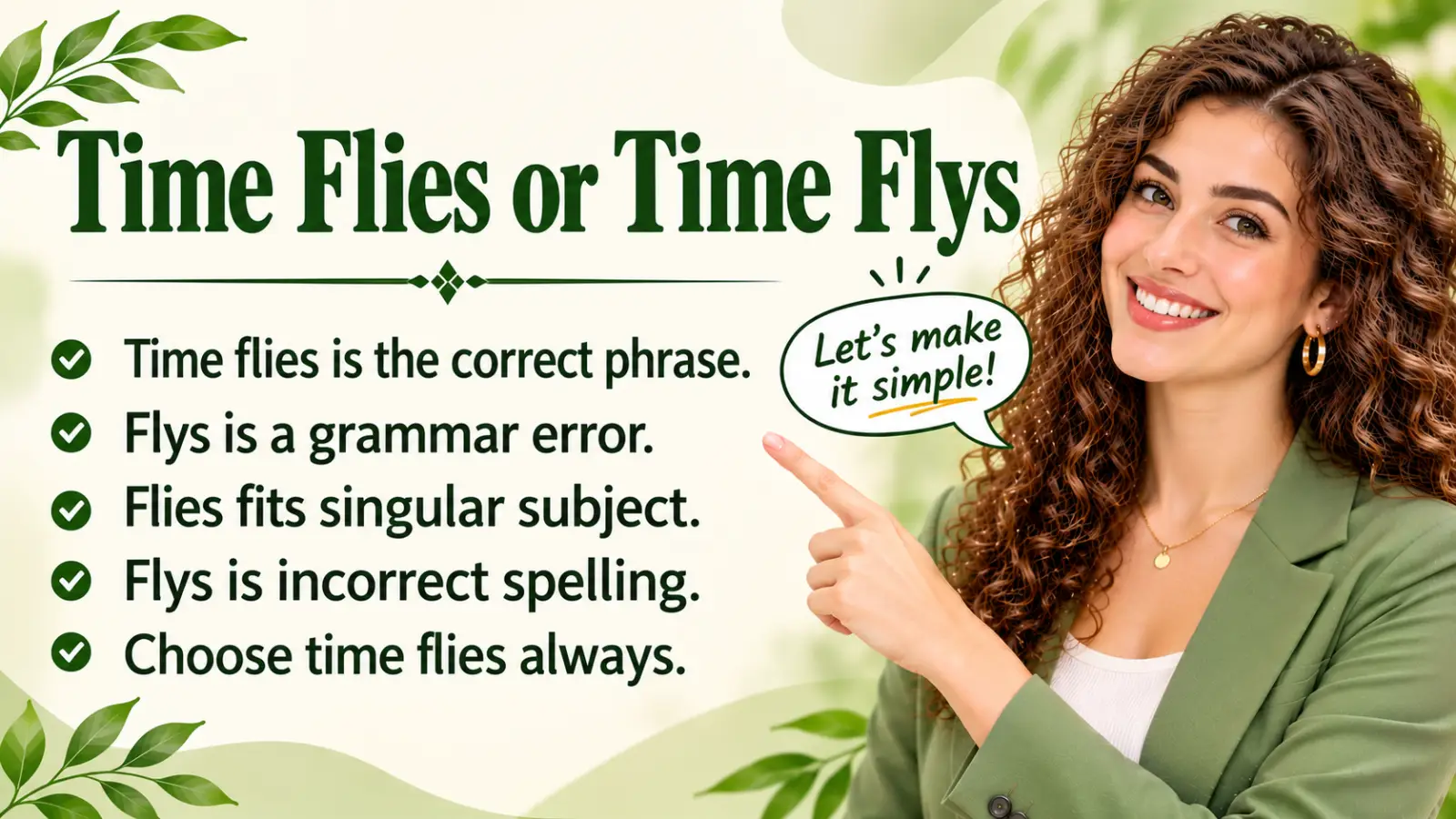
Time flies is the correct phrase. The word flies is the proper present-tense form of the verb fly when the subject is singular, as it is with the word time. Time flys is a spelling and grammar error for this expression.
The phrase means that time seems to pass quickly, often when you are enjoying yourself or looking back on an experience. Knowing why flies is correct can also help you spell other verbs, such as tries, carries, and studies.
Related Post: Spicey or Spicy
Time Flies vs. Time Flys: The Key Difference
| Term | Meaning or status | When to use it | Example |
|---|---|---|---|
| Time flies | Correct phrase | When saying that time seems to pass quickly | Time flies when you’re having fun. |
| Time flys | Incorrect spelling for this expression | Avoid it in standard writing | Write “Time flies,” not “Time flys.” |
The key difference is the verb ending. When a verb ends with a consonant followed by y, the third-person singular present-tense form usually changes the y to i and adds -es. That gives us fly → flies.
What Does Time Flies Mean?
The phrase time flies means that time seems to pass very quickly. It is often used when an enjoyable activity, an important event, or a period of life feels shorter than expected. Cambridge Dictionary also uses the expression to illustrate the idea of time passing quickly.
Examples:
- Time flies when you’re having fun. Enjoyable activities can make the hours seem to pass quickly.
- Time flies when I visit my grandparents. The speaker feels that visits end sooner than expected.
- It’s hard to believe how time flies as children grow up. The phrase expresses surprise at how quickly life seems to move forward.
When to Use Time Flies
Use time flies when talking about how quickly time seems to pass. The phrase works well for casual conversations, social media captions, personal reflections, and writing about memories or milestones.
For example, you might say it after a vacation, a family gathering, a school year, or a child’s birthday.
Time Flies in Example Sentences
- We talked for hours, and before we knew it, time flies no longer seemed like just a saying.
- Time flies when you’re absorbed in a good book.
- Looking back at old photographs reminds me how quickly time flies.
The first example is a little less natural than the others because it refers to the phrase itself. For a more direct everyday statement, write: “We talked for hours, and time flew by.”
How to Choose the Right Spelling
Use flies when the subject is singular and the sentence describes a present or general truth. Use fly with plural subjects and with I, you, and we.
| Subject | Correct form | Example |
|---|---|---|
| Time | Flies | Time flies. |
| She | Flies | She flies to Chicago. |
| The birds | Fly | The birds fly south. |
| We | Fly | We fly home tomorrow. |
| You | Fly | You fly often. |
A Quick Test You Can Apply
Use a singular subject as a test. If you would say “the bird flies,” the correct form for the singular subject time is also flies.
- Time flies.
- She flies.
- The hours fly.
- They fly.
When the Quick Test Does Not Work
The rule changes when you use a different tense or a helping verb.
- Present: Time flies.
- Past: Time flew.
- Present perfect: Time has flown.
- Future: Time will fly.
After helping verbs such as will, can, and does, use the base form fly, not flies.
For example, “Time will fly” is correct, while “Time will flies” is not.
Common Mistakes and How to Fix Them
| Original sentence | Corrected sentence | Why it changes |
|---|---|---|
| Time flys when you’re having fun. | Time flies when you’re having fun. | A singular subject takes flies. |
| Time fly when I’m busy. | Time flies when I’m busy. | The singular subject time requires the verb flies. |
| Time will flies by quickly. | Time will fly by quickly. | Use the base verb after will. |
| Time flied by so fast last year. | Time flew by so fast last year. | Flew is the usual past-tense form when describing time passing. |
Why These Forms Get Confused
The mistake often comes from applying a simple rule: add -s to a verb for a singular subject. However, verbs ending in a consonant plus y usually change y to i before adding -es.
Compare:
- Fly → flies
- Try → tries
- Carry → carries
- Play → plays
The last example is different because play ends with a vowel followed by y. The y remains, so the correct form is plays.
Does the Choice Change With Context?
The spelling rule does not change between American and British English. Time flies is the standard form in both.
The level of formality does not change the spelling either. You can use the phrase in a text message, a social media caption, an essay, or a professional email.
Can You Use Time Flies and Time Flys Interchangeably?
No. For the expression about time passing quickly, time flies is correct, while time flys is a spelling error.
However, the verb changes when you change the tense:
- Present: Time flies when we’re together.
- Past: Time flew when we were together.
- Present perfect: Time has flown since we last met.
- Future: Time will fly during the vacation.
These forms communicate related ideas, but they are not interchangeable in every sentence because they refer to different time frames.
Common Phrases With Time Flies
| Phrase | When to use it | Original example |
|---|---|---|
| Time flies when you’re having fun | When enjoyable activities seem to pass quickly | We spent all afternoon hiking. Time flies when you’re having fun. |
| Time flies by | To emphasize the passage of time | The school year seems to fly by. |
| How time flies | To express surprise at how quickly time has passed | How time flies! The twins are already teenagers. |
| Time flies so fast | An informal way to emphasize how quickly time seems to pass | Time flies so fast when the whole family gets together. |
Apply the Rule to a Real Situation
Imagine you are writing a birthday caption for a friend you have known since childhood.
Original Version
Can’t believe we’re both turning 30. Time flys when you’re having fun!
Improved Version and Explanation
Can’t believe we’re both turning 30. Time flies when you’re having fun!
The correction changes flys to flies because time is a singular subject. The casual tone and sentence structure are appropriate for a social media caption, so no other changes are necessary.
What Is the Past Tense of Time Flies?
The past-tense form is time flew. The past participle is flown, which is used with helping verbs such as has, have, and had.
Examples:
- Time flew during our weekend trip.
- The summer has flown by.
- By the time we returned, the afternoon had flown by.
Avoid writing “time flied” when describing time passing quickly. Although flied is used as a past-tense form in certain baseball contexts, flew is the usual form for this expression.
An Easy Way to Remember the Difference
Remember this simple pattern:
Fly → flies → flew → flown
- Flies: Time flies.
- Flew: Time flew by yesterday.
- Flown: Time has flown by.
For the present tense, remember that time flies follows the same pattern as “she flies.” Both subjects are singular and require flies.
Practice: Can You Choose the Right Form?
1. Time _____ when you’re having fun.
A. Flys
B. Flies
2. The weekend _____ by before we realized it.
A. Flew
B. Flys
3. Time has _____ since our last visit.
A. Flew
B. Flown
Answers and Explanations
- B. Flies — Time is a singular subject, so the present-tense verb takes -es.
- A. Flew — Flew is the past tense of fly.
- B. Flown — Has requires the past participle flown.
Frequently Asked Questions
Is it time flies or time flys?
Time flies is correct. The spelling flys is incorrect for this expression.
Why does fly change to flies?
When a verb ends with a consonant followed by y, the y usually changes to i before -es is added for a third-person singular present-tense subject. Therefore, fly becomes flies.
Is “time flies when you’re having fun” grammatically correct?
Yes. It is a standard expression meaning that enjoyable experiences can make time seem to pass quickly.
Is “time flys” ever correct?
Not as the standard present-tense expression about time passing quickly. Use time flies for this meaning.
Is the correct past tense “time flew” or “time flown”?
Use time flew for the simple past and time has flown or time had flown for perfect tenses. The correct form depends on the sentence’s grammatical structure.
Which Form Should You Use?
Use time flies when describing how quickly time seems to pass. The phrase follows the standard rule for a singular subject paired with a present-tense verb.
Remember: time flies, time flew, and time has flown. Avoid time flys when writing this expression.
Sources